Polyaxon v3 progress
Polyaxon v3 brings new ways to develop and debug agents, automate workloads, and manage infrastructure. It is fully backward compatible with v2. This page combines the product roadmap with the evolving v3 release notes.
Building toward v3
V3 is still in progress. We ship features incrementally, including in v2, so you can use improvements before the full release. A feature's maturity and its first shipped version are tracked separately below.
For example, you can already compare runs with synchronized charts in v2.14 and use sandbox execution, SSH access, and reconnectable shells in v2.16. The sandbox features remain in beta as they mature toward v3.
Feature progress
Select a status below to jump to its features. Shipped in links identify the first release containing a feature; alpha, beta, and development labels describe its maturity. Features without a shipped-version link should not be assumed available in a published release. Scope and maturity can change as development continues.
Completed
Completed work, including features already shipped in v2.
Richer run comparison
Shipped in v2.14Compare dense run views with charts, graphs, synchronized cursors, shared selections, and parameter and metric tooltips.
Explore visualizations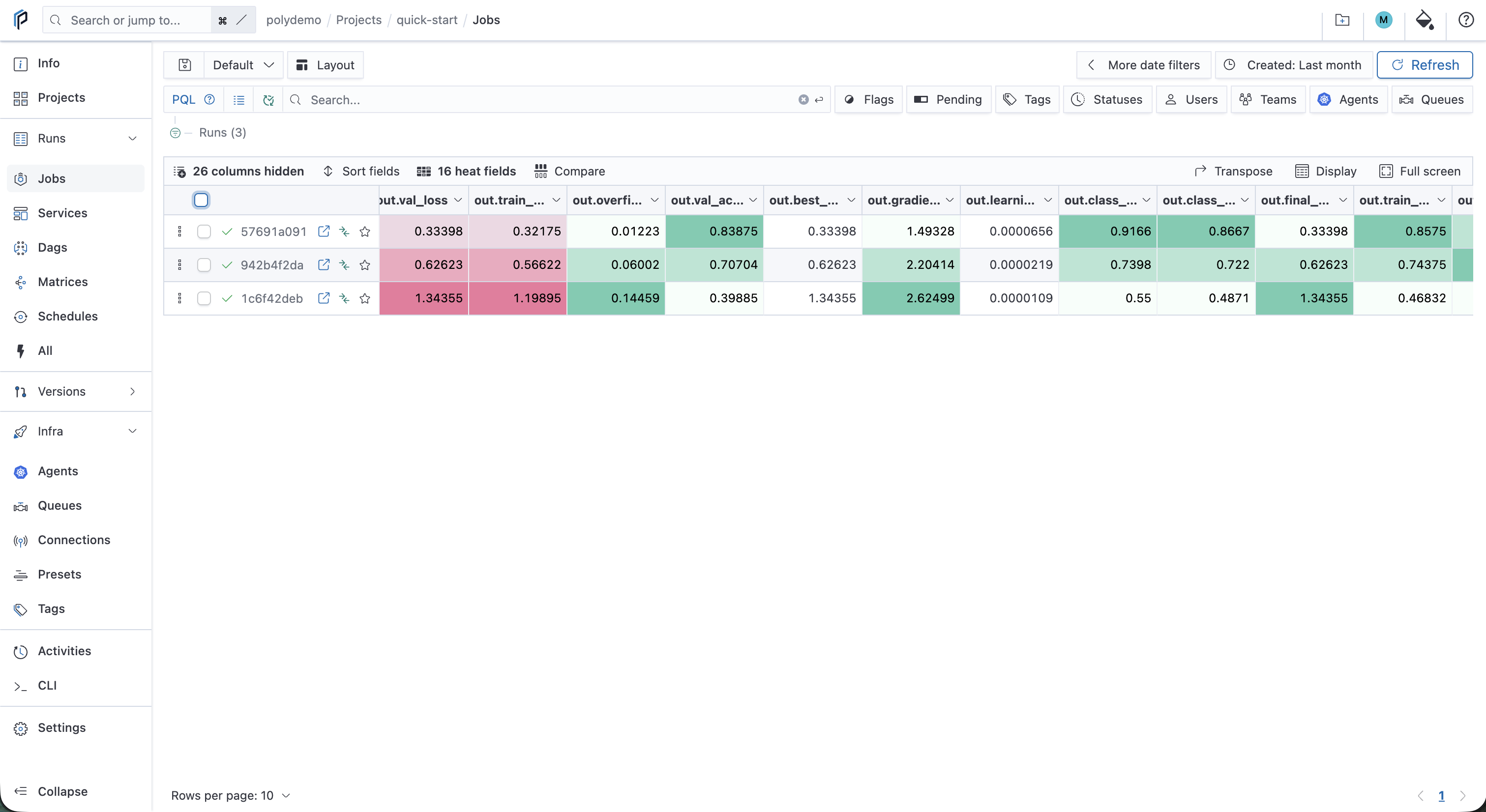
Heat fields 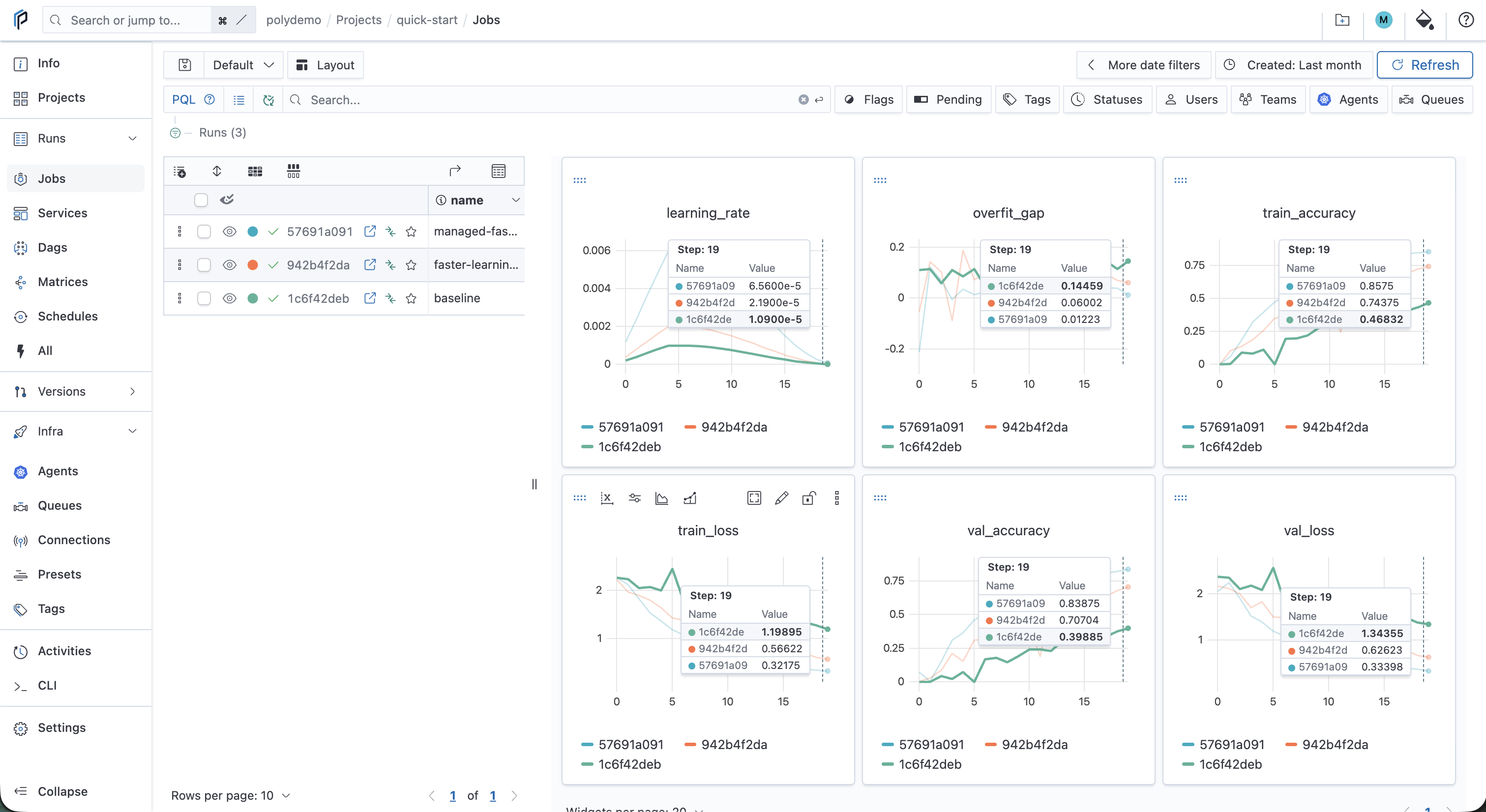
Metric charts 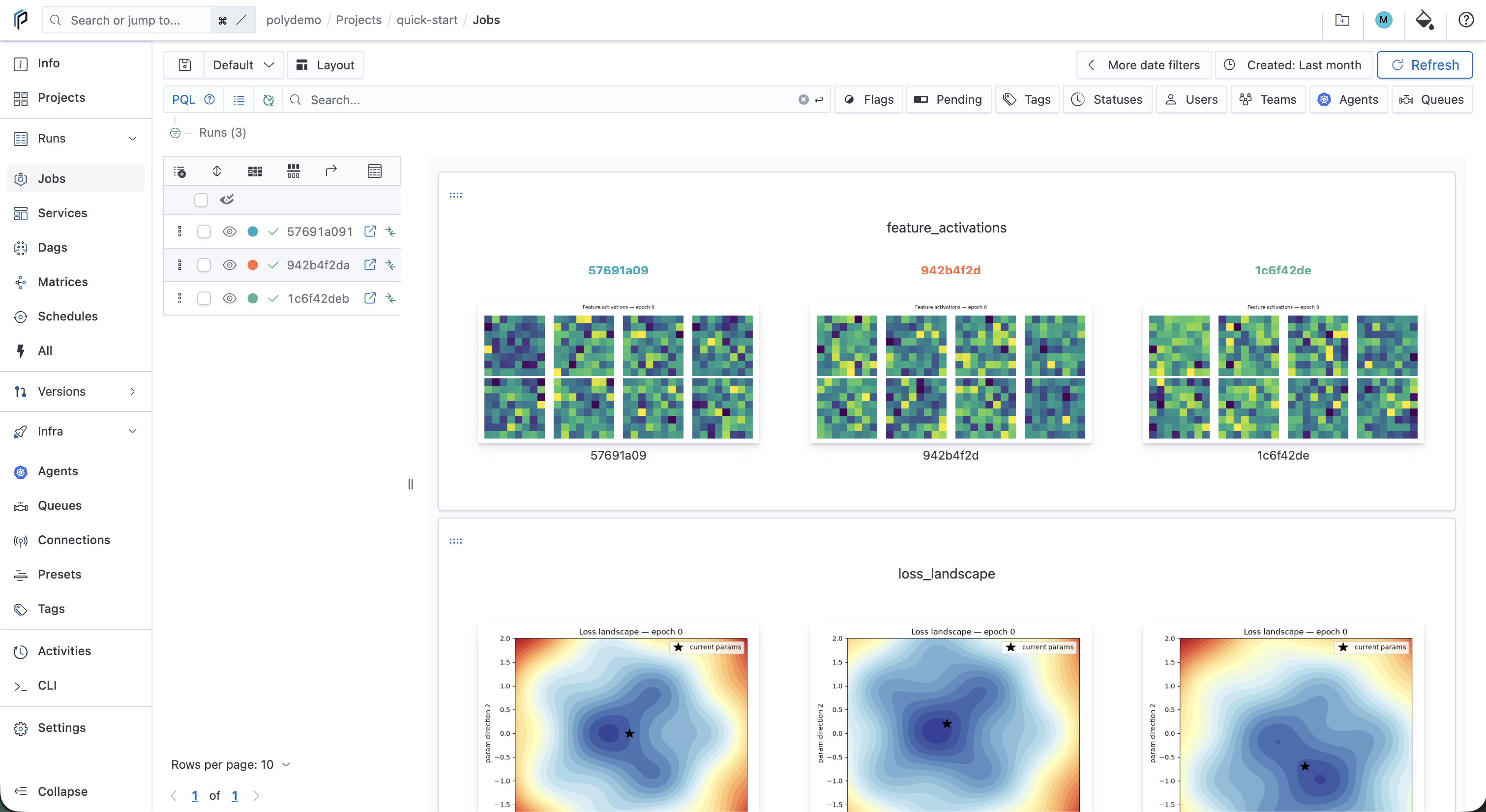
Image comparison Pass params without IO declarations
Implemented for the upcoming 2.18 release. Undeclared params become context values; strictParams enables undeclared-name checks. Declared input and output validation still applies.
Parameter referenceOmit the Polyaxonfile version
Implemented for the upcoming 2.18 release. Components, operations, and compiled operations can omit version; existing versioned files remain valid. The field no longer selects a validation schema.
Polyaxonfile specification
Beta
Features being refined as we work toward the final release.
Interactive debugging and sandboxes
Shipped in v2.16Debug live workloads with sandbox command execution, file access, and interactive terminals.
Explore sandboxesGoverned SSH access
Shipped in v2.16Connect local terminals, IDEs, and file-transfer tools to running services through Polyaxon's authenticated SSH tunnel.
Connect with SSHReconnectable shells with tmux
Shipped in v2.16Enable the tmux plugin to disconnect and return to the same shell from the CLI or UI. Attach to tmux explicitly over SSH to preserve your shell across SSH disconnects. Sessions retain their working directory, variables, and running programs while the container and tmux process remain alive.
Reconnect to your shell
Alpha
Early implementations that are still evolving.
Event-driven automation
Connect hooks and platform events to evaluations, notifications, and downstream jobs when runs change.
Control plane integrations
Manage built-in connections and integrations at the control plane level.
Incoming events
Bring events from Git providers, webhooks, and external systems into Polyaxon workflows.
WIP
Features under development. Target releases are shown where planned.
Run agent-driven research campaigns
Run bounded research campaigns that propose experiments, evaluate results, and retain evidence for each decision. Tune training configurations, agent prompts, or tool policies with explicit budgets and approvals. Track proposal branches, compare results against a baseline, and pause or resume across restarts. Configuration-only proposals come first, followed by isolated source experiments; numerical searches can delegate to native hyperparameter optimization.
Choose scoped credentials for each run
Create personal access tokens with explicit permissions, service access, and expiration dates. Set a default token for new runs or select a specific token when submitting from the CLI or UI. Inspect token scopes and expiry, revoke access, and audit token creation and revocation. A staged rollout introduces scoped run credentials before retiring legacy token behavior as agents and CLIs are upgraded.
Connect agents (compute clusters) without installing Polyaxon
Connect a Kubernetes cluster through cluster credentials or a linked cloud account, with Polyaxon hosting the agent and managing workloads remotely. No Polyaxon CRDs, operator, agent, or streams pods are installed in your cluster, so idle clusters need no resident Polyaxon pods or nodes reserved for them. Bring your own S3, GCS, or Azure artifact storage, and see connection, permission, and storage issues in agent status.
Managed artifact stores
Manage artifact storage alongside the workloads that produce it.
LLM and agent gateway
Access models through a gateway with fallbacks, load balancing, retries, custom guardrail hooks, and advanced evaluations.
Infrastructure observability
Monitor agents, jobs, and clusters with built-in monitoring and observability.
Connect queues to external schedulers
Explicitly bind Polyaxon queues to existing Kueue, Volcano, or KAI queues for native Trainer workloads. Follow runs from platform dispatch through cluster admission and scheduling, with pending reasons and scheduler messages visible in Polyaxon. View external queue usage and quotas where available, alongside Polyaxon's own concurrency, quota, and access controls.
Simpler Polyaxonfiles
Targeting 2.18. Define jobs and services with less nesting, using container settings, commands, environment variables, and resources. Declare ports to select a service without an explicit kind field.
Planned for Polyaxon 2.18. This example previews fine-tuning a language model with the TRL CLI.
container:
  image: ghcr.io/astral-sh/uv:python3.12-trixie-slim

env:
  MODEL: Qwen/Qwen2.5-0.5B
  DATASET: stanfordnlp/imdb
  GPUS_PER_NODE: "1"

resources:
  cpu: "4..8"
  memory: "8Gi..16Gi"
  gpu: 1

cmd:
  - uv pip install --system trl
  - |
    trl sft \
      --model_name_or_path "$MODEL" \
      --dataset_name "$DATASET" \
      --num_processes "$GPUS_PER_NODE"
The uv image includes Python and uv;
--systeminstalls TRL into the container's Python environment. The workload needs a compatible NVIDIA GPU node and access to download the packages, model, and dataset. KeepGPUS_PER_NODEequal to the requested GPU count.Commands use
cmd;runremains available for a complete native runtime specification. CPU and memory ranges define requests and limits.gpu: 1requests exactly one NVIDIA GPU; GPU ranges are not supported.For an API, notebook, or inference endpoint, declare its ports at the top level:
ports:
  - 8080
Polyaxon infers a service without an explicit
kindfield. Your container command starts the server on that port. Withoutports, the flat definition describes a job, as in the training example above.Run without a Polyaxonfile
Targeting 2.18. Define simple runs directly with CLI options, or start a sandbox with --sandbox.
Planned for Polyaxon 2.18. These examples preview the upcoming CLI options.
Fine-tune a language model on one NVIDIA GPU:
polyaxon run \
  --image ghcr.io/astral-sh/uv:python3.12-trixie-slim \
  --env MODEL=Qwen/Qwen2.5-0.5B \
  --env DATASET=stanfordnlp/imdb \
  --env GPUS_PER_NODE=1 \
  --cmd 'uv pip install --system trl' \
  --cmd 'trl sft --model_name_or_path "$MODEL" --dataset_name "$DATASET" --num_processes "$GPUS_PER_NODE"' \
  --gpu 1 \
  --cpu 4..8 \
  --memory 8Gi..16Gi
The image includes Python and uv. The first command installs TRL; the second starts training. Use a compatible NVIDIA GPU node with access to download the packages, model, and dataset. Keep
GPUS_PER_NODEequal to--gpu.Expose a service on port 8080:
polyaxon run \
  --image busybox:1.36 \
  --cmd 'httpd -f -p 8080' \
  --port 8080
Start a sandbox with one NVIDIA GPU, without specifying a user port:
polyaxon run --sandbox \
  --image python:3.12 \
  --gpu 1 \
  --cpu 4..8 \
  --memory 8Gi..16Gi
CPU and memory ranges define requests and limits. Use
--gpu 1for an exact count of one NVIDIA GPU; GPU ranges are not supported.--portselects a service, while--sandboxselects a service with the sandbox plugin enabled.Native hyperparameter optimization
Improve batch search with native TPE v2 and Gaussian process Bayesian optimization, benchmarked against Random and Grid search. Reuse imported evaluations without rerunning them and allocate trial budgets asynchronously with ASHA and TPE+ASHA. Versioned policies keep active studies on their original behavior, with one optimization engine for model training and agent evaluation.
Current hyperparameter tuning guide
Pending
On the roadmap; maturity and delivery timing are not yet confirmed.
Suspend and resume sandboxes
Release compute when sandboxes are idle and wake them on access. Workspace files survive suspension; running processes and terminal sessions do not.
Warm pools(sandboxes)
Reduce startup time for new runs with a pool of ready sandboxes. Used sandboxes never return to the pool.
Composable Python and TypeScript interfaces
Specify logic, hardware, and execution through composable programmatic primitives.
Step-by-step agent debugging
Test and debug agents with step-by-step execution, state inspection, and performance profiling in a sandbox environment.
LLM and agent observability
Trace requests with OpenTelemetry-compatible observability. Capture inputs, outputs, and metadata for intermediate steps to identify bugs and unexpected behavior in LLM applications and agents.
Evaluations across development and production
Evaluate and monitor GenAI applications throughout their lifecycle to measure quality, compare changes, and detect regressions.
Prompt management and optimization
Manage and optimize prompts alongside application traces, evaluations, and model access in an integrated GenAI workflow.
Comments across Polyaxon
Add comments to runs, models, artifacts, traces, spans, observations, and scores to share context and collaborate across teams.
Easier onboarding and faster dashboards
Improve onboarding and core screens for new and nontechnical users, and improve UI performance for large dashboards.
V3.0.0
Draft release notes. These notes collect work toward v3.0.0, including improvements delivered incrementally in v2. They are not a list of newly available features. Use the feature tracker for maturity and shipped versions, and the changelog for published releases.
Core
- New: Add new sandbox interface to allow running agent and AI-generated code in dynamically defined sandboxes.
- Enhancement: Extract schedules to be a first-class concept in the system.
Infra
- Enhancement: Move from Redis to Valkey and use the official chart.
UI
- New: Add markdown, summary, lineage, and performance widgets.
- New: Improve visualization of multiple runs in the compare dashboard.
- Enhancement: Improve rendering and performance of charts.
- Enhancement: Allow visualizing multiple images (index range) at the same time.
- Enhancement: Do not render large artifacts and provide preview button.
- Enhancement: Simplify switching to data view in metrics widgets.
Commercial
- New: Add new notifications/alerts/events layer to the clients to allow sending mid-run events to external systems.
- New: Add automations to monitor conditions and events and trigger actions.
- New: Add control plane integrations.
- New: Add an in-platform notification center to view and manage notifications and alerts.
- New: Improve the scheduler to trigger runs based on schedules and events.
- New: Add support for custom notifications and alerts.