Isolate reinforcement-learning agent rollouts
Use Polyaxon to run reinforcement-learning agent rollouts with bounded execution, separate reward evaluation, reproducible seeds, and isolated trajectory artifacts.
Page 2 of 3

Use Polyaxon to run reinforcement-learning agent rollouts with bounded execution, separate reward evaluation, reproducible seeds, and isolated trajectory artifacts.

Create a Polyaxon sandbox service, wait for readiness, track command execution, preserve outputs, configure timeouts and culling, and stop resources when work finishes.

Use Polyaxon to version guardrail experiments, compare case-level outcomes, constrain execution, and require evidence before promoting an agent release.

Connect Polyaxon projects, access controls, compute queues, workload identities, and connection catalogs into a practical tenant isolation design.

Use Polyaxon scheduling presets, workload identities, isolated compute, and run lineage to reduce and investigate container escape risk in AI execution.

Package a browser runner as a Polyaxon service, execute reviewed cases through SandboxClient, retrieve screenshots and reports, and compare agent behavior across releases.

Design Polyaxon agent execution around bounded runs, scoped connections, workload identities, controlled compute environments, and recorded runtime evidence.

Evaluate AI sandbox platforms using explicit security acceptance criteria, and map Polyaxon capabilities to application and Kubernetes controls.

Use Polyaxon services, sandbox access, queues, presets, connections, and artifact workflows to configure repeatable AI development and execution environments.

Correlate Polyaxon run records with external runtime-security events to investigate agent workloads, preserve evidence, and coordinate containment.

Configure Polyaxon workload credentials, service accounts, connections, and artifact handling while protecting LLM data across providers, caches, and evaluation.

Distinguish confidential computing from workload isolation, and define how Polyaxon scheduling and evidence fit a trusted execution design.

Translate sovereignty, privacy, audit, resilience, and approval requirements into an operable AI platform for government and regulated workloads.

Use Polyaxon run metadata, source revisions, artifact hashes, and independent review to establish provenance for AI-generated code.

Design LLM data flows around scoped Polyaxon connections, isolated execution responsibilities, redacted evidence, and explicit output retention.

Understand kubelet credential verification for cached images and apply it to shared Polyaxon training, notebook, and inference nodes.

Protect ML credentials with encryption, least-privilege access, workload identity, controlled delivery, rotation, and Polyaxon connections.

Use Pod certificate projections and trust bundles for workload TLS, with signer prerequisites and rotation handling for long-running ML services.

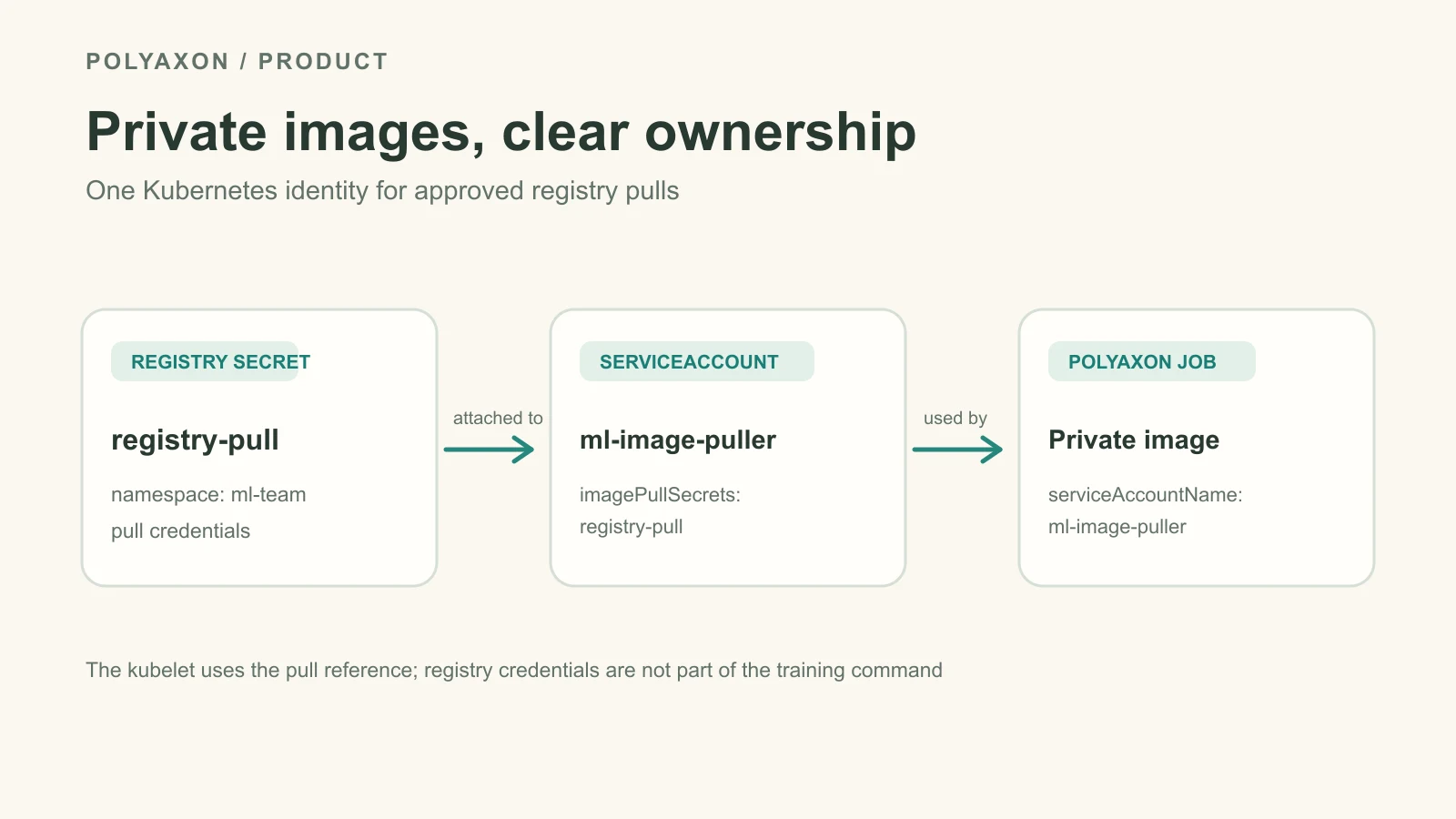
Attach a private-registry pull secret to a Kubernetes ServiceAccount, select it for a Polyaxon operation, and verify the new Pod can use the intended image.

Build layered Kubernetes DDoS protection with upstream filtering, edge controls, workload isolation, resource safeguards, observability, and tested response plans.

Detect and contain suspicious Amazon EKS behavior by correlating Kubernetes audit, AWS API, DNS, network, runtime, and workload context.

Design encryption for Kubernetes data at rest and in transit, with workload identity, certificate rotation, key ownership, and verifiable coverage.

Turn recurring Kubernetes incident patterns into practical controls for initial access, workload isolation, identity, software supply chains, detection, and response.

Prevent compromised Amazon EKS Pods from inheriting node credentials by using workload identity, restricting EC2 instance metadata, and detecting access attempts.