Build AI platforms for government and regulated industries
Translate sovereignty, privacy, audit, resilience, and approval requirements into an operable AI platform for government and regulated workloads.
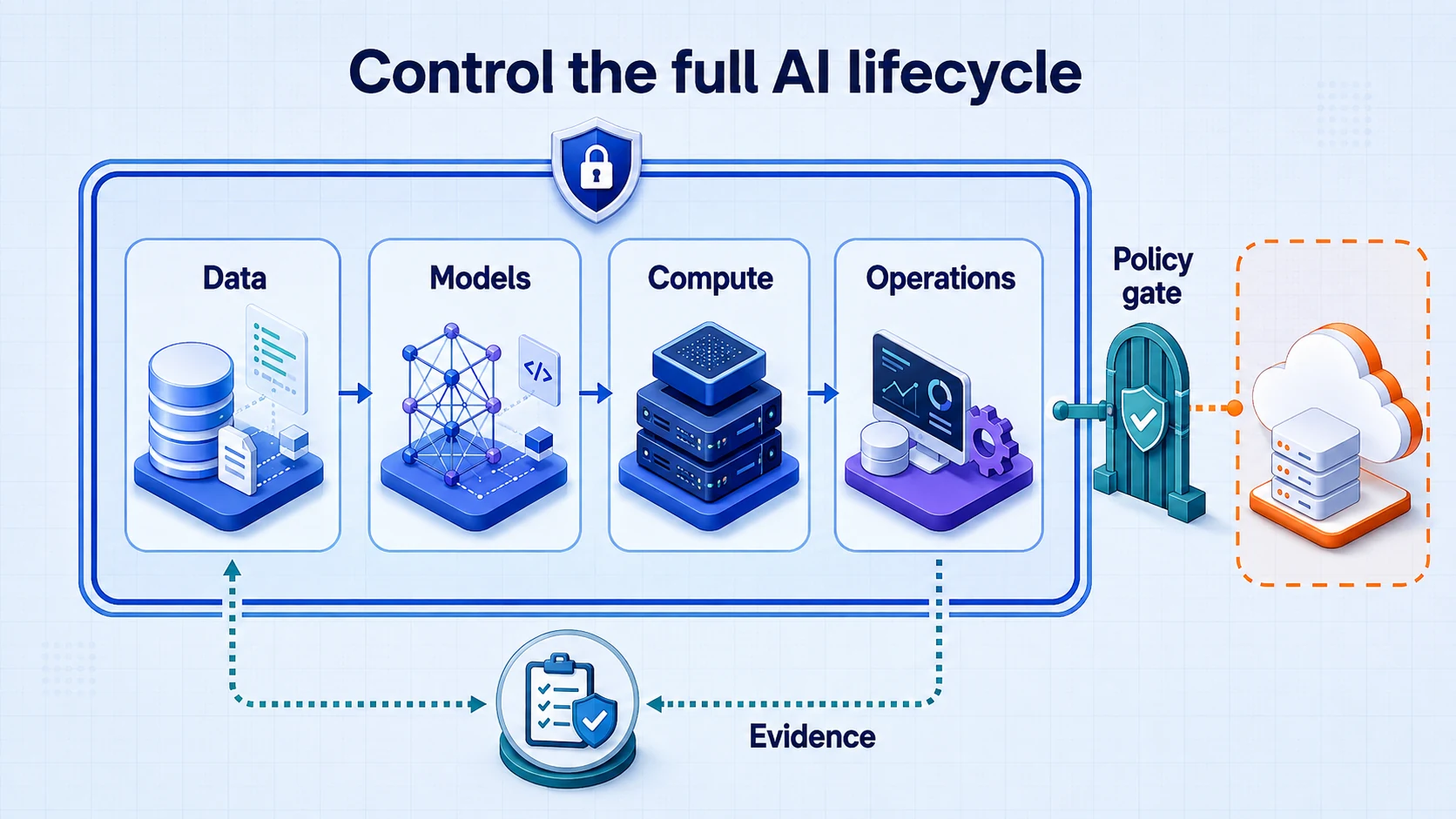
Government, financial, healthcare, and other regulated organizations do not need a separate definition of AI infrastructure. They need ordinary platform capabilities—identity, data, compute, deployment, observability, and recovery—implemented against stricter requirements for purpose, location, authority, evidence, and continuity.
The useful starting point is a control map that turns obligations into architecture and operating decisions.
Define the system and its consequence
Register the complete application, not only the model. Identify the business owner, intended users, affected people, data classes, decisions or actions, deployment locations, external providers, human review, and recovery owner.
Assign a risk tier using impact, scale, reversibility, autonomy, and data sensitivity. A public-information assistant, an internal document search service, and a system that recommends a financial action require different evidence and approvals even if they call the same foundation model.
Use the NIST AI Risk Management Framework or the organization's applicable framework to structure governance, mapping, measurement, and management. The framework should inform concrete platform gates rather than become a parallel spreadsheet.
Turn sovereignty into placement policy
Sovereignty can involve data residency, operational control, legal jurisdiction, personnel access, encryption-key ownership, dependency origin, and the ability to continue operating during disconnection. “Runs on premises” answers only one part.
Express hard constraints before cost or performance preferences:
- approved regions, facilities, and cloud accounts;
- permitted model and API providers;
- data classes allowed at each destination;
- required key owner and secret store;
- operator citizenship or clearance where applicable;
- backup and disaster-recovery location;
- prohibited cross-border telemetry and support paths.
Make the placement decision and its policy version part of the workload record. Test failover only to destinations that satisfy the same constraints.
Separate duties and identities
Use individual human identities and workload identities with short-lived credentials. Separate the authority to develop, approve, deploy, access production data, administer keys, and alter audit controls. Emergency access needs a narrow scope, strong authentication, a time limit, and review.
In Kubernetes, dedicate ServiceAccounts to workload classes, minimize RBAC, enforce Pod Security Standards, restrict network paths, and isolate tenants according to the threat model. Do not let application Pods inherit node or platform-admin credentials.
Map every external action by an AI agent to application authorization. A model's suggestion is not permission to transfer funds, modify a record, or disclose protected data.
Build evidence into the lifecycle
Each transition should retain verifiable references to code, data, model, prompt, tool, policy, image, environment, evaluation, approval, and deployment. Use stable identifiers so an auditor or responder can move from a production event back to the exact release decision.
Avoid copying sensitive prompts and datasets into an unrestricted evidence store. Record hashes, versions, locations, access decisions, and appropriately protected samples. Set retention by evidence purpose and legal requirement.
Evaluate against representative populations and known failure modes. High-consequence systems need independent review, security testing, rollback evidence, and confirmation that human oversight works under realistic load.
Control data and model movement
Inventory datasets, embeddings, checkpoints, model packages, caches, logs, and backups. Apply purpose-based access, encryption in transit and at rest, retention, deletion, and export controls to every copy.
Scan and verify external images, packages, models, and adapters before they enter protected environments. Keep build and artifact provenance, use immutable identifiers, and separate untrusted inspection from production credentials.
For retrieval-augmented systems, the index inherits the sensitivity and deletion requirements of its source data. Test whether authorization changes and source deletions propagate to retrieval results.
Design continuity and incident response
Define acceptable outage, data loss, degraded behavior, and manual fallback. Back up the platform's authoritative metadata and artifacts with consistent recovery points. A model endpoint may be healthy while the identity provider, vector store, approval queue, or key service makes the application unusable.
Prepare controls to disable a deployment, revoke a workload, remove a model or tool, isolate an artifact, preserve evidence, and restore an approved revision. Exercise those actions without depending on the affected AI system to cooperate.
Operate one governed platform path
Polyaxon can encode reusable components, workload identities, connections, resource profiles, evaluation pipelines, and promotion evidence on Kubernetes. Use connections to expose approved data and services, artifacts to retain governed outputs, and pipelines to make validation repeatable.
Keep organizational accountability explicit. Polyaxon can reproduce execution and preserve lineage; data owners, security teams, risk functions, and application owners still decide acceptable use and approve exceptions.
The platform succeeds when teams can move quickly through an approved path and operators can prove where a system ran, what it used, who authorized it, and how to stop or recover it.