Build an operating model for agentic AI
Operate agentic AI with explicit service ownership, platform contracts, task lifecycle rules, change control, incident response, SLOs, and financial accountability.
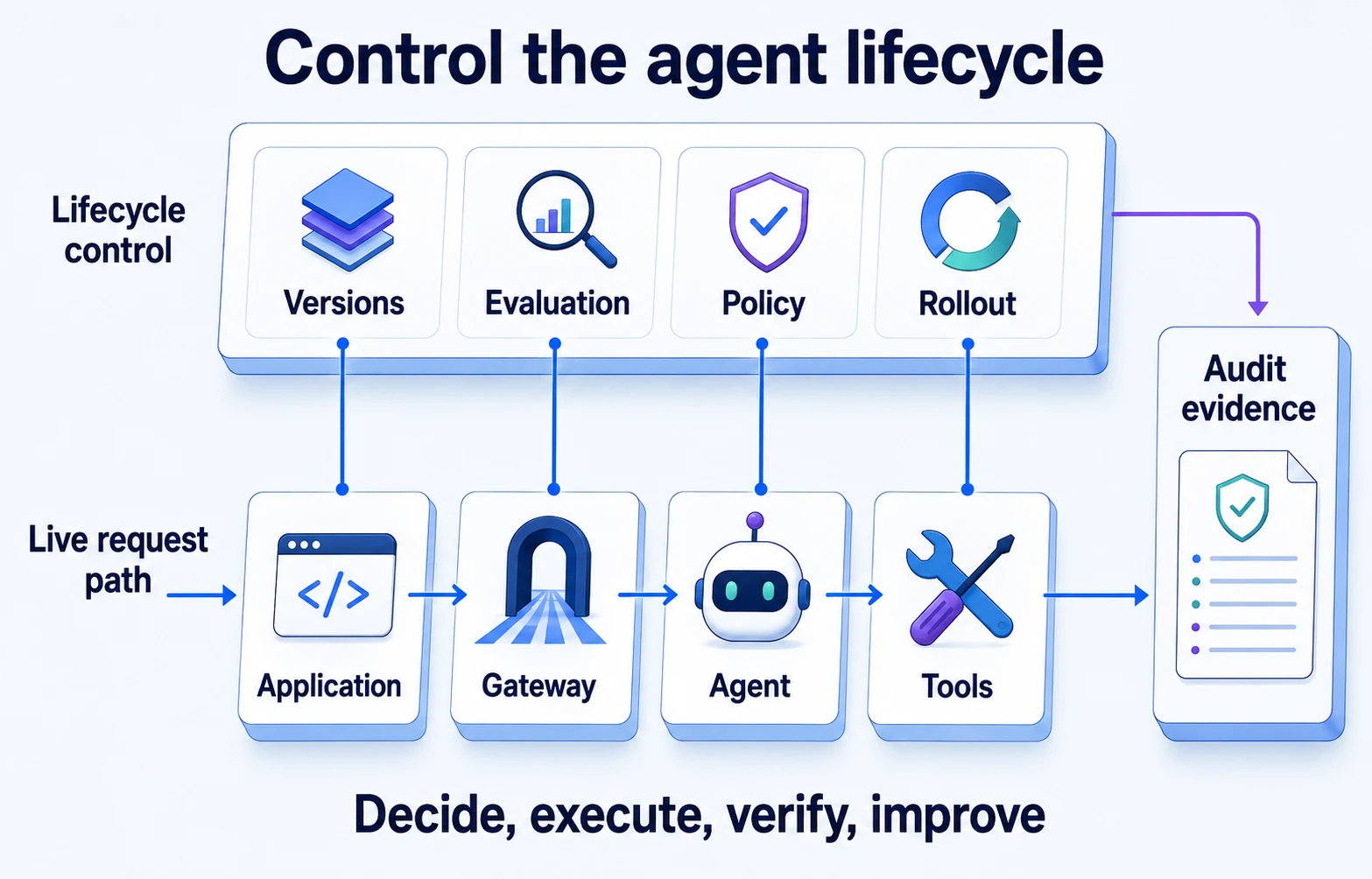
Agentic AI changes an application from a bounded request path into a system that may plan, retrieve, call tools, execute code, wait, resume, and act across organizational boundaries. Production success depends less on whether one team can build an agent and more on whether several teams can operate its complete lifecycle.
An operating model defines who owns each decision, which platform contract connects them, and how the system changes or stops safely.
Register the service, not only the agent
Create one record for the complete service: business purpose, product and technical owners, users, data, models, prompts, tools, external actions, deployment environments, risk tier, objectives, evaluation, and recovery plan.
Connect child assets and releases to this record. A foundation model may serve many applications with different consequences; the service is the useful unit for accountability.
Name a primary owner and an escalation owner. “The AI team” is not an actionable destination during an incident.
Assign decisions to durable roles
Define responsibilities across product, application, ML, data, platform, security, reliability, finance, and risk functions:
- Product owns intended outcomes, user experience, and acceptable failure.
- Application and ML teams own orchestration, prompts, model behavior, and evaluations.
- Data owners approve purpose, access, retention, and deletion.
- Platform teams own execution contracts, identity, isolation, scheduling, and evidence paths.
- Security owns threat baselines, detection, and response coordination.
- Reliability owns objectives, capacity, dependencies, and recovery exercises.
- Finance or FinOps connects consumption with budgets and business value.
One person may fill several roles, but the decisions and escalation paths should remain explicit.
Define the task lifecycle
Standardize accepted, queued, running, waiting, retrying, blocked, canceled, completed, and failed states. Give the logical task an identity independent of a Pod or worker.
Define which state is durable, how checkpoints work, what makes a retry safe, how uncertain actions are reconciled, and when waiting work releases compute. Record tool receipts and approval decisions.
Kubernetes can replace processes and reconcile workload resources. The agent control plane or application owns whether a logical task may resume or repeat an external action.
Publish platform contracts
Offer supported workload shapes, model access, tool integration, sandboxing, artifact storage, telemetry, queues, and deployment paths. Document limits, service levels, data boundaries, and the information developers must supply.
Use versioned templates and defaults for identity, networking, resources, deadlines, and evidence. Make the effective configuration visible after policy and admission changes.
Provide an exception path with an owner, compensating control, and expiry. Recurring exceptions should feed platform roadmap decisions.
Govern changes by consequence
List the changes that require reevaluation or approval: new data, model, prompt, tool, permission, population, region, autonomy, or fallback. A model-only release process misses many behavior changes.
Use risk tiers to vary the gate. Lower-consequence systems may promote after automated tests; high-consequence agents may require independent security evaluation, human approval, staged rollout, and a recovery exercise.
The NIST AI Risk Management Framework provides a lifecycle vocabulary for governing, mapping, measuring, and managing risk. Translate it into the organization's engineering workflow and retained evidence.
Operate day two
Define SLOs for accepted task success, latency, queue delay, recovery, and high-impact action correctness. Monitor model, retrieval, tools, state, infrastructure, cost, and policy together.
Prepare runbooks for provider degradation, runaway loops, tool failures, credential compromise, data deletion, artifact revocation, unavailable approvals, and failed checkpoints. The stop controls must work even when the agent is misbehaving.
Review incidents and near misses through the service registry. Fix the enabling condition, detection gap, and unclear ownership rather than only restarting the workload.
Connect cost to authority and value
Allocate model tokens, accelerator time, storage, network, tool APIs, and human review to the task, service, and owner. Set budgets and concurrency before scaling.
Compare cost with accepted outcomes and consequence. A high-authority agent deserves tighter task budgets and approval controls even when its request volume is low.
Polyaxon can implement the execution and evidence layer through components, operations, pipelines, connections, artifacts, queues, and tracked lineage. Use it to make platform contracts reproducible while organizational owners retain responsibility for purpose, risk, approval, and response.
Operational fluency means teams can explain what the agent is doing, why it is allowed, how much capacity it may consume, what state survives failure, and who can stop it. That is the foundation for scaling autonomy responsibly.