Manage cloud infrastructure for ML platforms
Operate cloud infrastructure for ML with declarative provisioning, clear ownership, workload isolation, capacity policies, cost allocation, and recovery exercises.
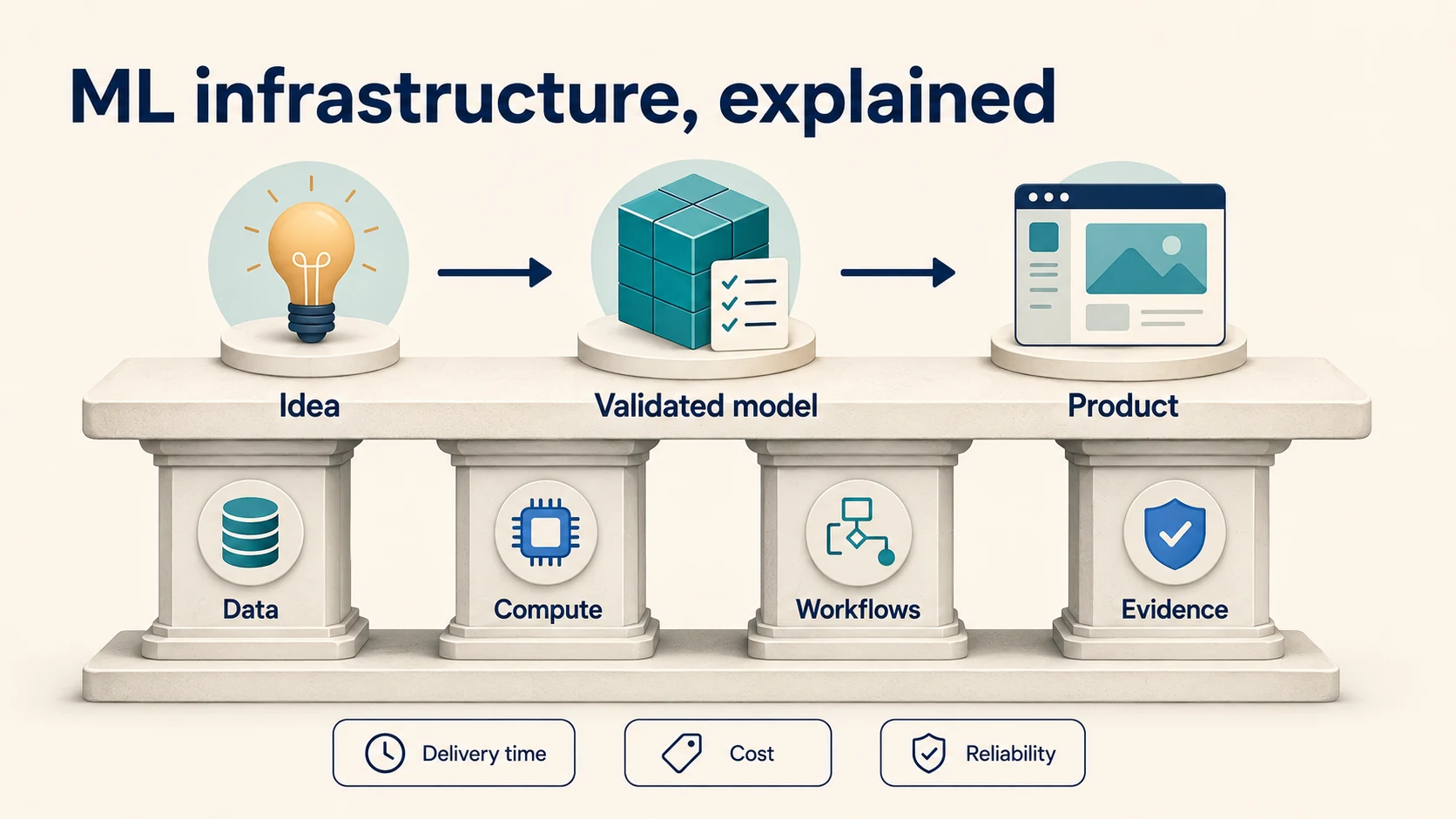
Cloud infrastructure management for ML spans more than creating clusters and GPU nodes. It includes accounts, networks, identities, storage, registries, Kubernetes, observability, budgets, and the platform interfaces that let teams use those resources safely.
The goal is a small set of supported paths that are reproducible, reviewable, and connected to workload outcomes. Ad hoc console changes and one-off clusters make both reliability and cost harder to explain.
Define the platform boundary
Inventory the resources the platform owns and the external services it connects to. For each resource, record environment, region, owner, data class, availability objective, cost center, provisioning source, and retirement condition.
Separate responsibilities:
- Cloud foundations own accounts, identity federation, networks, keys, and organization policy.
- Platform engineering owns clusters, node pools, registries, shared storage connections, and workload interfaces.
- ML teams own workload code, resource requirements, data use, evaluation, and declared outputs.
- Security and finance define controls, evidence, allocation, and exception processes with the operating teams.
Clear ownership prevents a platform team from becoming responsible for every model outcome and prevents application teams from bypassing infrastructure controls to ship faster.
Provision declaratively
Represent networks, clusters, node pools, identities, policies, and shared services as versioned configuration. Review changes, use automated plans, and apply them through controlled identities. Keep environment-specific values separate from reusable modules.
Detect drift between declared and actual state. Decide whether the response is to restore the declaration, import an approved emergency change, or investigate an unexpected mutation. Do not automatically overwrite every difference without considering active incidents.
Use immutable or replaceable patterns where practical, but plan migration for stateful components. Test cluster and node-pool upgrades on representative workloads before promoting them to sensitive environments.
Standardize workload classes
Interactive notebooks, batch preprocessing, distributed training, scheduled evaluation, and online inference need different capacity and reliability. Define templates for each class:
| Workload class | Important controls |
|---|---|
| Interactive | Idle timeout, user identity, network and data boundaries |
| Batch | Queue, retry, idempotency, deadline, and cleanup |
| Distributed training | Gang scheduling, topology, checkpointing, and failure policy |
| Evaluation | Reproducible inputs, isolation, and promotion evidence |
| Inference | Availability, rollout, latency, autoscaling, and rollback |
Templates should set resource requests, service accounts, placement rules, storage connections, logging, and security contexts. Teams can override supported fields without copying the entire infrastructure definition.
Manage capacity as a queueing system
Monitor allocatable resources, requested resources, actual activity, queue wait, unschedulable reasons, startup time, and useful throughput. Allocation alone does not show whether a GPU is active or a job is progressing.
Create node pools around compatible accelerator, CPU, memory, storage, and isolation needs. Use quotas, priority, and fair-sharing policy to prevent one workload from monopolizing capacity. Scale down empty pools while preserving minimum capacity for latency-sensitive services.
For interruptible capacity, identify checkpointable workloads and measure retry cost. Keep critical control-plane and stateful services away from capacity intended to disappear.
Secure every connection
Use workload identities and short-lived credentials instead of shared cloud keys. Grant access to the smallest resource and operation required. Keep development, staging, and production boundaries explicit.
Restrict network paths, protect metadata services, encrypt sensitive data, scan images, enforce workload security settings, and preserve audit records. Treat permission to create a powerful workload as a privileged operation because it can become a path to mounted secrets, node access, or external services.
Maintain a documented break-glass path with strong authentication, logging, expiry, and review. Emergency access should not become the normal deployment workflow.
Connect cost to use
Require owner, environment, project, and cost-center metadata on resources. Reconcile cloud billing with cluster allocation, then connect shared infrastructure to workload usage with a declared method.
Report cost per completed run, accelerator hour, pipeline, or serving unit alongside total spend. Identify idle nodes, unattached disks, abandoned load balancers, old snapshots, stale clusters, and telemetry with no consumer. Automate cleanup for unambiguous temporary resources and request owner review for uncertain data.
Optimize with constraints. A cheaper region or instance is not useful if it violates data residency, lacks the accelerator, increases transfer cost, or extends training beyond the delivery target.
Prepare recovery and decommissioning
Define recovery objectives for the platform control plane, data stores, artifact locations, and model-serving paths. Back up required state and restore it regularly into an isolated environment. Test credential rotation, cluster replacement, failed upgrades, region loss assumptions, and artifact recovery.
Decommissioning is part of the lifecycle. Revoke identities, remove network routes, export required evidence, apply retention rules, delete temporary data, and verify that billing resources are gone. An empty cluster can still leave disks, addresses, snapshots, and logging destinations behind.
Put ML context on top of infrastructure
Use Polyaxon to provide a consistent workload interface across the managed Kubernetes foundation. Pipelines encode reusable execution paths, tracking connects infrastructure choices to run outcomes, and artifacts preserve declared outputs independently from worker lifecycles.
The cloud layer supplies compute, storage, identity, and networking. The platform layer turns those capabilities into governed workload classes. Polyaxon adds the ML project, run, lineage, and collaboration context needed to understand whether the infrastructure produced useful work.