Five shifts shaping enterprise AI platforms
Plan enterprise AI platforms around measurable outcomes, heterogeneous compute, durable agents, cost per successful task, and continuous governance.
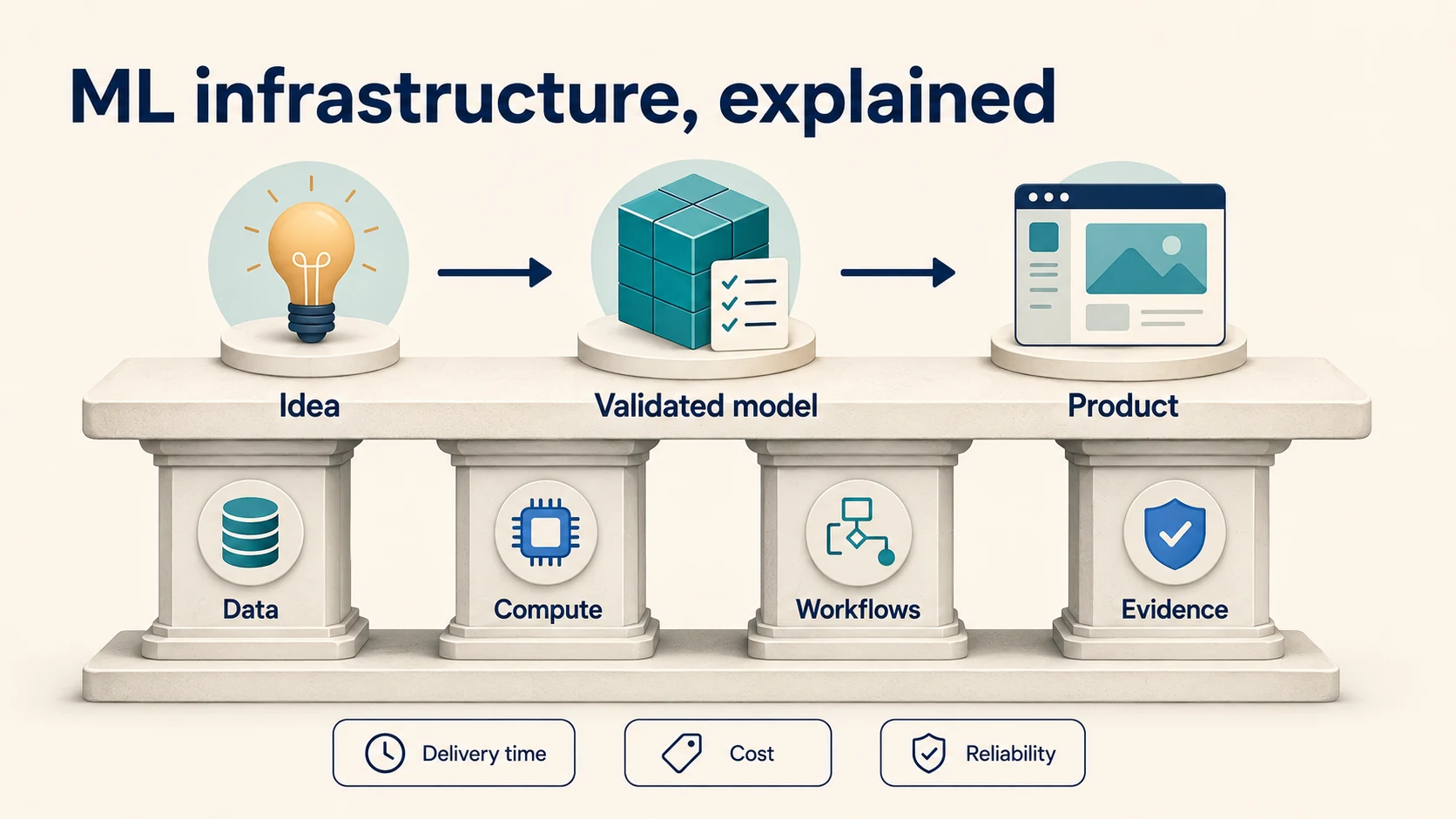
Enterprise AI is moving from isolated model experiments to systems that support products, employees, and operational decisions. That transition changes the platform problem. A successful demo proves that a model can respond; a production platform must prove that the complete workflow is useful, controlled, affordable, and recoverable.
Five shifts help platform teams decide what to build next.
Shift 1: Optimize for accepted outcomes
Model accuracy, endpoint latency, and accelerator utilization remain useful, but none of them independently measures business value. Connect infrastructure and model signals to a task outcome: an accepted document extraction, resolved support case, approved forecast, completed experiment, or safely executed agent action.
Define the outcome before choosing the architecture. Record the input population, quality threshold, latency objective, allowed cost, safety constraints, and recovery expectation. A faster model that creates more reviews or retries can make the overall workflow slower and more expensive.
Use evaluations in development and outcome monitoring in production. Keep the model, prompt, retrieval data, policy, and application release attached to each result so a change can be explained rather than merely observed.
Shift 2: Treat compute as a portfolio
AI platforms increasingly combine CPUs, GPUs, shared inference endpoints, batch accelerators, and external model APIs. The right resource depends on model size, precision, latency, concurrency, data location, and workload duration.
Expose workload classes rather than forcing every team to choose hardware SKUs. A class can describe an interactive CPU service, a cost-optimized GPU batch queue, a high-memory accelerator, or a restricted external endpoint. Platform owners can change the implementation as hardware and pricing evolve while preserving the developer contract.
Kubernetes Dynamic Resource Allocation provides a hardware-aware claim model for attached devices. Whether a platform adopts it immediately or continues with device plugins, the operational requirement is the same: inventory capabilities, make placement explainable, and detect unavailable or unhealthy devices.
Shift 3: Give agents durable execution semantics
Agentic applications do more than issue one model request. They retrieve data, call tools, wait for approvals, create artifacts, and may resume after an interruption. A restarted container cannot infer whether an external action already succeeded.
Separate the logical task from a particular process. Persist checkpoints, action receipts, approval state, budgets, and the exact code, prompt, model, tool, and policy versions. Make retries idempotent where possible and reconcile uncertain side effects before trying again.
Kubernetes remains a strong execution substrate for services and Jobs, but the application or agent control plane must own task state and recovery semantics. The platform should make this division explicit in templates and runbooks.
Shift 4: Measure cost per successful task
Infrastructure cost, provider invoices, and token usage describe inputs. Teams need the cost of an accepted outcome, including model calls, retries, retrieval, tools, compute, storage, and human review.
The FinOps Foundation notes that FinOps for AI adds granular, fast-changing usage data and requires allocation, forecasting, optimization, and governance. Preserve project, environment, application, tenant, model, and operation identifiers at the point of consumption so costs do not become an unallocated monthly total.
Set budgets and concurrency limits before a workload scales. Compare cost changes with quality and latency, and make fallback routing visible. A cheaper model is not an optimization if it increases retries or failure.
Shift 5: Make governance continuous
An approval at launch cannot cover later changes to data, tools, models, autonomy, or users. Register the complete AI system, assign owners, classify its consequence, and define which changes require reevaluation.
The NIST AI Risk Management Framework organizes risk work around govern, map, measure, and manage. Translate that lifecycle into versioned evidence: lineage, evaluations, access decisions, deployment approvals, production observations, incidents, and retirement.
Controls should match risk. A bounded internal summarizer and an agent that can change financial records should not pass through identical gates. Exceptions need an owner, compensating control, and expiration.
Build the operating loop
These shifts reinforce one another. Outcome measures inform compute and routing decisions. Durable task records connect cost and incidents to a release. Continuous governance determines which evidence is required before a change reaches production.
Polyaxon can provide the reproducible execution layer: tracked runs, components, pipelines, connections, artifacts, scheduling controls, and deployment history on Kubernetes. Use tracking to connect results to their inputs and pipelines to encode repeatable validation and promotion steps.
The enterprise AI platform is not one model server. It is the operating system around AI work—turning demand into governed execution and measurable outcomes.