Make a Kubernetes platform ready for AI workloads
Assess and close the gaps in accelerator access, batch scheduling, inference, data, identity, observability, cost, and ownership before AI workloads scale on Kubernetes.
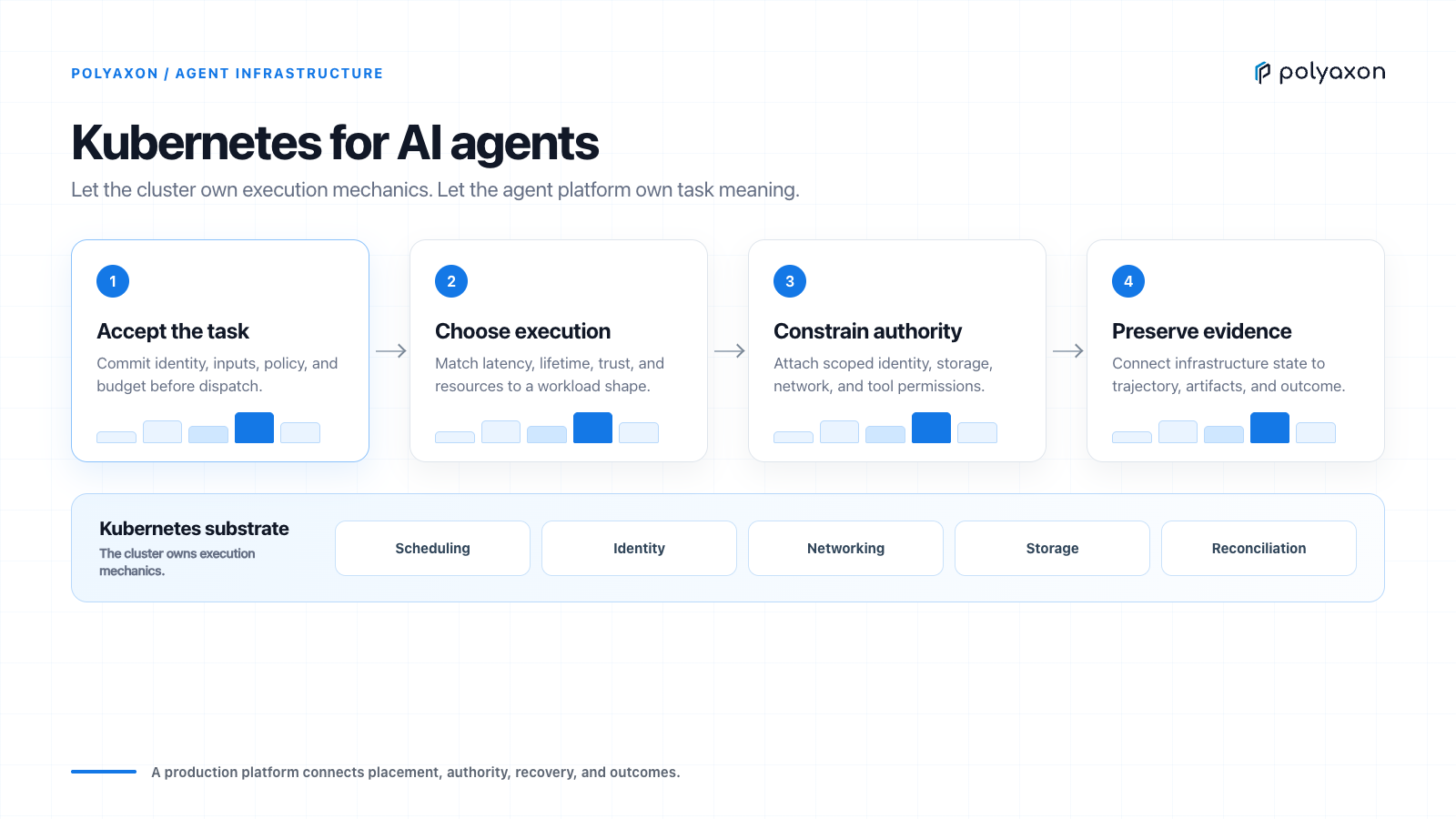
Kubernetes can schedule training Jobs, operate inference services, attach accelerators, isolate workloads, and reconcile infrastructure state. That makes it a strong execution substrate for AI, but not a complete AI control plane by itself.
An AI-ready platform adds the workload contracts, queues, data connections, model access, evidence, cost controls, and ownership rules that let ML teams use Kubernetes without becoming cluster administrators.
Define AI readiness as an operating capability
A cluster is not AI-ready because one notebook can see a GPU. The platform should support a representative workload from submission through scheduling, data access, execution, artifact retention, evaluation, deployment, monitoring, failure, and recovery.
Assess readiness across distinct workload shapes:
- bounded training, tuning, and batch inference;
- distributed workloads that require coordinated placement;
- interactive notebooks and development sandboxes;
- warm, latency-sensitive inference services;
- scheduled data and evaluation pipelines;
- agent tasks that retrieve, call tools, wait, and resume.
Each shape needs a lifecycle and service objective. Do not force them through one Deployment template or one autoscaling policy.
Offer capability-based compute classes
Developers should request a workload capability rather than copy node selectors, tolerations, driver assumptions, and cloud instance names. Define a small catalog such as CPU batch, general GPU, high-memory accelerator, distributed training, or latency-reserved inference.
Publish the memory, precision, topology, availability, queueing, and cost expectations for each class. Resolve the request to actual hardware centrally and record the result with the operation.
Kubernetes Dynamic Resource Allocation provides attribute-aware claims and DeviceClasses for supported devices and drivers. Conventional device plugins may remain appropriate in existing clusters. The platform contract matters more than exposing either API directly to every user.
Add queues before capacity becomes scarce
Accelerator demand is bursty, capacity is expensive, and not every pending workload is equally important. Admit Jobs through queues with priority, quota, concurrency, maximum duration, and destination eligibility.
Track accepted work separately from Kubernetes Pods. Explain whether a workload is waiting for quota, a compatible device, data locality, a scheduling group, or an unavailable cluster. Repeatedly creating Pods does not solve a hard placement constraint.
Reserve capacity for critical services and recovery operations. Use preemption only with clear checkpoint and interruption semantics.
Treat inference as its own platform product
Inference has different scaling and traffic behavior from ordinary stateless APIs. Model loading is slow, GPU memory can hold session or prefix caches, generation may last seconds, and request cost varies with tokens and model choice.
Define model packaging, rollout, warm capacity, health, request deadlines, streaming, cancellation, concurrency, and fallback. An AI gateway can centralize authentication, model eligibility, token budgets, routing, and telemetry.
The Kubernetes Gateway API Inference Extension introduces inference-aware routing for supported implementations. Whether the platform adopts it or another gateway, routing decisions and resolved models must remain visible.
Make data and artifacts first-class
Training and inference depend on datasets, registries, checkpoints, models, retrieval indexes, and output stores. Provide logical connections with workload-scoped identity rather than asking users to paste credentials and storage paths into manifests.
Record source revisions and artifact lineage. Define cache, staging, encryption, retention, deletion, and recovery behavior. A Pod that starts without access to its required data is not useful capacity.
For multi-cluster placement, data residency and transfer time are eligibility constraints. Route only to environments that can resolve the same approved logical inputs and outputs.
Separate human and workload authority
Give each workload class a dedicated ServiceAccount, minimal Kubernetes permissions, approved connections, and explicit network paths. Avoid inheriting a submitting user's broad interactive credentials.
Agent workloads need another authorization layer for tools and external actions. A model-generated call is a request, not permission. Validate the schema and current user, tenant, purpose, and action policy before execution.
Apply Pod Security Standards, default-deny networking where supported, admission checks, immutable images, and resource limits as platform defaults. Keep exceptions visible and time-bound.
Observe useful work and complete cost
Add AI signals to existing infrastructure telemetry: queue delay, allocation failures, device health, GPU memory, model load time, time to first token, token throughput, fallback, evaluation outcome, checkpoint progress, artifact errors, and cost per accepted task.
Connect these signals with stable project, operation, attempt, model, artifact, cluster, namespace, and owner identifiers. Missing telemetry should not appear as a healthy zero.
Allocate accelerator time, CPU, storage, network, model tokens, and external tools to the workload and team. Capacity decisions should use useful throughput and outcomes, not GPU utilization alone.
Assign ownership before the first incident
Document where model, application, platform, data, security, reliability, and FinOps responsibilities begin and end. Define who responds to a bad model result, incompatible driver, unavailable artifact store, runaway agent, full queue, or unexpected bill.
Polyaxon can provide the workload layer above Kubernetes through components, operations, pipelines, connections, artifacts, queues, presets, and tracked lineage. Teams declare the work and required resources while platform engineers maintain the detailed cluster implementation.
Start with one representative workload and follow it end to end. The platform is ready when teams can submit safely, operators can explain placement and behavior, costs have owners, and recovery works without reconstructing the system during an outage.