Scale agentic AI without breaking the infrastructure
Scale AI agents with admission control, dependency-aware concurrency, durable state, bounded authority, backpressure, and outcome-based capacity planning.
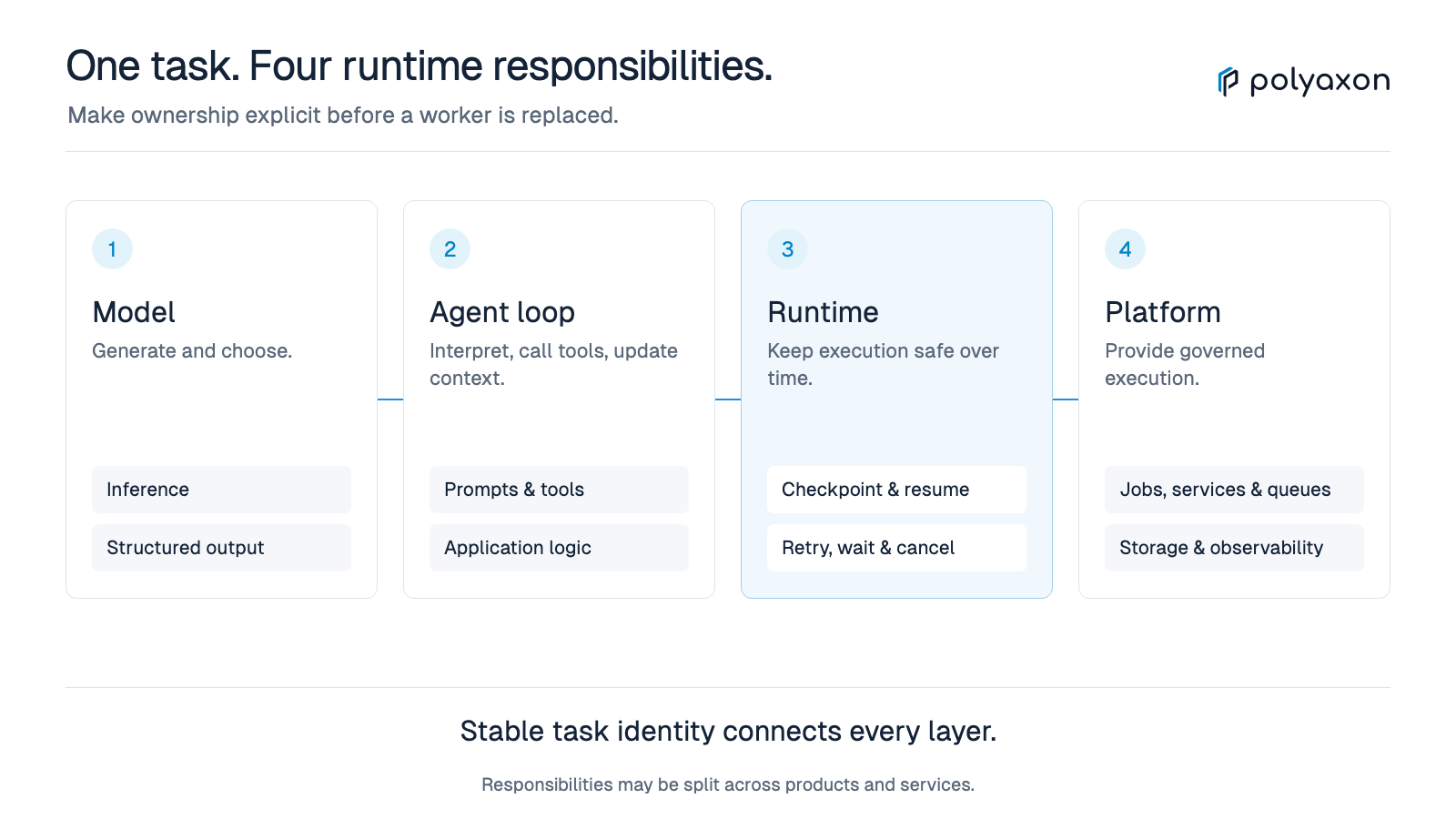
An AI agent can multiply one user request into retrieval calls, model generations, tool invocations, code execution, and retries. Scaling the entry-point service without controlling that fan-out can overload model quotas, databases, external APIs, sandboxes, and human approval queues long before Kubernetes runs out of Pods.
Capacity planning must follow the logical task through every constrained dependency.
Model the fan-out
For each agent task, measure typical and worst-case model calls, tokens, retrieval queries, tool calls, sandbox minutes, bytes transferred, and approval waits. Segment by task type because a short classification and a multi-step research workflow have different resource shapes.
Map every dependency's capacity, quota, timeout, and failure behavior. Identify whether load is bounded by GPU memory, provider concurrency, database connections, API rate limits, queue workers, or a downstream system that cannot scale with the agent tier.
Use this model to estimate amplification: how many units of downstream work can one accepted task create before it reaches its budget?
Admit work before executing it
Place a durable admission queue in front of expensive execution. Validate identity, task type, required connections, resource eligibility, deadline, and budget before dispatch.
Apply concurrency and quota by tenant, workload class, environment, model, tool, and destination. Reserve capacity for high-priority recovery and control actions. First-come scheduling can let a burst of low-value tasks block production work.
Return clear states—accepted, queued, blocked, running, waiting, completed, failed, or canceled—so clients do not resubmit uncertain work and create duplicates.
Enforce budgets across the whole task
Per-request limits at a model gateway are helpful but insufficient. An agent can remain under every call limit while looping indefinitely. Enforce maximum elapsed time, attempts, tokens, model cost, tool calls, sandbox time, and produced data across the logical task.
Budget policies should distinguish a controlled escalation from an accidental loop. A task may use a stronger model after a validated trigger, but the routing decision and added cost must remain visible.
When a budget is reached, stop at a safe checkpoint and return a diagnosable outcome. Do not leave background tool calls or execution environments running after the coordinator gives up.
Apply dependency-aware backpressure
Reduce dispatch when a constrained dependency shows high queue time, throttling, error rate, or exhausted quota. Retrying faster amplifies a degraded provider. Use exponential backoff, jitter, circuit breakers, and a total deadline.
Fallbacks need eligibility rules. Another model may have different quality, safety, region, context, or tool behavior. Evaluate fallbacks by task class and tell the application which target actually served the request.
Keep bulk and interactive traffic separate. Batch evaluations can use spare capacity without consuming the latency margin reserved for user-facing work.
Make execution durable
Persist task state outside an individual Pod. Record committed steps, model and tool responses needed for recovery, approvals, artifacts, and receipts from external actions. A replacement worker should resume from an explicit checkpoint.
Retries must be safe. Assign action identifiers, use idempotency support where available, and reconcile unknown outcomes before repeating a write. Kubernetes can replace a failed process, but it cannot decide whether an email, deployment, or payment already occurred.
Release compute while a task waits for a person or a distant event. Store the pending decision and resume in a new attempt rather than holding a GPU or sandbox idle.
Contain each execution
Scale increases the number of opportunities for a compromised prompt, tool, dependency, or generated program to cause harm. Give every task the minimum identity, files, network destinations, tools, and duration it requires.
Run untrusted code in an isolation boundary designed for the threat model. Separate the coordinator from execution credentials, apply default-deny networking, use fresh writable storage, cap resources, and clean up deterministically.
High-impact tools need application authorization and, where appropriate, action-time human approval. Prompt instructions are not a permission system.
Scale on useful signals
CPU or GPU utilization alone may not represent demand. Consider admitted queue age, eligible backlog, active model sessions, tokens in flight, dependency health, and completed tasks. Keep maximum capacity and cost bounds on autoscaling.
Track success rate, accepted outcome, task latency, queue delay, loop count, retries, tool failures, policy stops, cost, and recovery attempts. Connect those signals to cluster scheduling, model endpoints, and external dependencies with stable task and attempt identifiers.
Polyaxon queues can apply priority, concurrency, quota, and routing to Kubernetes workloads, while tracked operations preserve code, configuration, inputs, resources, logs, and artifacts. Use termination policies to bound execution attempts and tracking to connect infrastructure behavior with the task outcome.
Agentic scale is controlled fan-out, not simply more replicas. Admit deliberately, bound the complete task, slow down when dependencies cannot keep up, and preserve enough state to recover safely.