Choose a managed Kubernetes service for ML
Evaluate managed Kubernetes services for ML using responsibility, GPUs, networking, storage, identity, observability, cost, and portability.
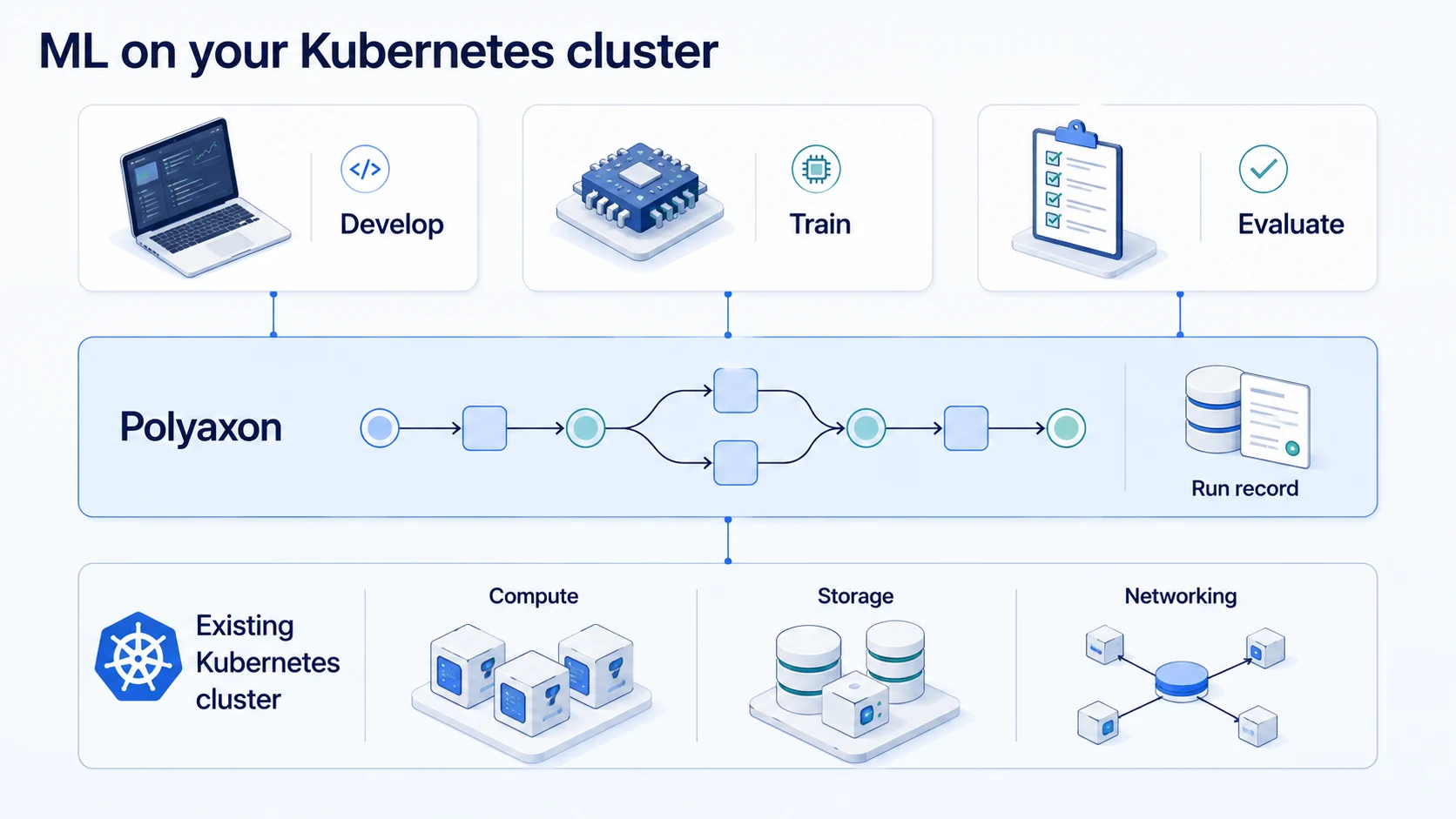
A managed Kubernetes service operates some portion of the cluster control plane, but “managed” does not mean every operational responsibility disappears. Teams still own workloads, access, data, many add-ons, worker capacity, cost, and incident response.
For ML platforms, choose a service by the workloads and boundaries it must support. A generic feature checklist can hide the constraints that matter most: accelerator availability, data locality, quota, networking, identity, and recovery.
Define the responsibility boundary
Start by writing down what the provider operates and what your team operates:
| Area | Questions to verify |
|---|---|
| Control plane | Availability objective, upgrades, backups, audit access, and support boundary |
| Worker nodes | Images, patching, scaling, repair, disruption, and supported operating systems |
| Add-ons | Ownership of CNI, CSI, DNS, ingress, autoscaling, metrics, policy, and GPU components |
| Security | Identity integration, secrets, encryption, admission, and private API access |
| Operations | Logs, metrics, alerts, maintenance events, quotas, and escalation path |
Read the current service-level and shared-responsibility documentation for every candidate. Do not infer production guarantees from the word “managed.”
Match accelerators to real workloads
Build an inventory of accelerator models, memory sizes, interconnect, driver and runtime support, availability zones, quotas, and provisioning lead time. Include fractional or shared GPU requirements only when the isolation and performance model fits the workload.
Test representative training and inference workloads. A device appearing as allocatable does not prove that distributed communication, storage throughput, model loading, checkpointing, or useful application throughput meets the objective.
Capacity availability can differ by region and zone. Plan an approved fallback instead of assuming the autoscaler can always obtain the requested instance.
Evaluate networking and data locality
ML jobs often move large datasets, checkpoints, container images, and model artifacts. Compare:
- Pod and Service address capacity;
- private cluster and egress architecture;
- load balancer and Gateway integration;
- NetworkPolicy enforcement;
- cross-zone and cross-region bandwidth and cost;
- storage classes, volume topology, snapshots, and throughput;
- object-store locality and access control;
- high-performance networking for distributed training.
The cheapest compute can become expensive when data transfer, idle loading time, or cross-zone traffic is included. Evaluate the full path from input to persisted output.
Integrate identity before migrating workloads
Map human, automation, and workload identities across the cloud provider, Kubernetes RBAC, and Polyaxon. Prefer short-lived workload identity over node-wide or static credentials.
Verify private registry access, key management, secret delivery, certificate issuance, and audit correlation. Test that a workload can access only its required datasets and artifact locations, not every resource available to the node.
Polyaxon connections centralize approved integrations, while RBAC governs platform-level access. Review those controls together with cloud IAM and Kubernetes permissions.
Compare lifecycle and recovery
Check supported Kubernetes versions, upgrade windows, version skew, extended support, node-image lifecycle, disruption controls, and add-on compatibility. A provider-managed control-plane upgrade can still expose incompatibility in controllers, webhooks, device plugins, or workloads.
Test node and zone loss, control-plane API disruption, exhausted IP space, storage failure, unavailable accelerator capacity, and restoration from backups. Document who opens the provider support case and which evidence must be captured first.
For multi-region or multi-cluster plans, make dispatch ownership explicit. Our multi-cluster GPU orchestration guide explains why free-device count alone is not a safe routing policy.
Model complete cost
Include more than control-plane and instance prices:
- worker, accelerator, storage, snapshot, network, and public-IP charges;
- observability ingestion, retention, and query cost;
- idle headroom and fragmented capacity;
- extended support and enterprise support;
- engineering time for upgrades, policy, incidents, and provider-specific integration;
- data migration and exit cost.
Use workload-level resource and throughput measurements rather than list-price comparisons. A more expensive device can reduce cost per accepted model if it completes work much faster and remains available where the data resides.
Preserve a practical portability layer
Kubernetes provides a common API, not identical infrastructure. Storage classes, load balancers, identity, GPUs, autoscaling, observability, and network behavior remain provider-specific.
Separate portable workload intent from environment policy. Standardize containers, resource declarations, health behavior, artifact contracts, and run metadata. Encapsulate provider differences in cluster configuration and Polyaxon scheduling presets.
Portability should support a defined business need—recovery, sovereignty, capacity access, or negotiation—not force every workload onto the lowest common denominator.
Run a scored proof of capability
Use a small set of representative workloads: interactive development, single-GPU training, distributed training, batch evaluation, and model serving. Score start time, runtime, failure recovery, useful throughput, cost, operator effort, and evidence quality.
Include negative tests such as missing quota, failed image pulls, unavailable storage, node interruption, and a broken telemetry exporter. The platform must make failure understandable, not merely succeed in a clean demonstration.
Polyaxon can provide one reproducible ML workflow across selected clusters while leaving each environment's infrastructure policy explicit. The best managed Kubernetes service is the one whose responsibility boundary, capacity, data path, security, lifecycle, and economics match your real workloads—and remain understandable when something fails.