Govern model access with an AI gateway
Operate an AI gateway as a policy boundary for workload identity, eligible models, routing, budgets, privacy, evidence, and controlled configuration changes.
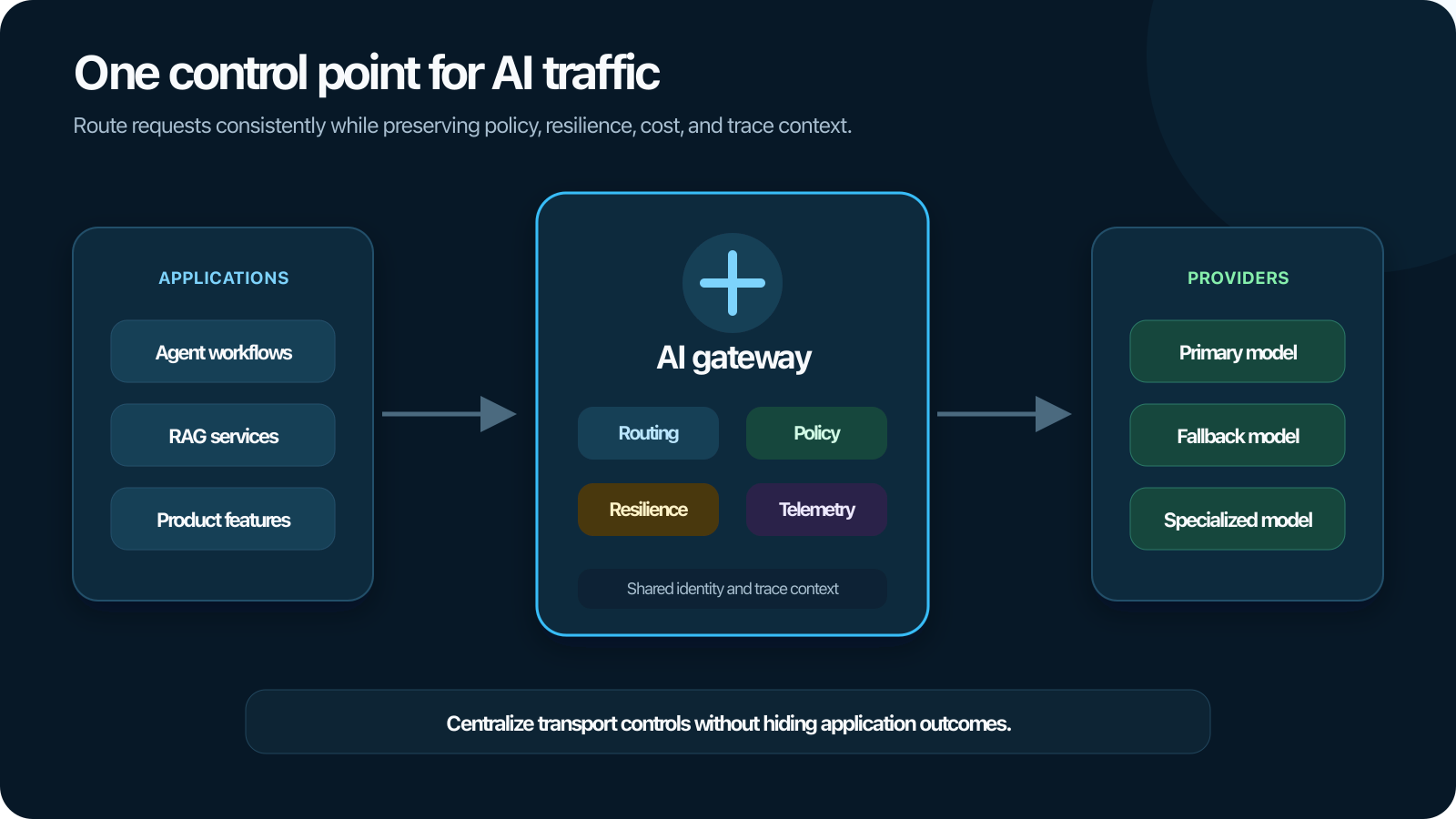
An AI gateway can centralize credentials, routing, limits, and telemetry across model providers and self-hosted endpoints. That convenience also makes it a high-impact control point. A routing or logging change can affect many applications at once.
Govern the gateway as production policy infrastructure, with explicit identities, versioned decisions, evaluation evidence, and a recovery path.
Authenticate workloads, not shared applications
Give each application and environment a dedicated identity. Avoid one gateway key shared across notebooks, services, experiments, and production. The gateway should know the tenant, application, environment, and workload class before selecting credentials or a model.
Scope access by capability: generation, embeddings, reranking, image, audio, fine-tuning, or administration. Keep provider credentials inside an approved secret system and return no secret material to the calling workload.
Record authentication and authorization outcomes without logging tokens or sensitive request content.
Define eligible models before routing
Routing should begin with a set of targets approved for the task's quality, safety, region, data class, and feature requirements. Cost and current latency can rank eligible targets, but they should not make an ineligible provider acceptable.
Use logical aliases that describe the required capability. Preserve the resolved provider, model, endpoint, version, region, and routing-policy revision with every request.
Evaluate each primary and fallback target on representative application tasks. A fallback is a release dependency, not an emergency guess.
Apply task-aware budgets
Limit requests, input and output tokens, context size, concurrency, and estimated cost by application, tenant, environment, user tier, and model. Add daily or monthly budgets, but enforce per-task limits in the application because one agent task may make many gateway calls.
The FinOps Foundation's FinOps for AI guidance highlights granular allocation and governance. Emit usage with stable ownership dimensions and the pricing-table version used for estimates.
Measure cost per accepted task. Gateway cost per call can fall while total task cost rises through retries, longer context, or tool loops.
Make retries and fallbacks visible
Define retryable errors, maximum attempts, total deadline, backoff, and whether another provider is permitted. Generation may not be idempotent from the user's perspective; repeated streamed output or duplicated downstream work must be handled by the application.
Return or propagate the actual target and fallback path. Alert on fallback rate, quota pressure, circuit-breaker state, and silent quality degradation.
The Kubernetes Gateway API Inference Extension introduces model-aware routing for self-hosted inference. Regardless of implementation, routing decisions need inspectable inputs and outcomes.
Control content handling
Decide whether the gateway stores prompts, responses, embeddings, tool schemas, or only metadata. Apply redaction, encryption, access control, retention, and deletion according to data class and purpose.
Do not enable full-content logging globally to simplify debugging. Use protected, time-bound diagnostic capture with an owner and audit trail when necessary. Ensure caches include tenant, authorization, model, prompt, tools, policy, and freshness in their boundaries.
Enforce maximum payloads and supported schemas. Content safety filters can complement application controls, but the gateway usually lacks the business context to authorize a high-impact tool action.
Version and test gateway policy
Store routes, aliases, credentials references, limits, redaction, caching, and fallback policy as reviewed configuration. Validate syntax, referenced targets, policy conflicts, and secret availability before rollout.
Canary configuration changes by application or traffic segment. Compare latency, errors, cost, target distribution, and task outcomes. Preserve the previous configuration and test rollback.
Separate policy authorship, approval, and emergency operation for high-impact environments. Every manual override needs an owner, reason, scope, and expiry.
Design gateway reliability
Centralization can create a common failure domain. Run the gateway with appropriate replicas, capacity, disruption controls, dependency timeouts, and regional design. Decide whether applications fail closed, use a restricted direct path, or enter degraded mode when the gateway is unavailable.
Monitor queue time, processing latency, request and token rate, errors, retries, fallbacks, policy rejections, cache behavior, provider health, and telemetry loss. Propagate trace context so model calls remain connected to the complete application task.
Polyaxon connections can expose approved gateway identities to eligible operations, while tracking preserves the application, environment, model alias, parameters, and outcome. Use evaluations to decide eligible routes and pipelines to promote policy changes alongside application releases.
An AI gateway is most valuable when it makes model access more accountable—not merely when it hides multiple APIs behind one endpoint.