Kubernetes service mesh for ML platforms
Decide whether a service mesh fits your ML platform, then design traffic policy, identity, observability, rollout, and failure behavior deliberately.
A service mesh adds a traffic-management layer between services. It can apply workload identity, mutual TLS, authorization, retries, timeouts, routing, and telemetry consistently without implementing every feature in each application.
That consistency is valuable, but it introduces another distributed system into the request path. ML platform teams should adopt a mesh for explicit traffic or security requirements—not because every Kubernetes cluster is expected to have one.
Understand the mesh boundary
The CNCF service mesh definition describes a layer that manages service-to-service communication and provides reliability, observability, and security capabilities.
Most meshes separate:
- a control plane that distributes configuration, identity, policy, and routing intent;
- a data plane that handles traffic close to workloads.
The data plane may use a proxy beside each Pod, node-level components, or a sidecarless design. These architectures have different resource, isolation, compatibility, and debugging tradeoffs. Do not assume “mesh” always means one injected container per Pod.
The mesh manages network behavior. It does not replace Kubernetes Services, NetworkPolicy, application authorization, an API gateway, or workload-level model safeguards.
Start from concrete requirements
A mesh is a good candidate when several services need the same capabilities:
- authenticated and encrypted service-to-service traffic;
- identity-based authorization independent of IP address;
- consistent timeouts and connection policy;
- controlled canary, traffic split, or failover behavior;
- request-level telemetry across heterogeneous applications;
- policy spanning many teams or languages.
If the platform has a small number of services, ordinary Kubernetes networking and application instrumentation may be simpler. A mesh cannot compensate for unclear service ownership or unreliable application behavior.
Write the target flows before selecting technology: which services communicate, which identities are allowed, what failure behavior is safe, and which evidence operators need.
Treat retries and timeouts as application policy
Central retries can improve resilience for idempotent requests and amplify damage for non-idempotent or expensive operations. Retrying model generation, artifact upload, or job submission can duplicate cost or create conflicting work.
Define timeouts from the caller's objective and the callee's behavior. Coordinate client, proxy, load balancer, and server deadlines so a downstream service does not continue expensive work after the caller has abandoned it.
Use circuit breaking and load shedding to preserve critical paths under overload. Test partial failure, slow dependencies, and connection exhaustion; clean happy-path traffic does not validate resilience policy.
Build identity and mTLS carefully
A mesh can issue workload identities and establish mutual TLS between data-plane components. Encryption in transit is useful, but it is not authorization by itself.
Map service identities to least-privilege policies. Decide how namespaces, service accounts, clusters, and environments affect trust. Protect certificate authorities and rotation mechanisms, and monitor expiring or rejected identities.
Keep cloud IAM, Kubernetes RBAC, NetworkPolicy, and application-level permissions aligned. A request can be allowed by the mesh and still need authorization to read a dataset or write an artifact.
Use mesh telemetry as one signal
Proxies can expose request counts, latency, response codes, connection behavior, and trace context without modifying every application. This provides broad, consistent network visibility.
It does not show whether a training run produced a valid model or whether a response was grounded. Combine mesh telemetry with application metrics, distributed traces, Kubernetes state, accelerator signals, and Polyaxon run metadata.
Control metric cardinality. Source and destination workload, namespace, cluster, route, and status are useful bounded dimensions. Unique run IDs, Pod UIDs, prompts, and artifact paths belong in traces, logs, or run metadata.
Account for ML traffic patterns
ML systems include different traffic classes:
- short platform API requests;
- long-lived notebook connections;
- large model and dataset transfers;
- streaming inference responses;
- high-throughput model-serving calls;
- collective communication for distributed training.
Do not route every path through the same proxy configuration. Validate streaming, gRPC, large payloads, connection reuse, and accelerator-serving latency. Distributed-training data planes may require direct, high-performance networking that should not pass through an application service mesh.
Measure proxy CPU, memory, latency, and connection limits with representative loads. Sidecars also change each Pod's resource request and startup or termination lifecycle.
Roll out with a failure plan
Begin with a non-critical namespace and a few well-understood services. Establish baseline latency, error rate, resource use, and trace coverage before enrollment.
Test control-plane loss, certificate rotation, invalid policy, data-plane restart, DNS failure, and upgrade compatibility. Document how to disable injection or bypass the mesh safely when it contributes to an incident.
Use canary upgrades and verify mixed-version behavior. Admission webhooks, injected containers, and cluster-wide networking components all expand the blast radius.
Connect the mesh to Polyaxon
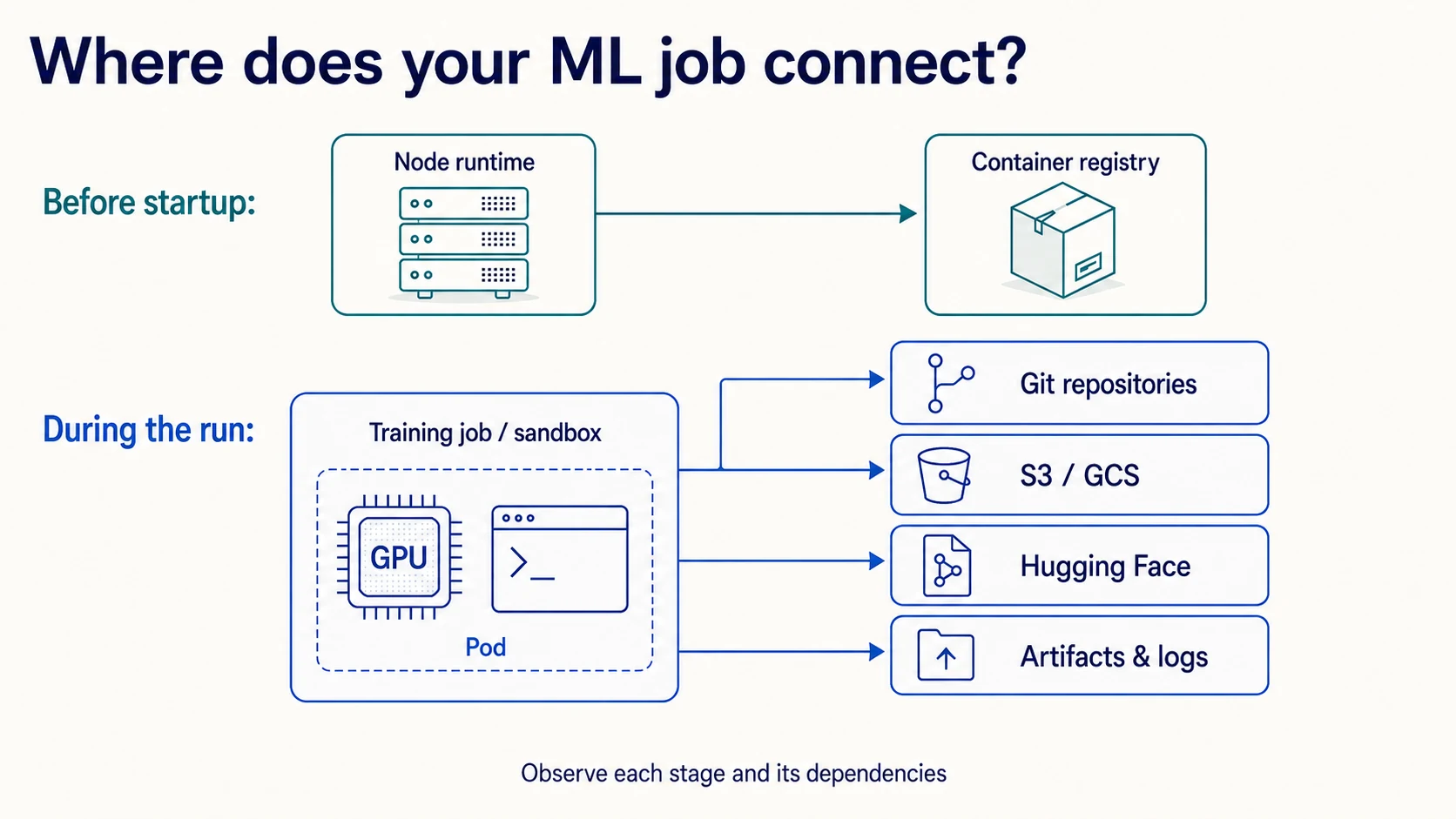
Polyaxon platform observability provides health and workload context above the network layer. Connections govern access to registries, data, artifacts, and external services that mesh policy alone does not authorize.
Use the mesh to make service communication safer and more observable, and Polyaxon to preserve the ML operation, inputs, parameters, logs, metrics, lineage, and artifacts. A mesh is successful when it solves a defined cross-service requirement without making the execution path harder to understand or operate.