Verified data pipelines for reliable AI agents
Design agent data paths that preserve source identity, versions, permissions, freshness, retrieval evidence, and verification results.
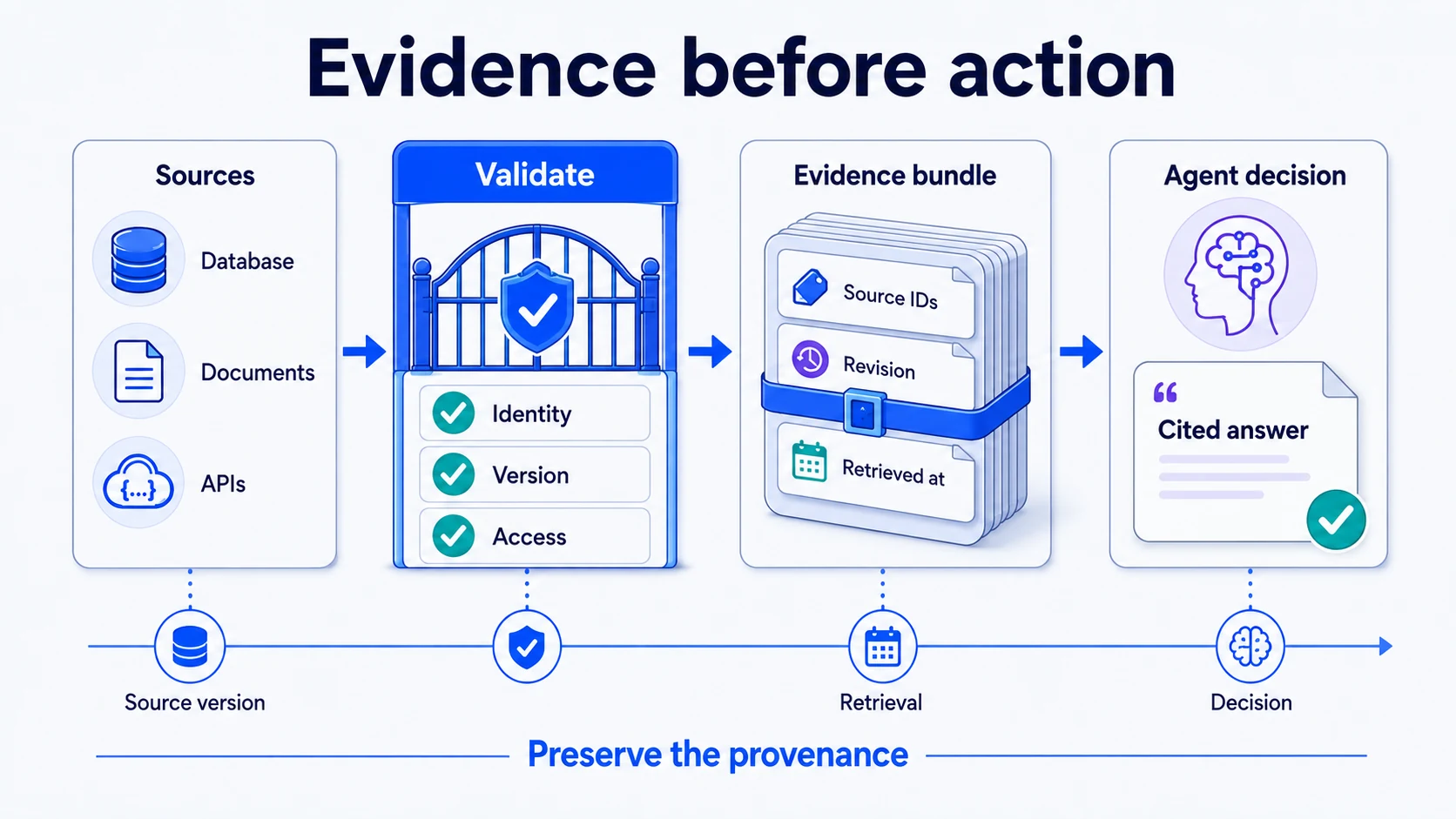
An agent can quote a retrieved document perfectly and still make the wrong decision. The document may belong to another customer, describe an expired policy, or have been replaced after the index was built. Grounding helps only when the supplied evidence is fit for the decision.
Reliable agent data therefore needs more than a vector search result. It needs an inspectable path from the source version and access decision to the exact context used by the model. That path lets a team distinguish a retrieval failure, a data-quality failure, and a model failure without reconstructing the run from scattered logs.
Define what verified means for the task
Verification is a contract for a particular decision. A support-answer agent and a payment-review agent can use the same customer record with different requirements.
| Property | Question to answer before use |
|---|---|
| Identity | Which customer, account, product, or case does this record describe? |
| Source | Which system produced it, and is that source approved for this claim? |
| Version | Which immutable revision, object version, or transaction position was read? |
| Freshness | How old may the value be for this decision? |
| Access | Was the requesting principal allowed to read it at retrieval time? |
| Integrity | Did the content arrive completely and match its recorded digest or checksum? |
| Consistency | What should happen when approved sources disagree? |
Write those rules per field or claim where the risk requires it. A product description may tolerate a daily snapshot. Inventory or account status may require a transactionally current read. “Latest” is not a reproducible version and “trusted database” does not resolve conflicting rows.
The NIST Generative AI Profile recommends documenting the suitability of data used across the AI lifecycle. Turn that principle into testable rules: required fields, acceptable sources, freshness windows, permitted scopes, and a defined response when verification cannot complete.
Preserve provenance at retrieval time
Record provenance while the data is being read. An answer assembled later cannot reliably recover which object version, filter, or identity check produced its context.
A compact retrieval record can look like this:
{
  "query_id": "query-0184",
  "principal": "support-agent-test",
  "source": {
    "uri": "s3://verified-records/customer-42.json",
    "version": "3Lg...F9",
    "digest": "sha256:example-digest"
  },
  "retrieval": {
    "retrieved_at": "2026-06-26T09:14:00Z",
    "tenant_filter": "tenant-a",
    "index_revision": "customers-2026-06-26-01"
  },
  "chunks": [
    {"id": "customer-42#status", "field": "account_status"}
  ]
}
Use real object versions and digests rather than illustrative values in production. Keep the record small enough to retain, and protect identifiers according to the data classification. A reference can be more appropriate than copying protected source content into every trace.
The W3C PROV data model provides useful language for this structure: entities are used or generated by activities, and agents bear responsibility for activities. You do not have to adopt the full model to preserve the same relationships: the retrieval activity used a versioned source entity, produced a context entity, and ran for an identified principal.
Verify before context reaches the model
Apply deterministic checks as early as possible:
- Authenticate the workload and resolve its tenant or account scope.
- Authorize access at the source or retrieval service.
- Select a pinned source or index revision.
- Validate schema, required values, timestamps, and integrity metadata.
- Reconcile conflicts using an explicit source-precedence or escalation rule.
- Package the accepted records with their provenance.
- Supply only the necessary fields to the agent.
Authorization after retrieval is too late if an unauthorized record has already entered a prompt, trace, or cache. Metadata filters are useful only when they are derived from a verified principal and enforced consistently at ingestion and query time. Test the underlying storage permissions as well as the application filter.
Keep validation results beside the data revision. Record the rule-set version, pass or failure reason, and when the check ran. When a rule changes, revalidate the affected data or mark its status unknown; do not silently treat an old pass as evidence for a new policy.
Make uncertainty part of the data contract
Approved sources can disagree. A CRM may say an account is active while a billing system says it is suspended. Preserve both values, observation times, and source priorities. The agent should receive a structured conflict state rather than whichever value happened to rank first in retrieval.
Define allowed outcomes for missing, stale, and conflicting evidence. Depending on the task, the agent can ask for clarification, retrieve a more authoritative source, defer the action, or hand the case to a person. Fabricating a resolution is never a suitable conflict policy.
When several agents participate, pass a versioned evidence bundle at the handoff. Include the task and entity identifiers, accepted source references, access scope, unresolved conflicts, and expiration time. The receiver should verify the envelope and its own authorization instead of trusting a free-text summary from the previous agent.
Evaluate the data path separately from the answer
Create evaluation cases that isolate the failure source:
| Case | Data-path assertion | Agent assertion |
|---|---|---|
| Current approved record | Correct version and scope retrieved | Answer uses the supported value |
| Stale indexed record | Freshness check fails or refreshes it | Agent does not present it as current |
| Cross-tenant match | Record is excluded before model context | No protected detail appears in output or actions |
| Conflicting sources | Both values and precedence state are retained | Agent follows the conflict policy |
| Revoked access | Retrieval is denied and cached context is not reused | Agent stops or escalates appropriately |
| Malformed tool result | Schema and integrity checks fail | Agent does not act on incomplete evidence |
This separation makes remediation concrete. If the correct record never entered the context, changing the model is unlikely to fix the issue. If the evidence bundle is correct and the agent contradicts it, the model, prompt, or action logic becomes the focus.
Check state changes independently from the final message. A cited answer is not sufficient evidence that a downstream update used the same record, entity, and authorization. The broader AI agent evaluation guide covers outcome and trajectory checks.
Run verification as a versioned pipeline
A practical pipeline can ingest a source snapshot, validate it, build an index, run retrieval tests, evaluate agent behavior, and promote the approved revision. Each step should produce an artifact or status that the next step consumes explicitly.
Polyaxon DAGs can coordinate those containerized steps. Use managed connections for source and artifact credentials, and preserve manifests, validation reports, evaluation results, and indexes in the appropriate artifact store. The runs and their dependencies provide execution lineage; the application still needs to record the external record and index identifiers described above.
Pin the code, rule set, source snapshot, index configuration, prompt, model, and evaluator for a qualification run. Publish a promotion manifest that refers to all of them. If only the model version is recorded, the comparison cannot explain a result caused by different data.
Monitor whether production evidence still qualifies
Data verification continues after release. Track rejected records, stale reads, conflicts, unauthorized retrieval attempts, unknown source versions, and answers unsupported by their evidence. Break these signals down by source, task, tenant boundary, index revision, and release.
Sample production evidence bundles for deterministic and human review without expanding access to protected content. Turn a new failure into a sanitized regression case, update the relevant validation rule, and rerun the affected pipeline. Preserve both the old and new results so a policy change does not look like a model improvement.
The useful deliverable is not a claim that every record is true. It is a repeatable account of which source revision the agent used, why it qualified, what the agent did with it, and where verification stopped when the evidence was insufficient.