What is distributed learning?
Distributed learning splits model training across processors or machines. Learn the main strategies, tradeoffs, and how to run it on Kubernetes.
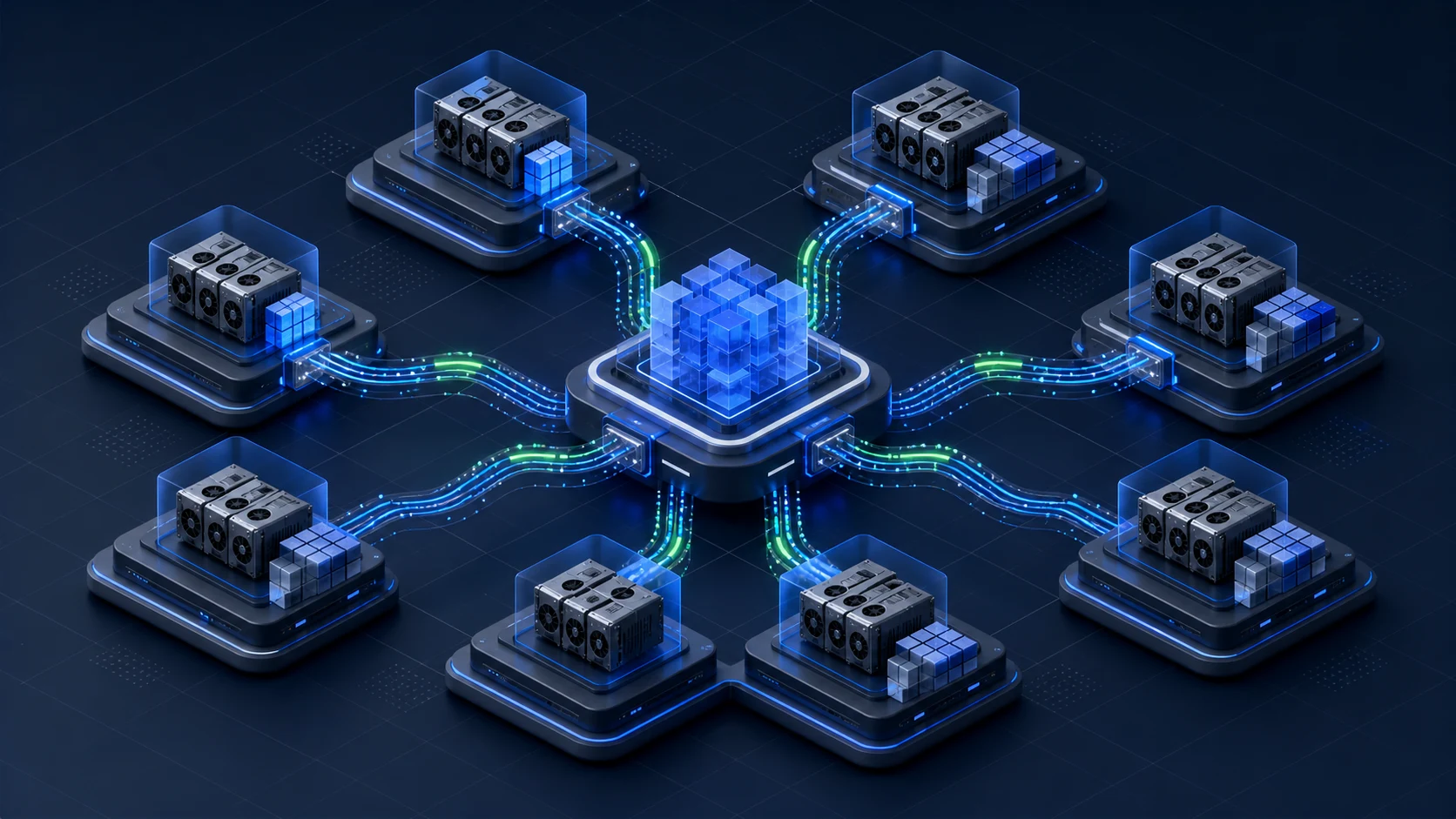
Training on one processor is simple: load a batch, run the forward and backward passes, update the model, and repeat. That approach becomes impractical when the model no longer fits on one accelerator, the dataset takes weeks to process, or a single machine cannot deliver the required throughput.
Distributed learning spreads the work across multiple processors, accelerators, or machines that cooperate on the same training objective. Each worker performs part of the computation, communicates with the others, and contributes to a shared model.
The idea sounds straightforward. The engineering is not. Adding more GPUs introduces communication, synchronization, data-loading, scheduling, and failure-handling costs. A successful distributed setup reduces time to train or makes a larger model possible without spending more on idle workers than it gains from parallelism.
Distributed learning, distributed training, and parallel experiments
The terms distributed learning and distributed training are often used interchangeably. Both normally describe one training job coordinated across multiple devices or machines.
That is different from running independent experiments in parallel. A hyperparameter search might launch 20 training jobs at once, but those jobs do not exchange gradients or build one shared model. Distributed training uses multiple workers inside the same job, and those workers communicate throughout the training process.
It is also different from federated learning. Federated learning trains across decentralized data owners while keeping raw data local, often for privacy or governance reasons. It is a specialized distributed approach with additional aggregation, security, and data-heterogeneity concerns.
| Approach | What runs in parallel | Do workers cooperate on one model? | Primary goal |
|---|---|---|---|
| Distributed training | Batches or parts of one model | Yes | Reduce training time or fit a larger workload |
| Parallel experiments | Independent training runs | No | Compare parameters, data, or model variants |
| Federated learning | Local training across data owners | Yes, through controlled aggregation | Learn without centralizing raw data |
Why distribute model training?
Teams usually adopt distributed training for one of four reasons.
Shorter training time
With data parallelism, more workers process more examples at the same time. If computation dominates communication and the input pipeline can keep up, this can substantially reduce the wall-clock time required for an epoch or a fixed number of training steps.
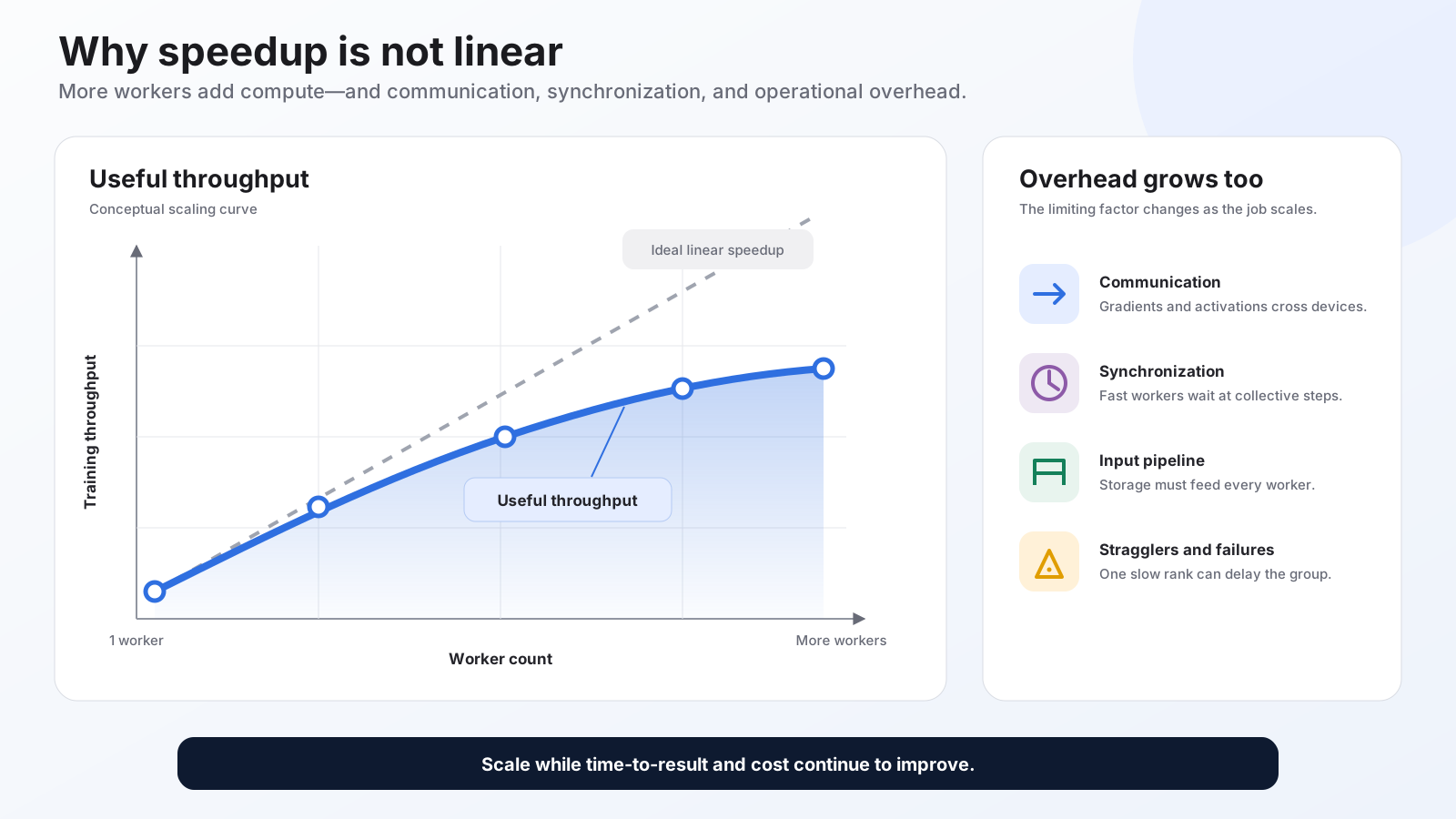
The speedup is rarely linear. Eight GPUs do not automatically train eight times faster than one GPU. Gradient synchronization, worker startup, network transfers, stragglers, and duplicated work all reduce scaling efficiency.
Models that exceed one device
Large neural networks can exceed the memory of a single GPU even with mixed precision and activation checkpointing. Model, tensor, pipeline, or sharded data-parallel strategies divide parameters, optimizer state, gradients, or activations across devices so the workload can fit.
Larger datasets and higher throughput
When data preprocessing or training over a large corpus becomes the bottleneck, multiple workers can consume separate shards concurrently. This is useful only when storage, networking, and data loaders can supply batches fast enough to keep the accelerators busy.
Better use of available infrastructure
Distributed training lets teams use multi-GPU nodes and cluster capacity for workloads that can benefit from them. The practical target should be useful throughput per dollar or per accelerator-hour, not the largest worker count a cluster can launch.
The main distributed training strategies
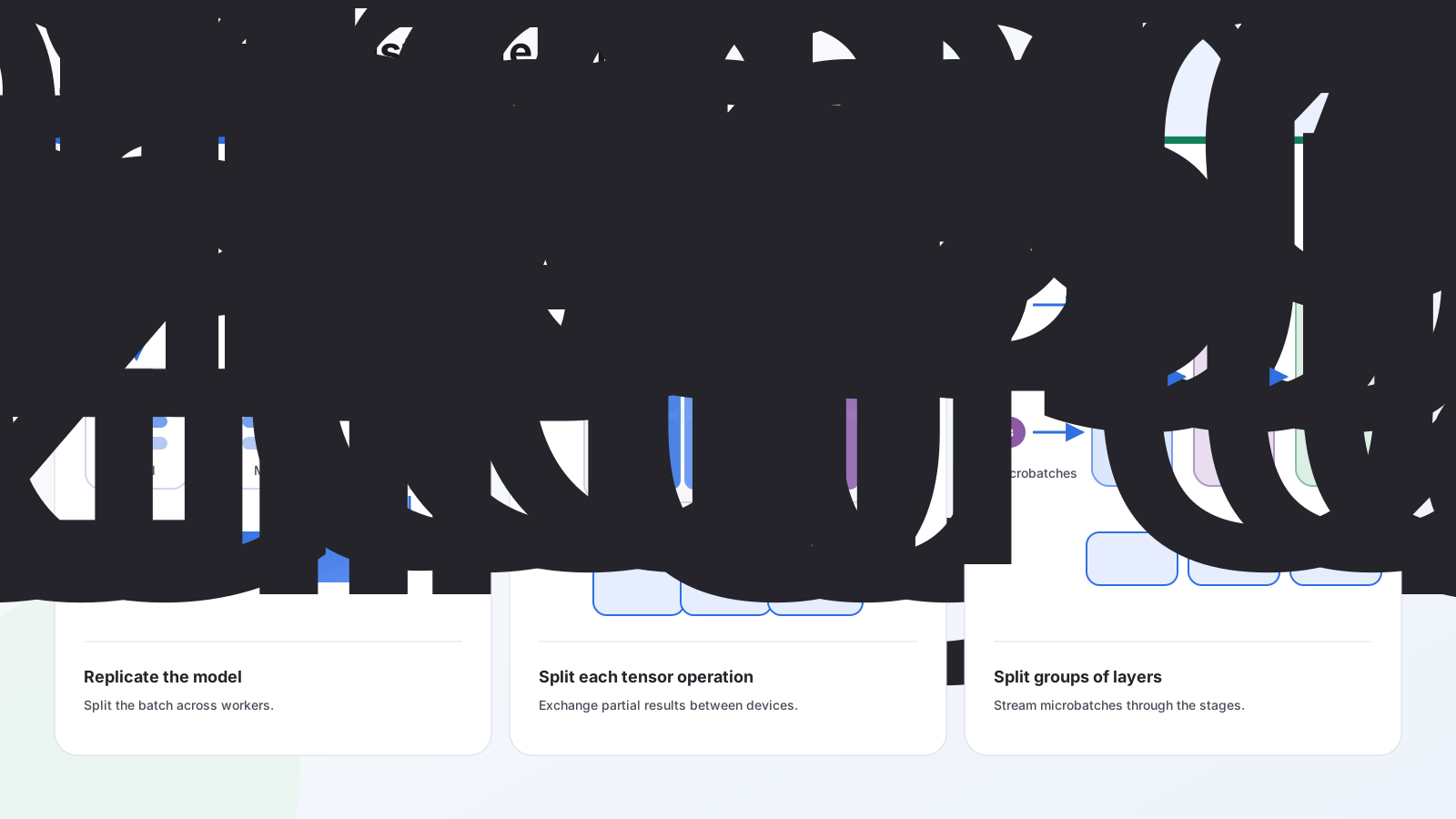
The best strategy depends on the limiting resource. Data parallelism addresses computation and throughput. Model parallelism addresses model memory and computation that cannot fit on one device. Modern large-model training often combines several strategies.
Data parallelism
Data parallelism copies the model to every worker and gives each worker a different subset of the batch. Each worker calculates gradients locally, then the workers aggregate those gradients before applying an equivalent model update.
A simplified synchronous step looks like this:
- Split the global batch across workers.
- Run a forward and backward pass on each worker.
- Aggregate gradients across workers, commonly with an all-reduce collective.
- Apply the update so every model replica remains consistent.
- Continue with the next batch.
This is the most common starting point because the model code often changes very little. PyTorch Distributed Data Parallel and TensorFlow's mirrored strategies are familiar implementations.
Data parallelism requires the full model, gradients, and usually optimizer state to fit on every worker. When that memory duplication becomes the limit, sharded data parallelism distributes some of those states across workers while preserving the data-parallel training pattern.
Model parallelism
Model parallelism divides the model itself across devices. It is useful when the parameters, activations, and optimizer state cannot fit in one device's memory.
There are two common forms:
- Tensor parallelism splits individual tensor operations across devices. Workers compute different slices of the same matrix operations and exchange partial results.
- Pipeline parallelism assigns groups of layers to different devices. Microbatches move through those stages like items through a pipeline.
Model parallelism makes memory capacity additive, but it also makes communication part of the forward and backward passes. Poor partitioning can leave devices waiting for other stages or transfer more data than they compute.
Hybrid parallelism
Large training jobs often combine strategies. A model might use tensor parallelism within a node, pipeline parallelism across groups of layers, and data parallelism across replicas of that partitioned model.
Hybrid parallelism can scale very large workloads, but every added dimension increases configuration and debugging complexity. Topology matters: communication that is inexpensive between GPUs in one server can be much slower across servers or availability zones.
Synchronous and asynchronous updates
Workers also need a strategy for sharing progress.
Synchronous training
In synchronous training, all workers contribute to the update for a step. Collective operations such as all-reduce combine gradients and return the result to every worker.
This keeps replicas aligned and makes the optimization behavior easier to reason about. Its main weakness is the straggler problem: one slow worker, input shard, or network link can delay every other worker at the synchronization barrier.
Asynchronous training
In asynchronous training, workers send updates independently, often through a parameter-server architecture. Fast workers continue without waiting for the slowest worker.
The tradeoff is stale information. A worker may calculate a gradient from parameters that have already been updated by others. Asynchronous methods can improve hardware utilization for uneven workers, but convergence and reproducibility become harder to control.
The choice is not simply about speed. It depends on model behavior, network topology, worker reliability, and how much inconsistency the optimization algorithm can tolerate.
Single-node and multi-node distribution
Distributed training can start inside one server. A multi-GPU machine avoids much of the operational complexity of a cluster and usually offers faster device-to-device communication. It is the best place to validate that the training code, batch partitioning, gradient synchronization, and checkpoint logic work correctly.
Multi-node training becomes necessary when one server does not have enough accelerators or memory. It adds several requirements:
- Workers must discover one another and agree on ranks and roles.
- The scheduler must place the right number and type of workers.
- The network must sustain collective communication without becoming the bottleneck.
- Every worker must access compatible code, dependencies, data, and credentials.
- The job needs a policy for partial failure, restart, and checkpoint recovery.
Moving from one GPU to many GPUs is a code and performance problem. Moving from one machine to many machines is also an orchestration problem.
When distributed training helps—and when it does not
Distribution is a good candidate when a single-device baseline is stable and one of these conditions holds:
- Training takes too long and the workload has enough computation to amortize synchronization.
- The model or its training state does not fit on one accelerator.
- The input pipeline can feed several workers without saturating storage or the network.
- Faster iteration has enough value to justify additional infrastructure cost and complexity.
It may not help when the model is small, epochs already finish quickly, preprocessing is serial, the dataset is read from slow storage, or workers spend most of their time exchanging gradients. In those cases, a faster single accelerator, larger batches, mixed precision, compiled kernels, better data loading, or profiling the current code may deliver more value.
Scaling should be measured, not assumed. Track examples or tokens processed per second, time to reach a target metric, accelerator utilization, communication time, and total cost. Throughput can improve while convergence slows, so the shortest epoch is not always the shortest path to a useful model.
The engineering challenges
Communication overhead
As worker count grows, gradient and activation transfers can dominate the step. High-bandwidth connections, topology-aware placement, efficient collective libraries, gradient compression, and overlapping communication with computation can improve scaling.
Global batch size and convergence
If every worker processes the same local batch size, adding workers increases the global batch size. That can change optimization behavior and may require learning-rate schedules, warmup, or other tuning. Comparing runs only by epoch time can hide a loss in sample efficiency or final model quality.
Data partitioning
Workers need non-overlapping, balanced input shards when the algorithm expects them. Uneven shards create stragglers; duplicated samples can bias metrics; inconsistent shuffling can hurt reproducibility. Data loading should be profiled separately from model computation.
Scheduling and placement
A distributed job often needs all of its workers at once. Starting only part of the group can waste reserved resources or cause the framework to wait indefinitely. Gang scheduling, queue policy, node affinity, accelerator topology, and per-role resource definitions become part of the training design.
Failure and checkpointing
The probability of a worker or node failure grows with the size and duration of the job. Checkpoints must include enough model, optimizer, scheduler, and progress state to resume safely. Teams should test recovery before committing an expensive multi-day run.
Observability and reproducibility
Logs from one chief process are not enough. Teams need worker status, per-rank logs, resource utilization, communication timing, data and code versions, world size, batch configuration, checkpoints, and model metrics attached to the same run.
A practical scaling workflow
1. Establish a single-device baseline
Confirm correctness and record throughput, memory use, utilization, convergence, and cost. A distributed run needs a trustworthy baseline for both quality and performance.
2. Remove local bottlenecks
Profile data loading, preprocessing, host-to-device transfers, kernels, and memory. Distribution amplifies bottlenecks; it does not remove them.
3. Scale within one node
Use data parallelism across the local accelerators and verify that batches are partitioned correctly, gradients synchronize, metrics aggregate, and checkpoints can be restored.
4. Choose a strategy for the actual constraint
Use replicated data parallelism for throughput when the model fits on each device. Add sharding or model parallelism when memory is the limit. Avoid a hybrid topology until a simpler strategy has reached a measurable boundary.
5. Scale gradually across nodes
Increase the worker count in stages and measure scaling efficiency at each step. Watch for network saturation, input bottlenecks, stragglers, and changes in convergence.
6. Make recovery and tracking part of the job
Set checkpoint intervals according to the cost of lost work. Preserve the runtime specification, code, data references, environment, metrics, logs, and artifacts so a run can be explained and repeated.
Distributed training on Kubernetes
Kubernetes provides the scheduling and isolation layer for multi-node workloads, but a distributed framework still needs coordinated worker roles, discovery, startup, and shutdown. Training operators encode those requirements in job-specific resources and controllers.
A typical operator creates the requested workers, injects the cluster configuration they need, watches the group as one job, and applies restart or cleanup policy. Depending on the runtime, the workload may define a chief and workers, a launcher and workers, or another set of framework-specific roles.
Kubernetes also gives platform teams a consistent way to express GPU resources, node selectors, tolerations, volumes, secrets, and network policy. The result is portable infrastructure configuration, but teams still need the training framework to implement gradient synchronization and model partitioning.
How Polyaxon supports distributed learning
Polyaxon packages a distributed workload as a tracked operation and delegates execution to Kubernetes-native training operators. It supports TFJob, PyTorchJob, and MPIJob runtimes, while cluster runtimes cover workloads built with Ray and Dask.
Each runtime can define its worker roles, replica counts, containers, resources, connections, and scheduling policy in a Polyaxonfile. Polyaxon then keeps the distributed job connected to the same project context as other experiments: status, logs from all replicas, parameters, metrics, artifacts, code and data references, and lineage.
That separation is useful. The training framework owns the mathematics and communication strategy. The operator owns the Kubernetes worker lifecycle. Polyaxon owns the reproducible run, scheduling context, metadata, and operational record around the job.
Start with the distributed training guide for a minimal example, then use the runtime references when you need role-specific resources, elastic policy, gang-scheduling options, or cleanup behavior.
Distributed learning is most valuable when it solves a measured constraint. Start with a correct baseline, choose the smallest parallel strategy that addresses the bottleneck, and scale only while time-to-result and cost continue to improve.