When CPU-accelerated AI inference makes sense
Evaluate CPU inference using model fit, precision, latency, throughput, memory, Kubernetes placement, and end-to-end cost instead of assuming every model needs a GPU.
GPUs are essential for many large-model and high-throughput workloads, but they are not the automatic answer to every inference problem. Modern CPUs include vector and matrix acceleration, are widely available, and can be operationally simpler for smaller models, bursty services, embeddings, reranking, computer vision, and conventional ML.
The right comparison is not CPU versus GPU in the abstract. It is the measured cost and reliability of meeting one workload's quality, latency, and throughput objective.
Identify CPU-friendly workloads
CPU inference is a strong candidate when the model fits comfortably in host memory, traffic is moderate or bursty, requests can be batched, cold-start simplicity matters, or a GPU would spend most of its time idle. It can also be useful at edge locations and in existing clusters where CPU capacity is easier to obtain.
Start with the workload shape:
- model architecture, parameter count, and memory footprint;
- supported numerical precision and quantization;
- input and output sizes;
- latency percentiles and throughput target;
- batch size and concurrency;
- warm-up and startup time;
- preprocessing and postprocessing cost.
Do not move a model to lower precision without reevaluating task quality. A fast result that crosses the application error threshold is not acceptable capacity.
Use hardware acceleration through the framework
Intel describes Advanced Matrix Extensions as tile registers and matrix-multiply instructions designed to accelerate supported deep-learning operations on recent Xeon processors. Other CPU architectures provide their own vector or matrix capabilities.
Application teams should normally consume these features through a supported inference runtime, compiler, or optimized framework build rather than maintaining hardware-specific intrinsics. Verify the framework version, operator coverage, model export path, precision, and container base image on the actual node generation.
Hardware support alone does not prove that the model uses it. Capture runtime logs or profiling evidence, and compare optimized and baseline builds under the same load.
Benchmark the complete request path
Measure warm and cold performance across representative request sizes. Report p50, p95, and p99 latency, useful throughput, error rate, memory, CPU time, power where available, and cost per accepted inference.
Include tokenization, image decoding, retrieval, serialization, networking, and response streaming. Accelerating matrix multiplication may not improve a pipeline dominated by data preparation or an external dependency.
Test concurrency until the service reaches its objective or begins queueing. More worker processes can improve throughput, but they also compete for caches, memory bandwidth, and cores. Record the saturation point rather than publishing a single best-case request.
Design Kubernetes placement deliberately
Label nodes by architecture and relevant CPU capability through a trusted node-discovery process. Use affinity or a platform workload class to place the optimized image only on compatible nodes. Keep a fallback image or placement path if the application must run on a broader fleet.
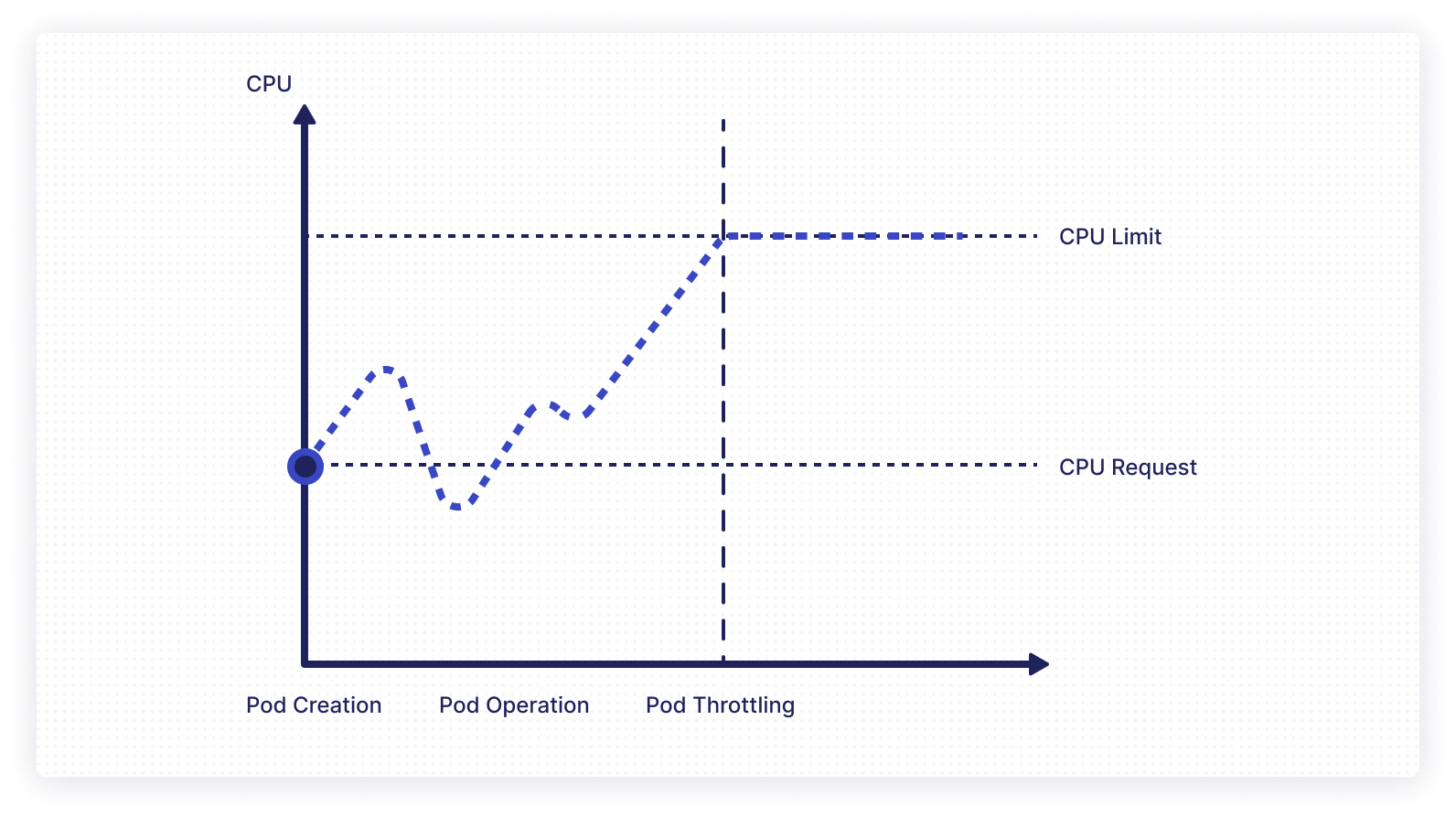
Set CPU and memory requests from measurements. CPU limits can introduce throttling that appears as tail-latency instability; validate any limit under sustained load. For latency-sensitive services, evaluate CPU Manager policies, topology, NUMA placement, huge pages, and memory bandwidth with the cluster team before exposing low-level settings to every developer.
Separate interactive services from batch inference when their scheduling goals differ. A Deployment may keep warm replicas for latency, while a queued Job can maximize throughput through larger batches.
Compare economics fairly
Compare the capacity required to meet the same service objective, not hourly instance price alone. Include replicas, idle headroom, licensing, storage, network, engineering effort, power, and the cost of unavailable capacity.
A GPU can be cheaper per inference at high utilization even when its hourly price is higher. A CPU can be cheaper for small or intermittent traffic because it scales in finer increments and shares familiar infrastructure. The crossover changes with model optimization, batch size, traffic, and hardware generation.
Use cost per accepted request, completed document, or successful task. Keep the benchmark inputs and pricing assumptions versioned.
Operate CPU inference like a product
Monitor latency, queue time, throughput, errors, memory, CPU utilization and throttling, model load time, worker restarts, and task quality. Record the node capability, runtime build, model revision, precision, and optimization configuration with every release.
Polyaxon experiments can compare model exports, runtimes, precision, batch size, and node classes under a reproducible load. Track the measurements and artifacts, then promote the configuration that satisfies the complete objective. Use presets to encode approved CPU placement and resource settings without copying hardware details into every component.
CPU acceleration expands the placement portfolio. Treat it as a measured workload option, not as a universal replacement for GPUs or a fallback chosen without evidence.