DataOps vs. MLOps: Differences and How They Work Together
DataOps delivers reliable data; MLOps delivers reliable ML systems. Compare their responsibilities, checks, and handoffs using a practical example.
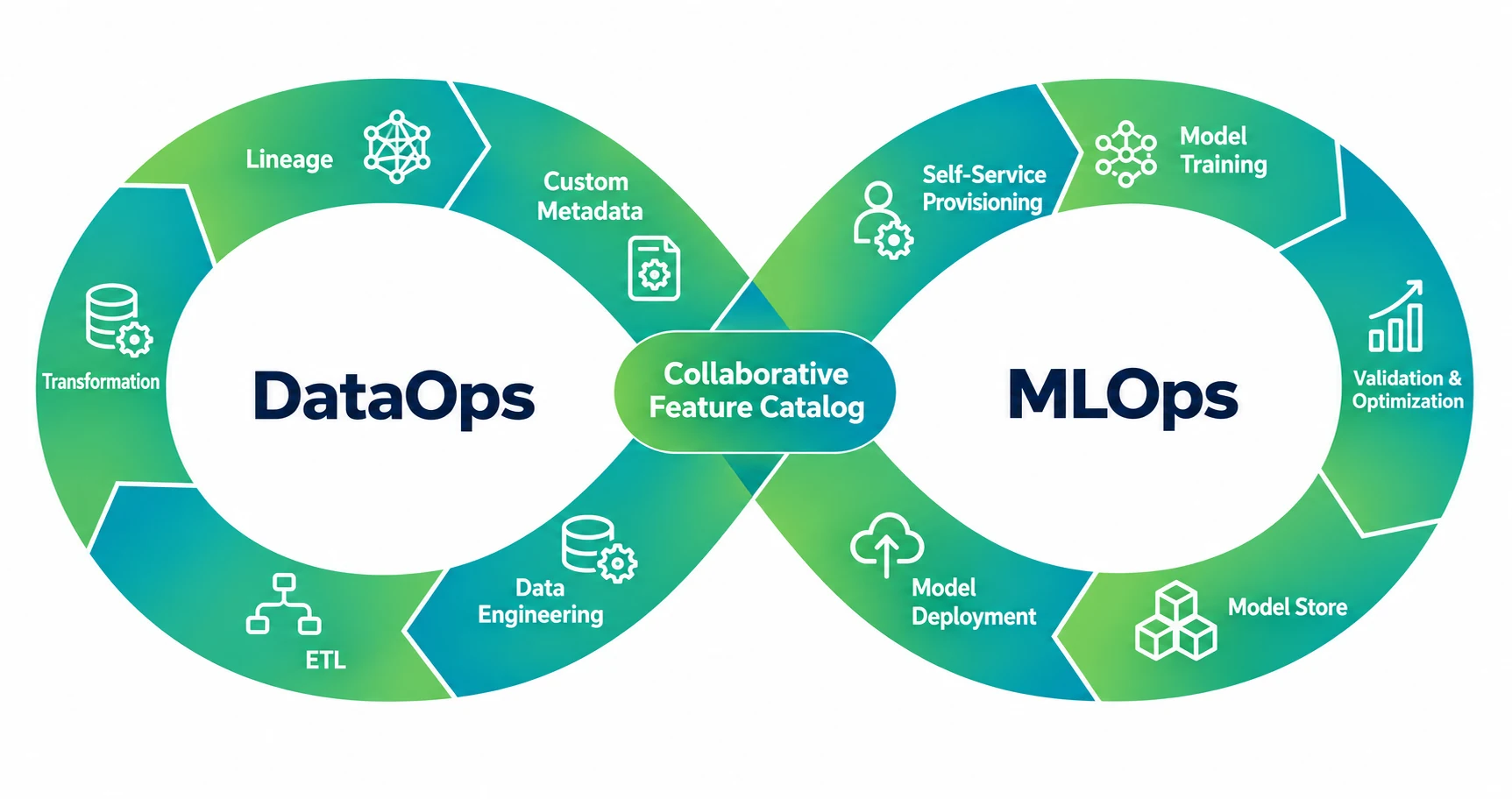
DataOps focuses on reliably delivering data and analytics. MLOps focuses on reliably developing and operating machine learning systems, including training, evaluation, deployment, and production monitoring. They overlap wherever changes to data affect model behavior.
For an ML team, the practical question is who guarantees the inputs, who decides whether a model candidate is acceptable, and how both teams investigate regressions. A ticket-classification workflow illustrates where those responsibilities meet.
What is MLOps
MLOps, or machine learning operations, connects model development to repeatable training, evaluation, release, and operation. Its scope includes the code, data, environment, and evidence behind a model, as well as the system serving its predictions.
For example, a team should be able to identify which dataset trained a deployed classifier, compare it with the previous model, and recover an earlier release when necessary. Google Cloud's MLOps guidance describes automation and monitoring across this lifecycle, including separate data and model validation.
What is DataOps
DataOps applies collaboration, automation, testing, and feedback to data and analytics delivery. It covers how data is collected, transformed, checked, versioned, and made available to consumers. Those consumers can include dashboards, analysts, applications, and machine learning pipelines.
The DataOps Manifesto emphasizes useful analytics, shared operational ownership, reproducibility, and continuous quality feedback. DataOps therefore has a role even in an organization that does not deploy ML models.
Difference between MLOps and DataOps
| Dimension | DataOps | MLOps |
|---|---|---|
| Main concern | Reliable data and analytics delivery | Reliable development and operation of ML systems |
| Typical outputs | Dataset versions, transformations, quality reports, and analytics | Tracked experiments, model packages, evaluation results, and release evidence |
| Example checks | Schema, freshness, completeness, and permitted access | Evaluation split integrity, predictive quality, and serving behavior |
| Example incident | A source change breaks a daily dataset | A model release performs poorly on a customer segment |
| Common contributors | Data engineers, analysts, data owners, and platform engineers | Data scientists, ML engineers, application owners, and platform engineers |
These are overlapping responsibilities, not fixed organizational boundaries. The same team may own both workflows. In an ML system, the distinction is between accepting data for a task and accepting a model for use; a successful data pipeline alone cannot make both decisions.
Where the workflows overlap
The two disciplines meet where a data change affects model behavior. A shared workflow needs several capabilities, with clear ownership for each:
Data integration and preparation capabilities
Data scientists need tools that allow them to easily integrate and prepare data for machine learning. This may include features such as data cleansing, data transformation, and data visualization.
Model training and evaluation tools
Data scientists need tools that allow them to easily train and evaluate machine learning models. This may include features such as hyperparameter tuning, model selection, and performance metrics.
Model deployment and management tools
Data scientists need tools that allow them to easily deploy and manage machine learning models in production environments. This may include features such as version control, model monitoring, and model updates.
Collaboration and communication tools
Data scientists need tools that allow them to easily collaborate and communicate with other members of their team, as well as with IT operations teams. This may include features such as shared notebooks, project management, and messaging.
Security and compliance features
Data scientists need tools that allow them to ensure that their data and models are secure and compliant with relevant regulations and standards. This may include features such as data encryption, access control, and audit logs.
Define the data-to-model handoff
The boundaries matter more than giving every capability to one platform. For a ticket classifier, define them like this:
| Handoff | Main responsibility | Evidence passed downstream |
|---|---|---|
| Source events to a usable dataset | Data ingestion, schema, freshness, and access | Retained snapshot, manifest, quality report, and owner |
| Dataset to a training candidate | Split design, preprocessing, and model fitting | Dataset identity, code, parameters, model, and validation results |
| Candidate to an approved release | Evaluation and deployment review | Baseline comparison, package identity, acceptance decision, and rollback target |
| Production behavior to the next investigation | Application, data, and model owners together | Failed cases, changed distributions, and the affected versions |
A new label taxonomy is a data change with model consequences. The data pipeline should report which labels changed and publish a new snapshot. Training and evaluation can then compare the new candidate with the baseline under an explicit evaluation contract. A schema check passing does not establish that the model still performs well.
In Polyaxon, DAG dependencies connect preparation, training, and evaluation operations, while artifact lineage connects their inputs and outputs. Your preparation and evaluation code supplies the actual data-quality and model-quality checks.
Keep data-centric AI focused on improving the data itself, and use the operational workflow to make those improvements repeatable and measurable.
Choose tools that fit the team's data sources, workload scale, and existing systems. The useful outcome is a handoff another team can understand and repeat: which data changed, which model used it, and which evidence supports the next release.
Where should you start?
Start with the failure that currently prevents a reliable handoff:
- If data arrives late, changes shape unexpectedly, or lacks a clear owner, strengthen ingestion, quality checks, and change notification.
- If model results cannot be reproduced, retain dataset identities, split definitions, code versions, parameters, and execution environments with each run.
- If model releases are risky, define evaluation criteria, a baseline comparison, a decision owner, and a rollback target.
- If your workload delivers analytics without an ML model, apply DataOps practices to that delivery process; model training and release controls become relevant when ML enters the workflow.
For a concrete check at the data-to-model boundary, follow the guide to preventing data leakage in evaluation datasets. To connect that evidence to experiments and model versions, continue with the MLOps and tracking learning path.