Offline vs. online evaluation for generative AI
Use offline evaluation for reproducible release decisions and online evaluation for real production behavior, then connect both in one feedback loop.
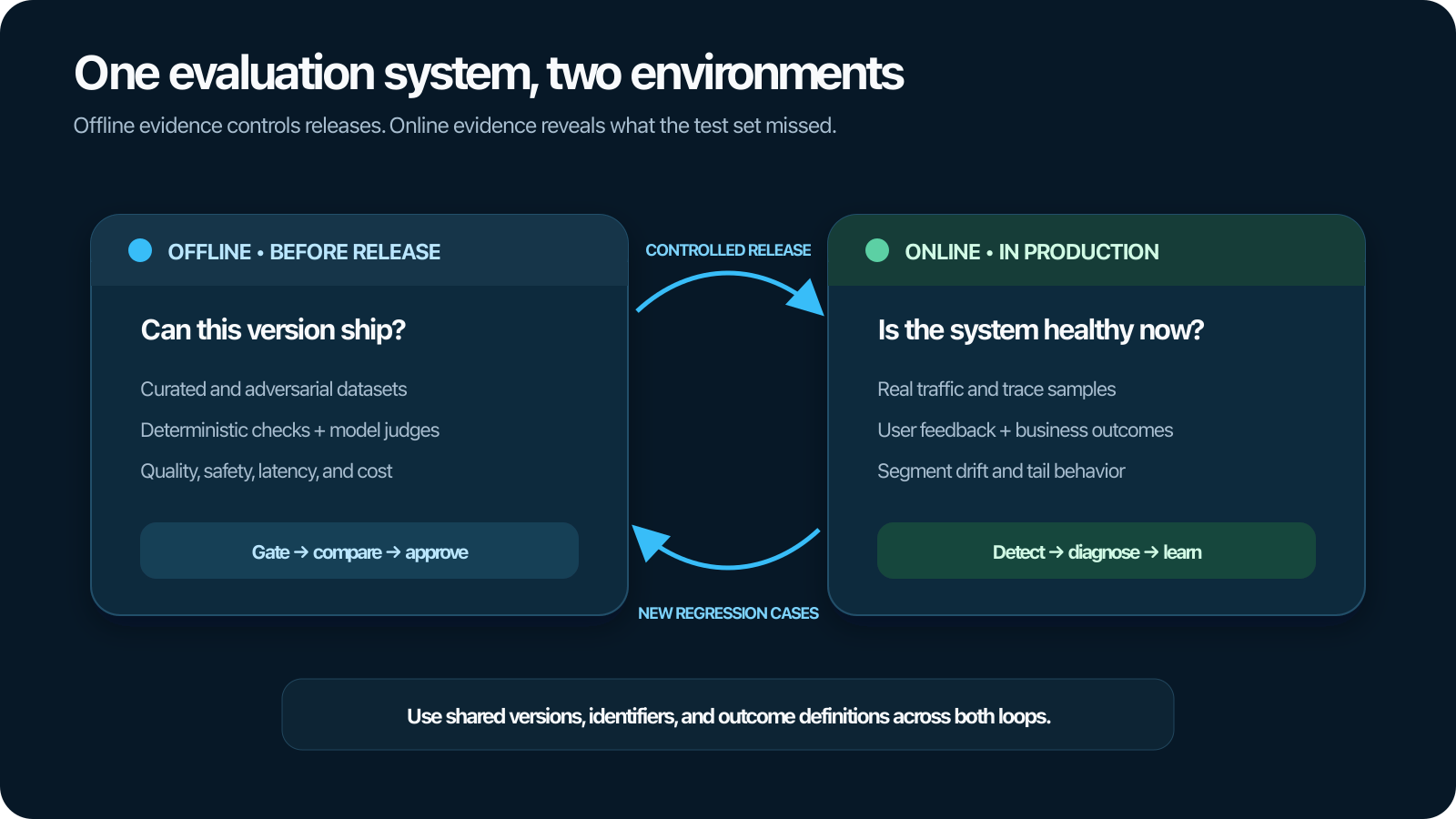
Offline evaluation tells a team how a candidate AI application performs on controlled, repeatable cases. Online evaluation tells the team how a released application behaves with real users, live context, changing tools, and production constraints.
Neither is sufficient alone. Offline evaluation supports safe comparison before release; online evaluation reveals the distribution and failures the test set did not anticipate. A mature evaluation practice connects them in a continuous loop.
What is offline evaluation?
Offline evaluation runs an application or model against a fixed, versioned dataset outside the live user path.
The dataset can contain user requests, source documents, initial environment state, expected outcomes, references, policy constraints, and evaluation rubrics. The team can run the same cases against different models, prompts, retrieval configurations, tools, or application versions.
Offline evaluation is best for:
- Comparing candidate changes under controlled conditions.
- Reproducing known failures.
- Running broad regression suites before release.
- Testing rare, adversarial, and safety-critical cases.
- Calibrating automated evaluators.
- Establishing release thresholds and guardrails.
- Estimating latency, tokens, and cost before production rollout.
Its main limitation is representativeness. A fixed dataset cannot automatically reflect new user behavior, changing external data, provider updates, tool failures, or emerging attacks.
What is online evaluation?
Online evaluation measures production interactions during or after live execution.
It can combine automated evaluators, operational metrics, trace analysis, explicit user ratings, implicit behavior, business outcomes, human review, and controlled experiments.
Online evaluation is best for:
- Detecting behavior under the real traffic distribution.
- Finding task types and edge cases missing from offline data.
- Monitoring quality, safety, latency, and cost after release.
- Comparing canary or experiment variants.
- Identifying provider, retrieval, tool, or data changes.
- Collecting evidence for the next regression dataset.
Its main limitation is control. Production signals can be delayed, noisy, confounded by changing traffic, and expensive or risky to collect. A live failure may already have affected a user.
Offline and online evaluation compared
| Dimension | Offline evaluation | Online evaluation |
|---|---|---|
| Traffic | Versioned test cases | Real production interactions |
| Repeatability | High | Lower because context and dependencies change |
| Safety | Can test risky cases in controlled environments | Must limit exposure and protect users |
| Coverage | Designed scenarios and known failures | Real distribution and emerging behavior |
| Labels | References, rubrics, simulations, expert review | Automated scores, feedback, outcomes, sampled review |
| Best decision | Whether and how to release | Whether the release is healthy and what to improve next |
| Main risk | Test set does not represent production | Signals are noisy, incomplete, or arrive after impact |
The two modes should use compatible task definitions, evaluator versions, and result schemas. That makes it possible to compare expected and observed behavior rather than maintaining two unrelated quality systems.
What belongs in an offline evaluation suite?
Representative core tasks
Cover the requests that create most user value and volume. Segment them by task, language, user type, permissions, source, and other meaningful dimensions.
Edge and failure cases
Include ambiguous requests, missing information, tool timeouts, conflicting context, long conversations, malformed inputs, and unanswerable questions.
Safety and policy cases
Test authorization boundaries, sensitive-data handling, prompt injection, prohibited actions, and required escalation. Critical policies should be hard release requirements.
Production regressions
Every confirmed production failure should be considered for the offline suite after sanitization and labeling. Preserve the trace context needed to reproduce the behavior.
Operating budgets
Measure end-to-end latency, model and tool calls, tokens, retries, and cost. A quality improvement that violates the product's performance or cost boundary is not automatically releasable.
What belongs in online evaluation?
Operational metrics
Track availability, errors, latency, throughput, tool failures, retries, token usage, and cost. Segment by release, model, prompt, agent, tool, and task.
Sampled model-based evaluation
Apply calibrated evaluators to a controlled sample of production traces. Sampling can prioritize new releases, high-risk tasks, evaluator uncertainty, unusual trajectories, high cost, or missing user feedback.
Do not send sensitive content to an evaluator without explicit data controls and provider approval.
User feedback
Explicit ratings and comments provide direct evidence but often have low response rates and selection bias. Capture the reason for negative feedback where possible.
Implicit signals—reformulation, abandonment, repeated tool attempts, escalation, correction, or task completion—can be more available but require careful interpretation.
Business and task outcomes
Connect the interaction with an observable result: resolution, accepted recommendation, completed form, correct system state, conversion, or human correction. These outcomes keep the evaluation aligned with user value.
Human review
Review high-risk cases, evaluator disagreements, novel patterns, and representative samples. Structured labels make the review usable for trend analysis and offline data creation.
Build one evaluation lifecycle
1. Define shared task and quality dimensions
Use consistent definitions for task success, groundedness, safety, tool correctness, latency, and cost across offline and online evaluation.
2. Establish the offline baseline
Run the current production version against the versioned suite. This creates a reference for candidate comparison and exposes weaknesses in the dataset or evaluators.
3. Evaluate the candidate change
Compare by dimension and segment, not only by an aggregate score. Apply hard safety requirements and agreed regression budgets.
4. Release gradually
Use shadow evaluation, canary traffic, feature flags, or an experiment when the risk warrants it. Record exactly which users, sessions, and application versions received the change.
5. Monitor online evidence
Compare the candidate with the baseline using quality, task outcome, reliability, latency, and cost. Watch segments where the offline suite had limited coverage.
6. Investigate with traces
When a metric or evaluator changes, inspect representative AI agent traces or application traces to attribute the behavior to retrieval, model, prompt, tool, state, or infrastructure.
7. Promote production evidence
Convert confirmed failures, new task types, and evaluator disagreements into labeled offline cases. Record the source and preserve privacy.
8. Reassess evaluators and thresholds
Production review may reveal that an evaluator is too permissive, a threshold is poorly calibrated, or a metric does not predict user outcomes. Update it as a versioned dependency and rerun the baseline.
Example: releasing a new support-agent prompt
Before release, the team evaluates the prompt on a dataset covering product questions, refunds, account permissions, missing information, policy boundaries, and known regressions.
The candidate must:
- Meet or improve task success by task category.
- Pass every authorization and sensitive-data check.
- Avoid a material regression in groundedness or escalation behavior.
- Stay within latency and cost budgets.
The team releases the candidate to a small traffic segment. Online evaluation compares resolution rate, escalation, tool correctness, user reformulation, model-based quality scores, latency, and cost with the baseline.
A spike in reformulations appears only for subscription questions. Trace review shows that the new prompt calls retrieval with a shortened query that removes the plan name. The team adds representative traces to the offline dataset, fixes the query-building instruction, and reruns the release gate.
The online signal discovered the gap; the offline suite made the fix reproducible.
Handle distribution shift explicitly
Compare the offline dataset with production traffic by task, language, input length, retrieval source, tool, user segment, and risk class. Track the share of production interactions that do not map confidently to an existing category.
Coverage does not require storing every production prompt. Privacy-preserving categories, embeddings, hashes, or sampled and redacted examples can reveal shifts without retaining unrestricted content.
When production changes, update the dataset intentionally. Keep historical versions so the team can distinguish improved coverage from changed application quality.
Use online evaluation without blocking users unnecessarily
Some online checks can run synchronously, but many should be asynchronous.
Synchronous checks are appropriate for deterministic safety, authorization, schema, and policy constraints that must block an action. Expensive semantic evaluators can add latency and may be better after the response, on sampled traffic, or before high-impact actions only.
Define what each online result does:
- Block or modify the current action.
- Trigger a retry or fallback.
- Route the task to a human.
- Create an alert or review item.
- Update a quality dashboard.
- Add a candidate regression case.
An evaluator without an operational response is only a report.
Common evaluation-program mistakes
Treating offline scores as production guarantees
Offline results are conditional on the dataset, environment, and evaluator. Use controlled rollout and online evidence.
Monitoring only aggregate online quality
A stable average can hide a serious regression in one language, tool, or policy-sensitive task. Segment the data.
Sending every trace to an expensive judge
Use risk-based sampling, smaller calibrated evaluators, deterministic filters, and human review queues. Measure evaluation cost separately from application cost.
Allowing online and offline definitions to diverge
If groundedness or task success means something different in each system, comparisons become misleading. Share definitions and versioned evaluators.
Collecting production content without controls
Define redaction, consent, access, retention, sampling, and data residency before storing prompts, retrieved context, tool arguments, or outputs.
Failing to close the loop
Production dashboards do not improve an offline suite automatically. Assign ownership for reviewing evidence, labeling cases, and updating release gates.
Polyaxon and the evaluation lifecycle roadmap
Polyaxon's tracking and orchestration capabilities provide a foundation for versioning datasets, configurations, runs, metrics, and evaluation workflows. Experiment tracking helps connect a comparison with the exact application inputs and artifacts.
Full offline and online evaluation for generative AI applications is an active area on the Polyaxon roadmap, alongside OpenTelemetry-compatible observability, an AI gateway, prompt management, and agent sandboxing.
The direction is a shared lifecycle in which a production trace can become a versioned evaluation case, a candidate fix can be tested against it, and the released outcome can be measured with the same quality definitions.
Use both sides of the loop
Offline evaluation creates controlled evidence for a release decision. Online evaluation tests that decision against reality. Production evidence then improves the next offline suite.
Connect the two with shared task definitions, evaluator lineage, application versions, and traces. Then turn production traces into regression tests so the feedback loop becomes more durable than treating a benchmark or production dashboard as a final verdict.