Prepare an AI platform for next-generation GPUs
Make AI platforms ready for new accelerator generations through portable workload contracts, device-aware scheduling, topology, storage, compatibility, and migration evidence.
New accelerator generations promise more compute, memory, bandwidth, and efficiency. They also introduce driver, image, topology, networking, cooling, scheduling, and software compatibility work. A platform that exposes a specific GPU model directly in every workload turns each hardware refresh into an application migration.
Readiness comes from stable workload contracts and a tested process for introducing a new device class.
Describe capabilities instead of SKUs
Ask workloads for the capabilities they require: minimum device memory, supported precision, interconnect, partitioning mode, local storage, network class, and reliability level. Map those requirements to available hardware through centrally managed workload classes.
Keep exact SKUs available for experiments that truly depend on them, but make the normal interface portable. A large-memory-training or cost-optimized-inference class can move to a new generation after validation without editing hundreds of components.
Record the resolved node pool, device model, partition, driver, firmware, runtime, and image with the operation. Abstraction should simplify submission without hiding what actually ran.
Modernize device discovery and allocation
Kubernetes Dynamic Resource Allocation lets drivers publish device attributes and platform teams define DeviceClasses that workloads claim. It supports more expressive filtering and configuration than a simple integer extended resource when compatible drivers are available.
Adopt DRA according to the Kubernetes and vendor versions the platform supports. Restrict DeviceClass and ResourceSlice administration, monitor driver health, and understand current limitations such as preemption behavior. A mixed cluster may use DRA for some devices and conventional device plugins for others during migration.
Whichever allocation path is used, detect the difference between installed capacity, allocatable devices, requested devices, active devices, and devices producing useful work.
Plan topology as part of the resource
Accelerators depend on host memory, CPU, PCIe, high-speed fabric, local disks, power, and cooling. Distributed training also depends on the topology between nodes. Counting GPUs without these dependencies creates nominal capacity that cannot deliver expected performance.
Define topology-aware pools and placement rules. Benchmark collective communication, input throughput, checkpoint writes, and failure recovery at the target scale. Keep a small single-device benchmark for functional compatibility and a representative multi-node benchmark for platform acceptance.
Separate workloads that require tightly coupled devices from embarrassingly parallel batch inference so the latter does not fragment scarce training capacity.
Validate the complete software matrix
Test the node operating system, kernel, firmware, driver, container runtime, device plugin or DRA driver, collective libraries, framework, compiler, and model code as one release matrix. Pin supported combinations rather than allowing each workload to assemble them independently.
Build new base images, scan them, run functional tests, and benchmark representative models. Verify checkpoint compatibility and numerical behavior, not only container startup. Precision or kernel changes can alter output quality even when performance improves.
Roll drivers and node images through a canary pool. Preserve the earlier class until workloads meet acceptance criteria and rollback has been exercised.
Protect data and storage throughput
Faster compute exposes slow input pipelines. Measure dataset staging, remote reads, cache hit rate, decompression, local scratch, checkpoint duration, and artifact upload. Place frequently reused immutable data close to the workload while retaining a durable source of truth.
Budget host memory and ephemeral storage alongside accelerator memory. Monitor pressure and cleanup so a fast device does not sit idle behind a full disk or starved data loader.
For multi-environment platforms, include transfer time in placement decisions. Available accelerators are not useful if policy or data gravity makes the destination ineligible.
Introduce capacity through queues
Do not expose a new pool as unbounded first-come capacity. Use queues, priority, quotas, concurrency, and maximum duration. Define which teams and workloads may use the class during evaluation, then expand access from evidence.
Track queue delay, scheduling failures, allocation time, device health, utilization, memory, throughput, energy where available, job completion, and cost per accepted result. Compare the new class with the previous baseline at the workflow level.
Make migration reversible
Choose pilot workloads with reproducible inputs and clear success criteria. Run shadow or comparative experiments, validate artifacts, document changes, and keep the previous destination available until the new pool proves stable under real scheduling and failure conditions.
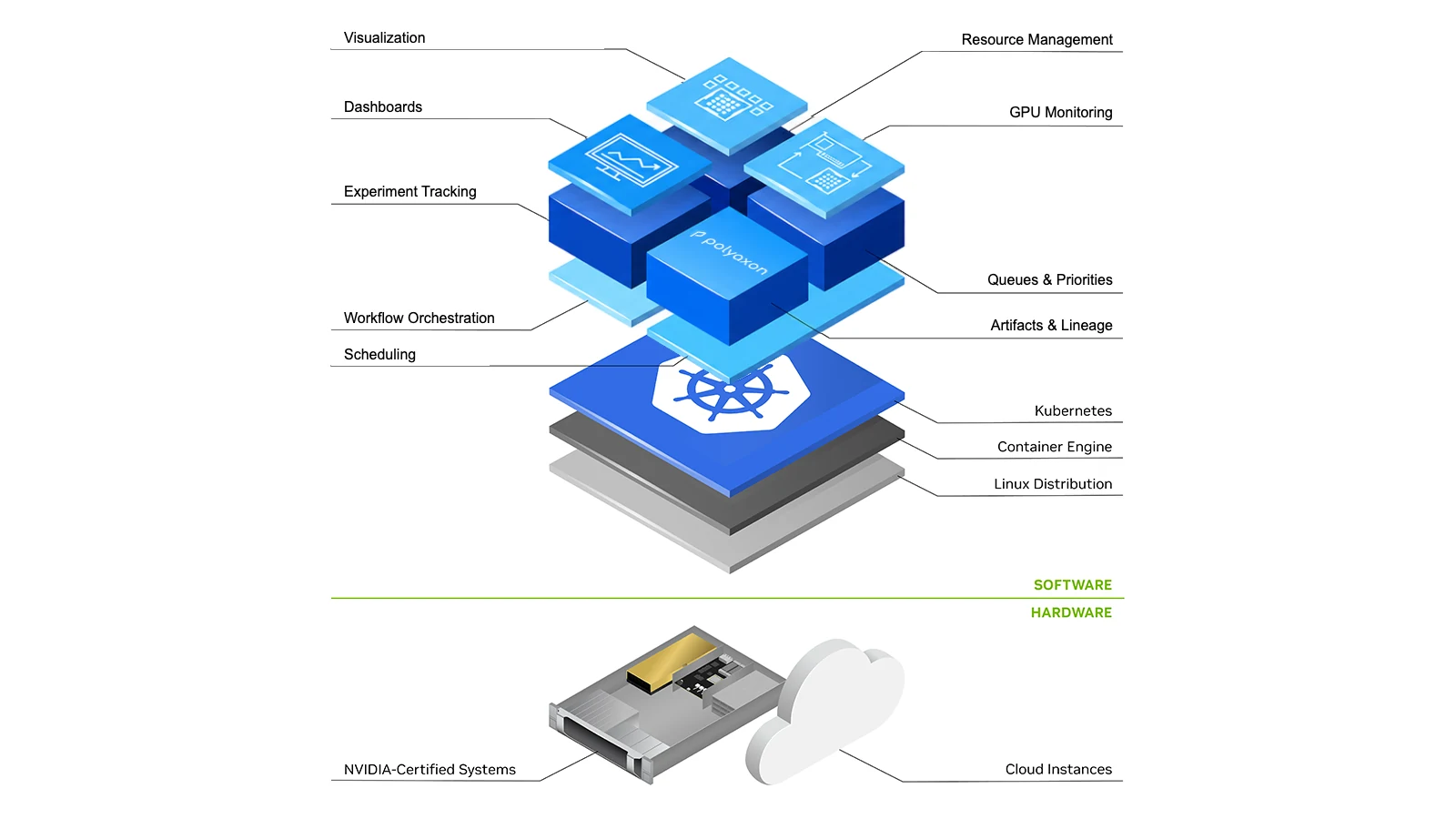
Polyaxon components can keep the application contract stable while presets encode approved images, node selection, tolerations, and resources. Commercial queues can control priority, concurrency, and routing across accelerator pools. Tracking connects each benchmark and production run to the resolved hardware and software matrix.
Next-generation GPU readiness is an operating capability: introduce hardware behind a portable contract, validate the full stack, observe useful outcomes, and retain a safe path back.