Remove the bottlenecks blocking AI platform delivery
Diagnose AI platform bottlenecks across ownership, integration, delivery, infrastructure, feedback, and skills, then improve the highest-leverage constraint first.
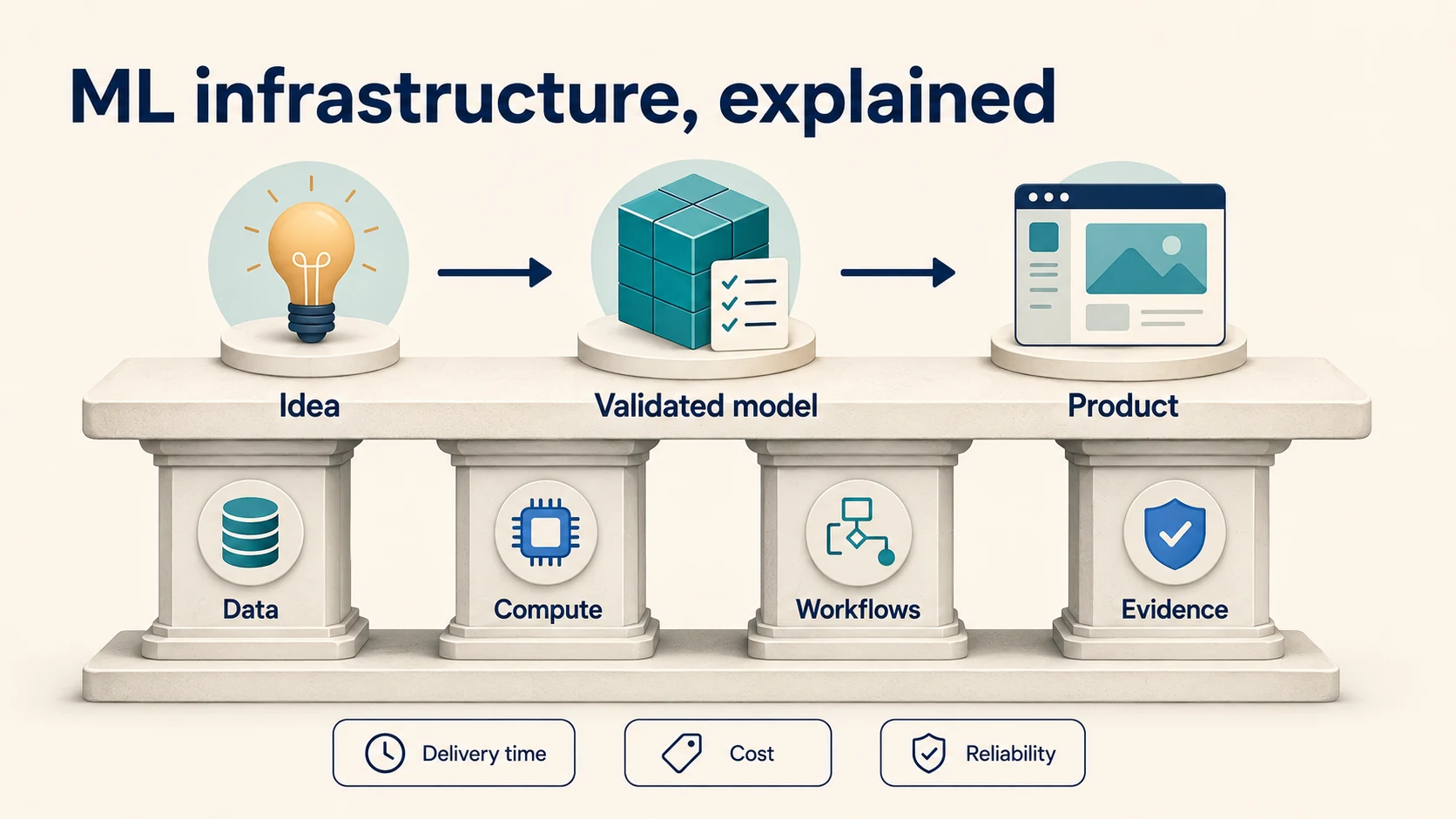
AI delivery often slows after the first successful experiments. Data scientists can train a model, application teams can build an integration, and infrastructure teams can provide compute, yet the complete path remains fragile and manual.
The bottleneck is rarely one missing tool. It is usually an unclear transition between teams, artifacts, environments, or operating responsibilities. Map the delivery flow and improve the constraint that most limits reliable outcomes.
Measure the path from idea to operation
Choose several representative systems and reconstruct their timeline: access request, first reproducible run, evaluation, security review, infrastructure allocation, deployment, production acceptance, and first incident or rollback.
For each transition, capture waiting time, active work, repeated work, owner, required evidence, and common failure. Separate research iteration from platform delay. A week spent improving model quality is different from a week waiting for an undocumented GPU request.
Track time to reproducible result and time to accepted production outcome. Counting deployed models can reward releases that nobody can operate.
Fix ownership gaps
Model, application, data, platform, and security teams often own their individual layers while nobody owns the complete service. Assign a product owner, technical owner, and recovery owner for every production AI system.
Define decisions at the boundaries:
- Who approves data purpose and access?
- Who owns task quality and failure thresholds?
- Who packages and promotes the model?
- Who controls workload identity and infrastructure?
- Who responds when quality, cost, or latency degrades?
- Who can stop the system and restore an approved release?
Keep the answers with the service record. The first incident should exercise an existing responsibility map, not create one.
Standardize integration contracts
Models depend on feature or retrieval data, prompts, tools, model APIs, storage, and application schemas. Document inputs, outputs, versions, identity, deadlines, retries, and failure behavior for each dependency.
Prefer a small set of supported interfaces over one custom connector per project. Use logical connections for storage and services, model aliases for eligible inference targets, and typed artifacts between pipeline steps.
Adopt emerging protocols only when they solve a defined boundary. Preserve ownership, authorization, observability, and version negotiation rather than assuming a standard transport makes an integration safe.
Adapt delivery to model and data changes
Traditional CI/CD usually starts with code. AI behavior can change through data, model, prompt, retrieval index, tool, policy, or serving runtime. Make each dependency versionable and declare which changes trigger evaluation or approval.
Build a repeatable pipeline for data validation, training or packaging, task evaluation, security scanning, performance checks, promotion, rollout, and rollback. Retain the candidate, evidence, policy decision, and resolved environment.
Do not retrain or deploy automatically merely because new data arrived. Define freshness requirements, drift signals, minimum evaluation, and safe promotion rules.
Equalize infrastructure through workload classes
Teams lose time when every cluster, cloud, or edge location exposes different node labels, accelerator names, storage paths, and credentials. Publish capability-based workload classes and an environment contract describing available compute, data, policy, quota, and service levels.
Separate hard eligibility from placement preferences. Data residency, model license, hardware capability, and required connections come before queue time or cost.
Use templates and infrastructure as code behind the platform interface. Developers should not need to understand every low-level field, while operators must still see the effective configuration.
Close the feedback loop
Connect production outcomes to the exact data, model, code, prompt, tool, policy, and infrastructure release. Monitor task success, critical slices, drift, latency, queueing, cost, and user feedback alongside container and cluster health.
Create a triage path that routes model behavior, data quality, application errors, scheduling failures, and platform outages to the right owner. A single dashboard is less important than consistent identifiers and responsibility.
Use incidents, support requests, policy failures, and exceptions as platform product input. Repeated manual work reveals the next automation opportunity.
Build skills through the platform
Teams need shared operational fluency, not identical expertise. Let data scientists learn reproducible packaging and evaluation, application engineers learn AI failure modes, and platform teams learn workload and accelerator behavior.
Provide safe sandboxes, reference components, example pipelines, office hours, and concise runbooks. Training is most effective when it uses the same golden path teams will operate in production.
Avoid making the central platform team the permanent operator of every application. Self-service should transfer routine ownership with guardrails and an escalation path.
Improve one constraint at a time
Rank bottlenecks by delivery delay, incident impact, frequency, and number of teams affected. Fix the highest-leverage constraint, publish the new contract, and measure the flow again.
Polyaxon can reduce handoffs by connecting reusable components, pipelines, experiments, evaluations, artifacts, connections, and Kubernetes execution in one tracked workflow. Platform teams encode supported infrastructure and governance while workload teams retain ownership of model and application outcomes.
AI-native maturity is not the number of tools or accelerators deployed. It is the ability to turn a change in data, code, or model into a reproducible, governed, observable outcome without heroic coordination.