Build an ML knowledge repository your team can reuse
Connect experiment records, dataset versions, model artifacts, and review decisions into a reusable ML knowledge repository with Polyaxon.
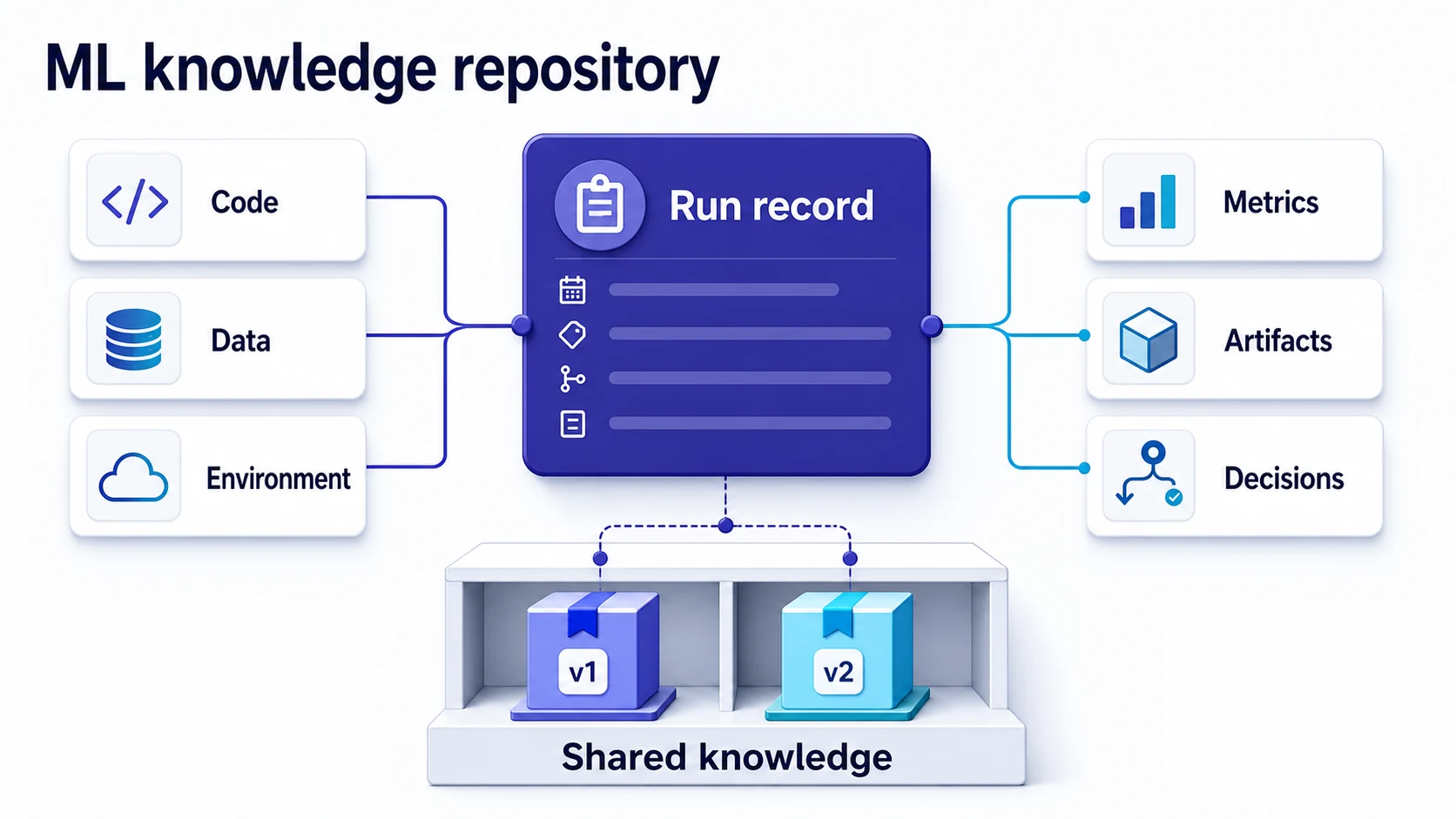
An ML knowledge repository connects the evidence behind an experiment to the decisions a team makes with it. It should let a colleague answer three questions without contacting the original author: what ran, what did we learn, and which outputs can we reuse?
Consider a demand-forecasting team revisiting a model before a seasonal launch. A saved model file tells them what to load. A training score gives them one result. Neither explains whether the evaluation included the relevant season, which stores were excluded, or why a previous candidate was rejected. Those details determine whether the old work is useful now.
The metadata store supplies the recordkeeping foundation. Building a useful knowledge repository also requires a shared structure for evidence, interpretation, and ownership.
Make a run the starting point
Give each execution a stable identity and attach its actual inputs and outputs. Avoid using a notebook filename or a mutable storage path as the sole identifier.
| Record | Preserve | Question it answers |
|---|---|---|
| Code and environment | Source revision, container digest, dependency lockfile | Which implementation produced this result? |
| Data | Snapshot or object versions, split definition, preprocessing revision | Which examples did the model see? |
| Configuration | Parameters, seeds, resource requests, relevant runtime settings | How was the experiment configured? |
| Evidence | Metrics, per-case predictions, evaluation reports, logs | What happened, including failures? |
| Outputs | Artifact locations, checksums, model and tokenizer versions | Which bytes are available to reuse? |
| Decision | Reviewer, comparison baseline, limitations, disposition | Why did the team accept or reject it? |
Store references to large datasets where appropriate. Copying a dataset into every experiment record can increase storage costs without improving its identity. The referenced snapshot must remain available under a retention policy the team understands.
In Polyaxon, run lineage connects input and output artifacts and related executions. Use that relationship to navigate from a training run to its preparation step and downstream evaluation. Capture application-specific context explicitly through metadata logging; a platform cannot infer an undocumented exclusion rule from a dataset name.
Preserve decisions alongside measurements
Use a short review document attached to the relevant run. For the forecasting example, it might contain:
Question: Does the new feature set improve forecasts for new stores?
Baseline: Link to the currently approved model version
Evaluation: Link to the frozen dataset and evaluation run
Finding: Better aggregate error, but worse error for recently opened stores
Decision: Retain the baseline and investigate the new-store cohort
Owner: Forecasting team
Follow-up: Repeat the comparison after correcting the cohort definition
This is an illustrative decision record, not a benchmark result. Its purpose is to preserve reasoning that a scalar metric cannot express.
Keep the record close to the evidence and link any follow-up execution back to it. A long project document containing screenshots of several unrelated runs is harder to maintain than a brief explanation attached to each decision.
Give reusable outputs a versioned interface
A successful experiment is not automatically a reusable package. A colleague also needs the loading procedure, expected inputs, preprocessing dependencies, and limitations.
Use artifact versions for reusable datasets or other assets, and model versions to associate model packages with their originating runs. A model handoff should identify its weights, tokenizer or feature transformation, environment, and evaluation evidence together.
Version labels help people communicate; content digests help identify exact bytes. Keep both when a downstream deployment must match a reviewed artifact. If a version can be overwritten, establish a policy against overwriting approved releases. A familiar name alone does not establish immutability.
Use the component hub to share the executable procedure separately from its results. This lets another team repeat the same preparation or evaluation step with different inputs while retaining the original run as evidence.
Make search reflect how the team works
Choose a small set of consistent fields: task, dataset revision, model family, evaluation suite, owner, and review status. Decide which belong in typed inputs, outputs, or tags, and keep their meaning stable across projects.
A useful search might identify all completed candidates evaluated on the same dataset revision. The team can then compare runs using compatible metrics. Comparing two fields both named accuracy is misleading if one covers every store and the other excludes new stores.
Document metric definitions with their units, population, and aggregation rule. Preserve failed and rejected experiments when they explain a decision or prevent repeated work; they often contain the most useful operational knowledge.
Check whether another person can reproduce the result
Ask someone outside the original experiment to locate an approved model, trace its inputs, retrieve its package, and repeat its evaluation. Record missing permissions, expired objects, undocumented setup, and incompatible dependencies as concrete gaps.
Define what reproduction means for the task: identical outputs, metrics within a stated tolerance, or the same conclusion about a candidate. Recording a seed and container does not by itself guarantee identical numerical behavior across hardware and software environments.
Start with one important model family and repair the gaps exposed by this exercise. The model registry learning path connects artifact organization, lineage, and promotion; the repository becomes useful when those records support an actual handoff.