GPU cluster scheduling tools compared
Compare Kueue, KAI Scheduler, Volcano, Coscheduling, and Slurm Bridge by responsibility, workload fit, and Polyaxon integration path.
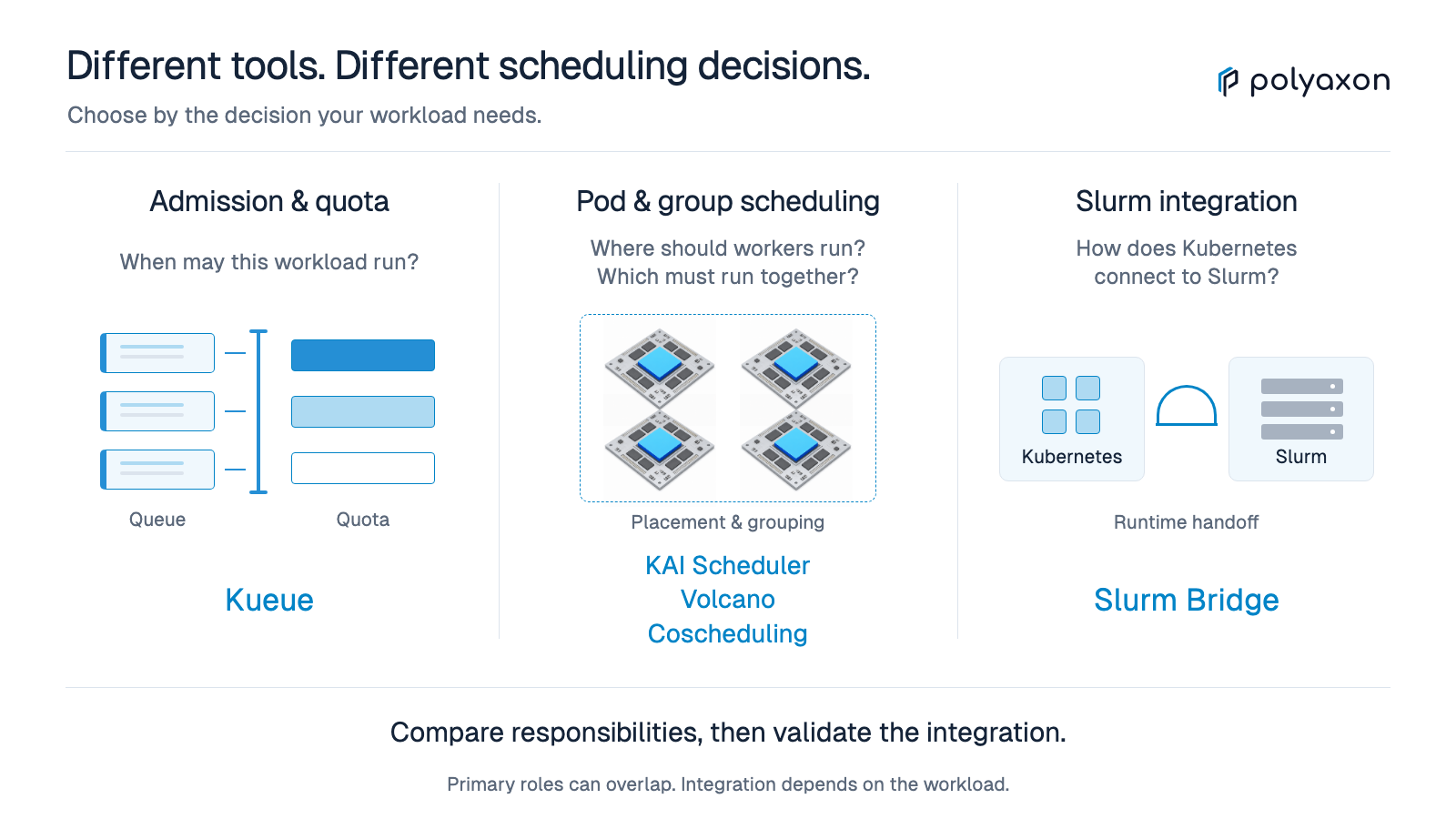
Choosing a GPU scheduler starts with a more specific question: which decision is your current platform failing to make?
If teams cannot share quota, you need admission and allocation policy. If distributed workers hold GPUs while waiting for peers, you need coordinated scheduling. If jobs fit numerically but run slowly, topology or application behavior may be the problem. These are related requirements, but they are not interchangeable.
This comparison covers five options relevant to Kubernetes-based ML infrastructure: Kueue, KAI Scheduler, Volcano, the scheduler-plugins Coscheduling plugin, and Slurm Bridge. It separates upstream capabilities from the configuration paths currently available through Polyaxon.
Compare responsibilities before features
| Tool | Primary role | Useful starting point when... | Main integration question |
|---|---|---|---|
| Kueue | Workload admission and quota management | Jobs need queue-based access to shared capacity | Does Kueue manage the exact object your platform emits? |
| KAI Scheduler | Kubernetes scheduling for AI workloads | You need GPU-oriented placement, grouping, and resource-sharing policy | Do pods select KAI and receive the required queue and grouping metadata? |
| Volcano | Batch scheduling and workload-management ecosystem | Distributed or batch jobs need gang and queue-aware scheduling | Which job controller and scheduling policy are installed together? |
| Coscheduling | Group scheduling through scheduler plugins | You need related pods to meet a minimum group size before scheduling proceeds | Who creates the PodGroup and labels its member pods? |
| Slurm Bridge | Integration between Kubernetes workloads and Slurm scheduling | An existing Slurm environment must participate in the execution model | Does the bridge receive the grouping and runtime policy it requires? |
The table describes roles, not a benchmark ranking. Evaluate supported versions, operational ownership, and real workload behavior before choosing a combination.
Kueue: control admission and quota
Kueue decides when supported workloads wait, receive admission, or are preempted according to quota and policy. It leaves pod-to-node placement to the Kubernetes scheduling layer. Its overview describes this separation of responsibilities.
ClusterQueues represent quota and admission policy; namespace-scoped LocalQueues provide submission entry points. Kueue is a candidate when the immediate problem is controlled access to shared resources rather than replacing pod placement.
Do not assume admission alone proves that all workers will become ready. Check scheduling constraints, device availability, and startup failures. Kueue also has its own topology-aware scheduling capabilities, so it is inaccurate to say topology always requires adding another scheduler.
KAI Scheduler: select an AI-oriented scheduler
KAI provides Kubernetes scheduling capabilities including batch grouping, hierarchical queues, fairness policies, and GPU sharing. The exact behavior depends on its configuration and installed components. The KAI project documentation is the source of truth for release-specific features.
Polyaxon's scheduler-selection configuration is straightforward:
# Environment fragment for an existing Polyaxon component or preset.
environment:
  schedulerName: kai-scheduler
This selects an installed scheduler; it does not install KAI, create a queue, or establish every grouping rule. Confirm the emitted pod's spec.schedulerName, queue metadata, and owner relationships. Kubeflow's KAI integration guide also identifies the scheduler, queue, and PodGrouper prerequisites for its runtime integration.
Volcano: coordinate batch workloads and resource policy
Volcano brings gang scheduling, queue-based resource policies, and placement options to batch workloads. Its documentation describes a broader ecosystem than a single placement algorithm.
The important compatibility unit is the workload controller plus the scheduler. A controller must communicate the job's group membership and requirements in a form that the scheduler consumes.
For existing Polyaxon Kubeflow runtimes, schedulingPolicy offers a partial path to queue and gang-related configuration. That is not the same as generic runtime PodGroupPolicy support.
Also avoid assuming that adopting another scheduler requires moving every pod in the cluster to it. Kubernetes supports multiple schedulers, selected by workload configuration. The deployment design and controller compatibility still need validation.
Coscheduling: make the group explicit
The scheduler-plugins Coscheduling implementation uses a PodGroup and member-pod labels to coordinate related pods. Its minMember setting defines a minimum membership requirement. The plugin documentation describes the API and scheduler-plugin configuration.
Setting a scheduler name without creating the expected group is not a complete gang-scheduling integration. Neither is assuming that one project's PodGroup schema can be used by another scheduler.
Polyaxon's existing TFJob, PyTorchJob, and MPIJob scheduling policy can express minimum availability for compatible Kubeflow integrations. It should not be presented as first-class generic Coscheduling support for every runtime. See the gang-scheduling guide for the distinction.
Slurm Bridge: evaluate the complete runtime path
Slurm Bridge addresses a different integration boundary: connecting Kubernetes workloads with a Slurm-backed scheduling environment. Kubeflow lists it among its runtime scheduling integrations.
For Polyaxon, this is not currently a first-class integration. Passing pod scheduling fields may provide part of the required configuration if a particular bridge deployment consumes them, but the missing runtime PodGroupPolicy path remains a limitation.
Treat this as deployment-specific integration work, not a ready-to-run configuration recipe. Establish who creates groups, who admits work, and how cancellation and completion are reconciled before relying on it.
Current Polyaxon integration paths
This status describes Polyaxon's integration surface as assessed for this article on September 2, 2026. It does not describe every capability available upstream.
| Framework | Polyaxon integration state | Configuration path and boundary |
|---|---|---|
| Kueue | Conditional for supported emitted objects; no supported TrainJob path through Polyaxon in this assessment | The queue label must reach a resource managed by an enabled Kueue integration, with compatible suspension and admission behavior |
| KAI Scheduler | Available through scheduler selection | Set environment.schedulerName: kai-scheduler, directly or through a preset/runtime environment; configure KAI separately |
| Coscheduling | Not first-class for generic runtimes | Existing Kubeflow schedulingPolicy.minAvailable applies to compatible TFJob/PyTorchJob/MPIJob integrations; generic runtime PodGroupPolicy is missing |
| Volcano | Partial for existing Kubeflow jobs | Existing schedulingPolicy.queue and minAvailable expose relevant settings; generic runtime PodGroupPolicy is missing |
| Slurm Bridge | Not first-class | Pod scheduling fields may help in a compatible bridge deployment; the runtime PodGroupPolicy path is missing |
The local configuration references are Polyaxon's environment specification and Kubeflow scheduling policy.
Upstream Kueue explicitly documents TrainJob support for Kubeflow Trainer's resource type. The TrainJob limitation in the table is a Polyaxon integration limitation, not an upstream Kueue limitation. A similarly named resource in a different Kubernetes API group does not inherit that integration.
For the conditional Kueue path, kueue.x-k8s.io/queue-name can be passed through operation/runtime labels, but inspect the generated object rather than assuming metadata propagation. A queue label on a pod is not necessarily equivalent to the same label on its parent job. Confirm the full API group, version, and kind, enabled Kueue integration, queue existence, and suspension/admission lifecycle together. A label alone is not a complete admission integration.
Avoid overlapping control policies
Using several components can be appropriate, but installing them together does not establish a valid integration.
Decide which system owns admission, preemption, pod grouping, placement, retries, and cleanup. Configure any relationship between queues explicitly: a Polyaxon dispatch queue, Kueue LocalQueue, and scheduler-specific queue are separate objects. Selecting a Polyaxon queue must not be interpreted as automatically creating or selecting an external scheduler queue.
Kubernetes already supports priority and preemption. Additional scheduling tools add different policies and workload semantics; they are not introducing the first notion of preemption to Kubernetes. Nor does any eviction policy automatically create a usable application checkpoint.
Validate with a small workload suite
Before expanding an integration, test a single-GPU job, a distributed group, two competing queues, an impossible resource request, and an interrupted run. For each case, record:
- Which object and controller hold the workload while it waits.
- Which policy explains the admission or placement decision.
- Whether the expected group is created and all required workers become ready.
- Whether cancellation releases quota and resources.
- Whether interruption preserves the progress the application claims to preserve.
Choose the tool that addresses the measured bottleneck and fits the platform's supported runtime path. Then use GPU utilization metrics and end-to-end completion time to determine whether the integration improved outcomes.