Kubernetes cost monitoring for ML workloads
Allocate Kubernetes and GPU costs to ML teams and runs while keeping idle capacity, shared services, failed work, data movement, and useful outcomes visible.
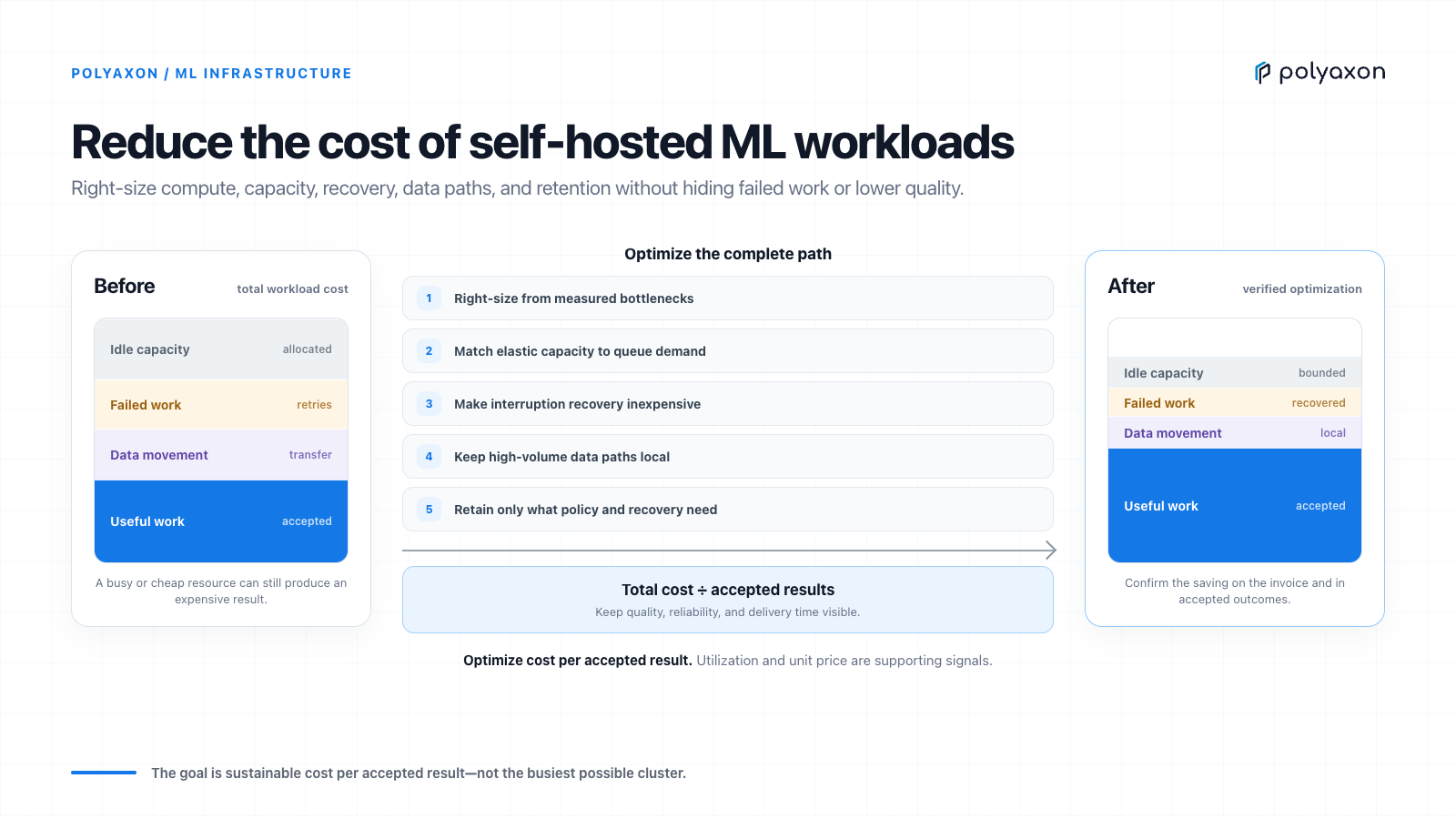
Kubernetes cost monitoring connects infrastructure spend to the teams and workloads that create it. For ML platforms, that requires more than dividing a node bill by CPU and memory requests. GPUs, idle headroom, failed experiments, shared services, storage, and data transfer can dominate the result.
The goal is not merely accurate chargeback. Teams need evidence they can use to change workload configuration, capacity planning, scheduling, and retention without reducing reliability or model quality.
Define the cost boundary
Start with the complete billable system:
- worker and control-plane charges;
- CPUs, memory, accelerators, and local disks;
- persistent volumes, snapshots, and object storage;
- load balancers, public addresses, and network transfer;
- registries, build infrastructure, and image storage;
- monitoring ingestion, retention, and queries;
- licenses, support, and shared platform services.
Decide whether the report represents list price, amortized commitment price, invoice cost, or an internal rate. Mixing these values makes comparisons misleading.
OpenCost provides an open specification and implementation for Kubernetes cost allocation; its documentation is a useful reference for the concepts and data sources involved.
Separate allocation from activity
Kubernetes schedules using resource requests. A Pod that requests one GPU can make that device unavailable to other workloads even when device activity is low. Allocate capacity cost from the reservation model first, then report activity as optimization evidence.
Keep these measurements distinct:
| Measurement | Question |
|---|---|
| Requested resources | What capacity did the workload reserve? |
| Runtime activity | How much of the reserved device was active? |
| Wall-clock duration | How long did the reservation last? |
| Useful throughput | What work or accepted output was produced? |
A team should not be charged less merely because its process left an exclusively allocated GPU idle. Conversely, utilization alone cannot tell whether a workload generated a valuable result.
Allocate shared and idle cost explicitly
Not every cost maps cleanly to one Pod. System nodes, ingress, DNS, observability, spare capacity, and cluster management support many tenants. Publish how these costs are assigned:
- equally across teams;
- proportional to direct resource cost;
- proportional to usage or requests;
- assigned to a central platform budget;
- split by a documented hybrid rule.
Keep unallocated and idle cost visible. Hiding it inside workload rates removes the signal needed for node-pool consolidation, commitment planning, or queue-policy changes.
Idle capacity is not automatically waste. Headroom can protect serving objectives, absorb bursts, or make scarce accelerators available without provisioning delay. Associate it with an explicit reliability or capacity policy.
Preserve ML ownership metadata
Cost allocation needs stable dimensions: organization, project, environment, workload class, queue, cluster, and owner. Enforce a bounded label vocabulary through the platform rather than trusting every workload to invent its own labels.
Unique run IDs can be useful in detailed allocation records, but avoid placing them into broad Prometheus labels if the resulting cardinality is unbounded. Join infrastructure records to Polyaxon run metadata in a system designed for that relationship.
Record the resource request, node or device type, start and end times, retry attempt, outcome, and artifact retention. A Pod name alone does not explain which experiment or pipeline step incurred the cost.
Include failed work and retries
Failed and interrupted workloads consume real capacity. Report their cost separately so teams can distinguish productive execution from retry overhead.
Classify failure by actionable cause: user code, invalid configuration, infrastructure, preemption, unavailable data, image retrieval, quota, or scheduler policy. Do not use cost reports to punish teams for failures owned by the platform.
Checkpointing can lower retry cost but adds storage and runtime overhead. Measure the complete effect. Spot or interruptible instances are economical only when recovery is reliable enough to preserve cost per accepted result.
Track storage, transfer, and retention
Data movement can erase compute savings. Attribute persistent volume capacity, snapshot retention, object storage, registry traffic, cross-zone transfer, and cross-region transfer where the provider exposes it.
Keep data locality in scheduling decisions. A cheaper accelerator in another region may produce a higher total cost after repeated dataset transfer and slower startup.
Define artifact and telemetry retention by recovery, compliance, and learning value. Delete redundant intermediates, but preserve the checkpoints and evidence required to reproduce accepted results or investigate failures.
Turn reports into controlled action
Useful cost views support three horizons:
- Run: resource cost, duration, retries, and result.
- Team or project: trends, budgets, idle allocation, and workload mix.
- Platform: node-pool efficiency, shared cost, commitments, and capacity gaps.
Use budgets and anomaly notifications before hard controls. When enforcement is required, apply queues, concurrency, quotas, and approved resource presets with clear failure messages.
Polyaxon queues control access to shared capacity, while scheduling presets make right-sized configurations reusable. Our GPU utilization metrics guide helps separate assigned capacity from device activity and useful throughput.
Optimize cost per accepted result, not the lowest invoice line or the busiest cluster. A trustworthy report keeps shared cost, idle capacity, failed work, quality, and delivery time visible so savings do not come from hiding work that still needs to be done.