LLM-as-a-judge: Design and validate model-based evaluators
Use LLMs as scalable evaluators without treating them as ground truth: design clear rubrics, calibrate against humans, and monitor bias and drift.
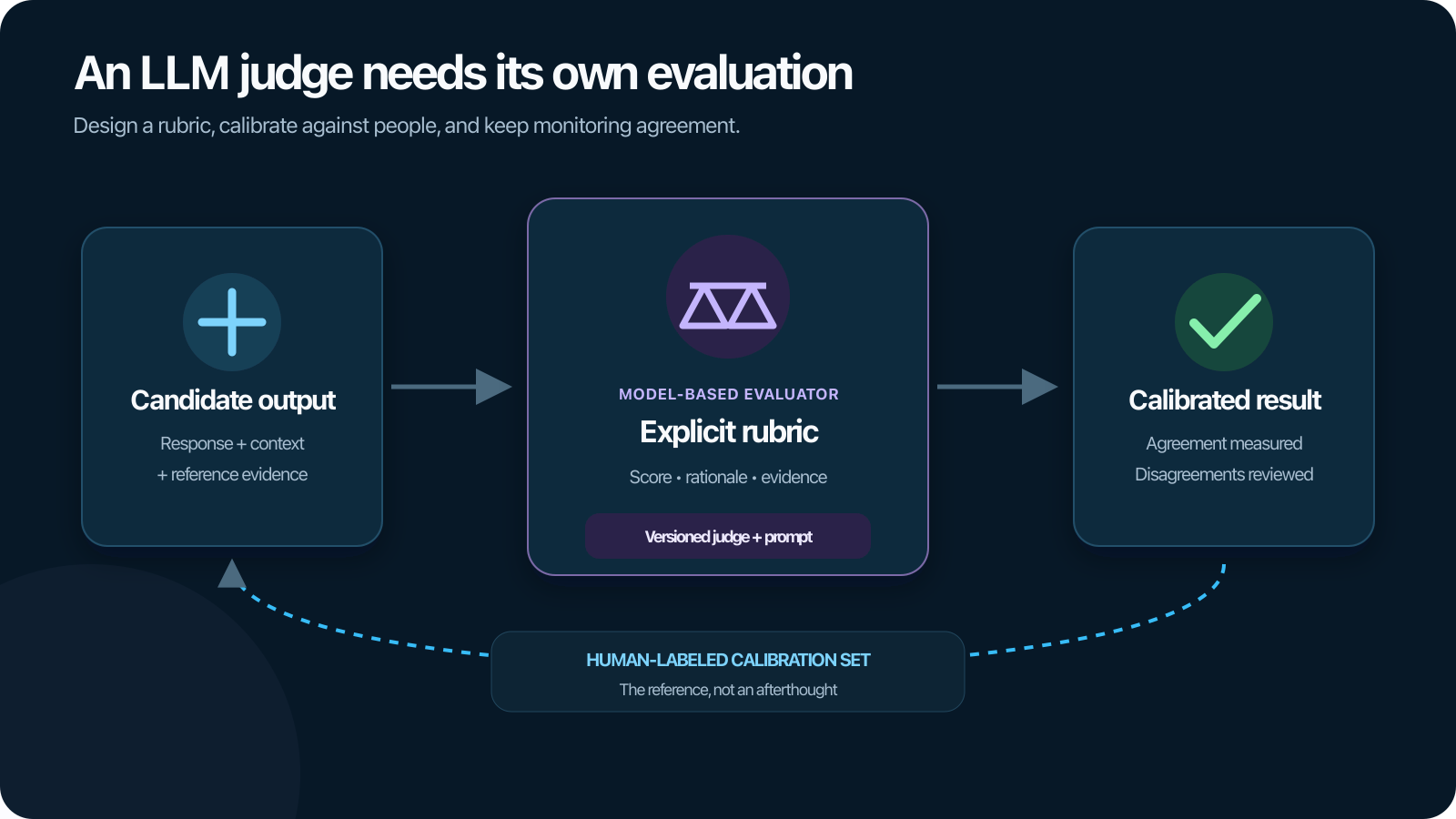
Many important qualities of a generative AI response are difficult to express as exact rules. Relevance, groundedness, completeness, tone, and the reasonableness of an agent trajectory often require judgment.
LLM-as-a-judge uses a language model to make that judgment at scale. It can turn a rubric into structured labels, scores, pairwise preferences, or explanations—but it remains an evaluator that must itself be tested, versioned, and monitored.
What is LLM-as-a-judge?
LLM-as-a-judge is an evaluation method in which a large language model assesses the output or behavior of another AI system according to defined criteria.
The judge may receive:
- The original user input.
- The candidate response.
- A reference answer or expected outcome.
- Retrieved context or source documents.
- Tool calls or an agent trajectory.
- A rubric describing the quality dimension.
- Examples of acceptable and unacceptable judgments.
It returns a structured result such as a pass/fail label, a categorical rating, a numeric score, a preferred candidate, and a concise rationale.
Research such as G-Eval explored model-based evaluation for nuanced text-generation qualities, while MT-Bench and Chatbot Arena examined model judges for pairwise and multi-turn assistant evaluation. The same research also highlights limitations such as position, verbosity, and self-preference bias.
The practical conclusion is not that a strong model can replace ground truth. It is that a calibrated model judge can automate specific judgments within a broader evaluation system.
When model-based evaluation is useful
Use an LLM judge when the criterion is semantic, examples are open-ended, and deterministic checks cannot capture the desired behavior.
Good candidates include:
- Whether an answer is supported by supplied evidence.
- Whether a response addresses every part of a request.
- Whether the tone follows a product or brand guideline.
- Whether an agent's actions form a reasonable trajectory.
- Whether a summary preserves the important information.
- Whether one response is more useful than another.
- Whether an interaction should be routed to human review.
Do not use a model judge for properties that code can verify more reliably. Schema validity, exact identifiers, tool argument types, citation existence, latency, token counts, and final database state should usually be deterministic checks.
Pointwise, pairwise, and listwise judging
Pointwise evaluation
A pointwise judge rates one candidate independently. It is useful for release thresholds and production evaluation because every result has a self-contained score or label.
Pointwise scores can be difficult to calibrate. A judge may compress most outputs into a narrow range or apply the scale inconsistently across task types. Descriptive categories such as unsupported, partially supported, and fully supported are often easier to define than a vague 1–10 score.
Pairwise evaluation
A pairwise judge compares two candidates and selects the better one, allows a tie, or reports that neither is acceptable. Pairwise comparison is useful for model, prompt, or retrieval experiments because relative judgment can be easier than absolute scoring.
Swap candidate order and repeat a sample of judgments to detect position bias. Do not force a preference when the difference is immaterial.
Listwise evaluation
A listwise judge ranks several candidates. It can reduce the number of calls for broad comparisons, but it increases context, order effects, and reasoning complexity. Use it cautiously and verify stability under reordered candidates.
Reference-based and reference-free judges
A reference-based judge compares the candidate with an expected answer, outcome, policy, or source. This anchors the judgment but makes the quality of the reference critical.
A reference-free judge applies the rubric using the input and candidate alone. It is useful where many answers can be valid, but it gives the evaluator more discretion and may require stronger calibration.
For RAG, supply the retrieved evidence when evaluating groundedness. For an agent, supply the trace or relevant tool operations when evaluating trajectory quality. A judge cannot reliably assess evidence it never receives.
Design a clear evaluation rubric
The rubric is the evaluator specification. It should be narrow enough that two knowledgeable reviewers can apply it consistently.
Evaluate one dimension at a time
Avoid prompts that ask whether a response is accurate, relevant, safe, concise, complete, and well-written in one score. The judge may trade one property against another silently.
Use separate evaluators or separate output fields with explicit criteria. Keep critical safety requirements independent from general quality.
Define every label
Describe what each rating means and how borderline cases should be handled. For example:
| Groundedness label | Definition |
|---|---|
fully_supported | Every material factual claim is supported by the supplied context |
partially_supported | The main conclusion is supported, but at least one material claim is unsupported or overstated |
unsupported | The main conclusion is not supported or contradicts the supplied context |
not_applicable | The response contains no factual claim that requires the supplied context |
These definitions are easier to calibrate than “rate groundedness from 1 to 5.”
Specify evidence and exclusions
Tell the judge which information it may use. A groundedness evaluator should not rely on its own world knowledge. A policy evaluator should use the supplied policy version. An agent evaluator should distinguish tool failure from a bad tool decision.
Require structured output
Return a stable schema containing the label or score, rationale, confidence or review flag, and evidence references where appropriate. Validate the schema in code.
Include difficult examples
Provide a small set of examples that clarify common ambiguities. Do not overload the prompt with examples that leak the expected label through superficial patterns.
Calibrate a judge against human decisions
A judge is ready for automation only after comparison with a trusted human-labeled set.
- Create a balanced calibration dataset with clear successes, clear failures, and difficult boundary cases.
- Have at least two qualified reviewers label an overlapping subset.
- Resolve disagreement and improve the rubric before blaming the judge.
- Run the candidate judge on the same cases.
- Measure agreement overall and by task, language, risk level, and label.
- Inspect false passes and false failures separately.
- Set a human-review policy for uncertain or high-risk cases.
Human disagreement provides an important ceiling. If experts cannot apply the rubric consistently, the evaluator specification needs refinement.
Choose metrics that fit the output. Classification can use precision, recall, and a confusion matrix. Ordinal ratings can use rank correlation or weighted agreement. Pairwise preferences can use agreement rate and order-consistency checks.
Keep rubric-development cases separate from an independent validation set. If you revise the judge after inspecting its validation errors, use a fresh assessment before presenting the next result as independent evidence. A deliberately balanced challenge set reveals failure modes, but its overall error rate need not represent the production case mix.
For example, consider this illustrative validation table with 100 cases:
| Expert decision | Judge passes | Judge rejects |
|---|---|---|
| Acceptable: 70 cases | 66 | 4 |
| Unacceptable: 30 cases | 4 | 26 |
Overall agreement is 92%, yet the judge passes 4 / 30, or 13.3%, of the unacceptable cases. Among the 70 cases it passes, 4 / 70, or about 5.7%, are unacceptable. State the denominator when reporting a false-pass metric; these two rates answer different operational questions. Retain the case-level decisions so reviewers can inspect the errors that matter to the release.
Test for judge bias and instability
Position bias
Pairwise judges may favor the first or second candidate. Swap order and compare the decision.
Verbosity bias
Longer responses can appear more complete even when they add unsupported detail. Include concise high-quality and verbose low-quality examples in calibration.
Self-preference and style bias
A judge may prefer outputs that resemble its own style or provider family. Compare multiple judges or human labels when this could affect a decision.
Reference leakage
A judge may reward lexical similarity to a reference rather than equivalent correctness. Include valid answers expressed differently.
Prompt sensitivity
Small rubric or formatting changes can alter decisions. Version the evaluator prompt and rerun calibration after changes.
Non-determinism
Repeat a sample of evaluations. If decisions are unstable, simplify the rubric, use categorical labels, reduce irrelevant context, or route uncertain cases to review.
Contamination and prompt injection
Candidate responses and retrieved documents are untrusted data. Delimit them clearly and instruct the judge to treat embedded instructions as content, not evaluator commands. Test adversarial cases explicitly.
Operate the judge as a versioned system
Record:
- Judge provider and model version.
- Evaluator prompt and rubric version.
- Output schema version.
- Candidate application, model, and prompt version.
- Dataset version and case identifier.
- Inputs made available to the judge.
- Label, rationale, latency, tokens, and cost.
- Human review and override where applicable.
This lineage lets the team distinguish a product-quality change from an evaluator change.
Monitor judge behavior in production. Sample cases for human review, track label distribution and disagreement, and recalibrate after judge-model, rubric, product, or user-distribution changes.
Example: a groundedness judge
Suppose a support assistant answers questions from approved policy documents.
The evaluator receives the question, retrieved passages, and response. It extracts the material claims, checks whether each claim is entailed by the passages, and returns one of the groundedness labels with the unsupported claim identifiers.
Require evidence for the label
Use the fictional refund-policy fixture: the supplied policy allows standard refunds within 14 days, the user purchased 20 days ago, and the candidate promises eligibility under a 30-day window. A suitable output contract could produce:
{
  "case_id": "refund-policy-042",
  "rubric_revision": "groundedness-v1",
  "label": "unsupported",
  "findings": [
    {
      "claim_id": "claim-1",
      "claim": "The standard refund window is 30 days.",
      "evidence_ids": ["refund-policy-v3"],
      "reason": "The supplied policy states 14 days, which contradicts this claim."
    }
  ],
  "needs_review": true
}
This is an illustrative evaluator output, not an observed model response or a Polyaxon API schema. The application validates its fields and checks that evidence IDs refer to supplied passages. A resolving citation alone cannot establish entailment; the evaluator's interpretation still needs calibration against expert decisions.
Record the evaluator's model, prompt, and schema versions along with this report. A Polyaxon evaluation run can retain the case file and judgment as artifacts and log summary metrics for comparison. The evaluator code owns the judgment; the run record makes its inputs and outputs reviewable.
Combine the judgment with release checks
The release process combines that result with deterministic checks:
- Every citation resolves to an approved document.
- The document was effective for the requested date and region.
- The response contains no prohibited personal data.
- End-to-end latency and cost remain within budget.
A human reviews all unsupported cases in the high-risk policy category and a sample of passes. Over time, the review results improve the calibration set and reveal whether the judge is becoming too permissive or strict.
Use multiple evaluators deliberately
An ensemble or jury can reduce dependence on one judge, but more models do not automatically create truth. Judges may share training data, biases, or failure modes.
Use multiple evaluators when disagreement itself is informative, the decision is high impact, or different evaluators specialize in different criteria. Define how disagreements are resolved: majority vote, weighted decision, conservative failure, or human review.
Keep the individual judgments. An aggregate decision without the underlying evidence is difficult to audit.
Common LLM-as-a-judge mistakes
Treating the judge as ground truth
The judge is an approximation of a rubric. Validate it against human decisions and known invariants.
Using one broad quality prompt
Combined criteria create inconsistent tradeoffs. Separate dimensions and define each label.
Reporting only correlation or agreement
Aggregate agreement can hide dangerous false passes in a critical category. Inspect confusion matrices and segments.
Changing the judge silently
A model or prompt update can shift evaluation scores even when the application is unchanged. Version and calibrate every evaluator release.
Ignoring evaluation cost and latency
Online judges can become a major part of application spend. Sample intentionally, use smaller validated judges where appropriate, and reserve expensive review for high-value cases.
Exposing sensitive content unnecessarily
Judge inputs may contain prompts, retrieved records, or tool results. Apply the same redaction, access, retention, and provider policies used for production traces.
Polyaxon and the evaluation roadmap
Polyaxon's tracking and orchestration foundation can version evaluator configurations, datasets, judgments, metrics, and human-review artifacts while automating repeatable evaluation workflows.
Full evaluation and monitoring for generative AI applications is an active area on the Polyaxon roadmap, together with OpenTelemetry-compatible LLM and agent observability, an AI gateway, prompt management, and agent sandboxing.
The direction is to attach every judgment to the exact evaluator, application version, trace, and dataset case so teams can reproduce the result and distinguish model behavior from evaluator behavior.
A judge needs evaluation too
LLM-as-a-judge is valuable because it makes nuanced evaluation repeatable at a scale that human review alone cannot reach. Its value depends on a narrow rubric, representative calibration data, explicit bias testing, and ongoing human oversight.
Use model judges as measured instruments. When their versions, errors, and operating boundaries are visible, they can support safer releases and more useful production feedback without being mistaken for an objective source of truth. Apply those principles in AI agent evaluation and connect the results across offline and online evaluation.