How to evaluate RAG systems
Evaluate retrieval and generation separately and end to end with representative datasets, groundedness checks, retrieval metrics, and production feedback.
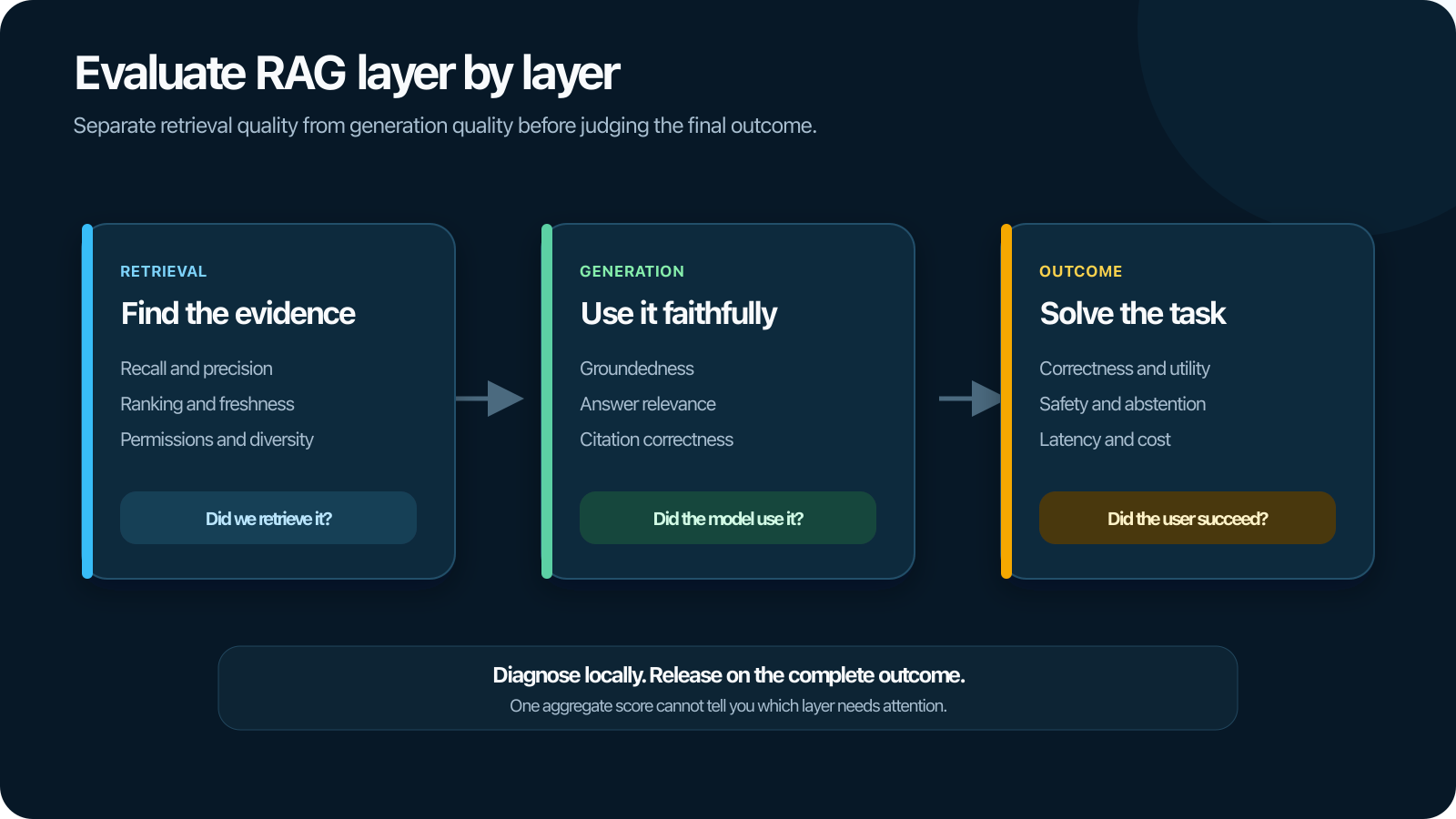
A retrieval-augmented generation system can return a polished answer and still fail in several different ways. The retriever may miss the relevant document, rank an outdated passage first, send too much context to the model, or retrieve the right evidence only for the generator to ignore it.
RAG evaluation should identify which part failed. That requires measuring retrieval, generation, and the complete user outcome separately before connecting them into one release decision.
What is RAG evaluation?
RAG evaluation is the process of measuring how effectively a retrieval-augmented generation system finds relevant evidence and uses it to produce a correct, grounded, useful response.
A complete evaluation answers three groups of questions:
- Retrieval: Did the system find the evidence needed to answer the question?
- Generation: Did the model use the supplied evidence faithfully and produce a useful response?
- End-to-end outcome: Did the system solve the user's task within the required safety, latency, and cost boundaries?
This separation is essential for diagnosis. If retrieval never surfaced the refund-policy exception, changing the final prompt may not help. If the correct policy was present but the answer contradicted it, the generator or its instructions need attention.
The RAGAS research framework helped formalize this decomposition by evaluating the relevance and focus of retrieved context, faithfulness to that context, and response quality. A production evaluation program can use those ideas without depending on one framework or one aggregate score.
Define the RAG task before selecting metrics
Start with the application outcome and consequence of failure.
A documentation assistant may need to answer accurately, cite the exact page, and admit when the documentation does not contain the answer. A compliance assistant may need to retrieve only approved policies valid for a jurisdiction and effective date. A support agent may use retrieval as one step before taking an action.
Document:
- The users and question types in scope.
- The sources the system is allowed to use.
- Freshness and permission requirements.
- Whether an answer requires citations.
- When the system should abstain or escalate.
- The acceptable latency and cost per task.
- The failures that must block a release.
These decisions determine the dataset, labels, metrics, and evaluation methods. A generic benchmark cannot define product-specific correctness.
Evaluate the retrieval layer
Retrieval evaluation measures whether the system supplies useful evidence to the generator.
Context recall
Context recall asks whether the retrieved set contains the evidence required to answer the question. When the evaluation dataset includes known relevant documents or passages, calculate how much of that evidence appears in the top results.
Low recall can indicate poor chunking, incomplete indexing, weak query formulation, inappropriate filters, embedding mismatch, or a top-k value that is too small.
Context precision
Context precision asks how much of the retrieved material is relevant. Returning the correct passage alongside many irrelevant chunks may preserve recall while increasing tokens and distracting the generator.
Inspect precision at the ranks the application actually sends to the model. Relevant evidence at rank 20 does not help if only the first five chunks enter the prompt.
Ranking quality
Metrics such as mean reciprocal rank, normalized discounted cumulative gain, hit rate, or precision at k can evaluate where relevant items appear. Select the measure that reflects user experience and the downstream context limit.
Ranking labels may be binary or graded. A current policy page can be highly relevant, a related FAQ partially relevant, and an obsolete policy actively harmful.
Source quality and freshness
Retrieval can be semantically relevant and still unsafe to use. Evaluate whether results satisfy permissions, tenant boundaries, effective dates, source authority, language, and document status.
Treat unauthorized or superseded context as a hard failure where appropriate, not merely a lower relevance score.
Context diversity and redundancy
Several nearly identical chunks can crowd out complementary evidence. Measure duplicate content, source diversity, and whether the retrieved set covers the different facts required for a multi-part answer.
Evaluate the generation layer
Generation evaluation assumes the exact retrieved context is available for inspection. Preserve it with the response so evaluators can determine how the model used it.
Groundedness or faithfulness
Groundedness checks whether factual claims in the response are supported by the supplied context. A grounded answer may still be incomplete or based on a poor source, which is why the retrieval checks remain separate.
Evaluate individual claims when the risk is high. A single response-level score can hide one unsupported statement inside an otherwise accurate answer.
Answer correctness
When a reference answer or verifiable system state exists, check whether the response reaches the correct conclusion. Use deterministic checks for structured values and task-specific rules; use human or model-based review for nuanced language.
Correctness and groundedness are related but different. A response can make a correct statement that is unsupported by the retrieved context, or faithfully repeat an incorrect source.
Answer relevance and completeness
Measure whether the response directly addresses the question and includes the information needed to complete the task. Penalize unnecessary background when it obscures the answer or increases cost.
For multi-part requests, score each requirement separately. This makes missing elements actionable.
Citation quality
If the product shows citations, test whether each citation exists, supports the associated claim, points to the intended source, and resolves for the user. Citation presence alone is not evidence of citation correctness.
Abstention behavior
Include unanswerable and insufficient-context cases. Evaluate whether the system recognizes missing evidence, communicates uncertainty, asks for clarification, or escalates instead of inventing an answer.
Evaluate the complete RAG experience
End-to-end evaluation connects retrieval and generation with user and operating outcomes.
| Dimension | Example question |
|---|---|
| Task success | Did the user receive the information or complete the workflow? |
| Safety and policy | Did the system avoid prohibited sources, disclosures, and advice? |
| Freshness | Was the answer based on the current approved source? |
| Latency | Did retrieval and generation complete within the user-facing budget? |
| Cost | How much did retrieval, reranking, context, and generation cost per successful task? |
| User outcome | Did the user accept the answer, reformulate the question, or escalate? |
An end-to-end score is useful for comparing releases, but keep the component scores available. Otherwise, a quality improvement may hide a retrieval regression or a latency increase.
Build a representative RAG evaluation dataset
A useful dataset contains more than questions and ideal answers. Each case should record:
- The user question and relevant conversation history.
- The expected answer or outcome.
- Required and acceptable source documents.
- Explicitly irrelevant, outdated, or prohibited sources when important.
- The reason the case matters and its risk category.
- Language, user segment, permissions, and effective date.
- Expected abstention or escalation behavior.
Include ordinary questions, multi-hop questions, ambiguous wording, exact identifiers, misspellings, conflicting documents, recently updated sources, permission boundaries, and questions the corpus cannot answer.
Start with a small set reviewed by domain experts. Expand it with sanitized production questions, low-rated conversations, search reformulations, failed citations, and incidents. Version the dataset and its source corpus so results remain reproducible.
Work through one policy question
Here is a fictional seed case. Its purpose is to separate retrieval quality from answer support, not to report a benchmark or prescribe a real refund policy.
{
  "case_id": "refund-policy-042",
  "corpus_revision": "support-policies-v3",
  "question": "I bought an unused annual plan 20 days ago. Am I within the standard refund window?",
  "required_document_ids": ["refund-policy-v3"],
  "retrieved_passages": [
    {
      "document_id": "refund-policy-v3",
      "text": "Unused annual plans are eligible for a standard refund within 14 days of purchase. Requests outside that window require review."
    }
  ],
  "response": "Yes. The standard refund window is 30 days, so your purchase qualifies.",
  "citation_ids": ["refund-policy-v3"],
  "expected_outcome": "Explain that 20 days is outside the 14-day standard window and offer review without promising a refund."
}
The required document appears first, so document-level recall at 1 is 1 / 1 for this case. The citation identifier also resolves. Neither success makes the answer correct: its material claim contradicts the retrieved passage.
| Check | Result for this fixture | What it tells the team |
|---|---|---|
| Required document retrieved | Pass | The expected policy reached the generator |
| Citation ID resolves | Pass | The answer names a supplied document |
| Claimed window supported | Fail | The answer changes 14 days to 30 days |
| Expected outcome satisfied | Fail | The answer promises eligibility instead of offering review |
Keep these results in separate fields. If a second candidate retrieves only an archived 30-day policy, investigate corpus freshness or filtering first; if it receives the current passage and still answers 30 days, inspect generation and context handling. The groundedness judge example uses this same case to show evidence-linked output.
For a comparison in Polyaxon, save the cases and per-case report as run artifacts, record corpus, candidate, and evaluator revisions, and log aggregate metrics separately. Use experiment matrices to vary retrieval settings while keeping the evaluation contract fixed. The retrieval and evaluator programs produce the results; orchestration makes the comparison repeatable.
Choose complementary evaluation methods
Deterministic retrieval metrics
Use known relevant documents and ranking metrics where ground truth is available. These checks are inexpensive and easy to compare across index, embedding, chunking, and reranking changes.
Rule-based response checks
Validate citation structure, required fields, prohibited phrases, source URLs, JSON schemas, and exact values with code. Do not use a model-based judge for properties that software can verify reliably.
Model-based evaluators
Use a clearly defined rubric for groundedness, answer relevance, completeness, and qualitative citation support. Supply the evaluator with the question, retrieved context, response, and reference evidence needed for the decision.
Calibrate every model-based evaluator against expert-reviewed cases and track its errors by task type. The evaluator is another versioned model dependency, not ground truth.
Human review
Use domain experts for high-risk cases, ambiguous labels, new failure types, and evaluator calibration. Structured rubrics make the resulting judgments useful for automation and trend analysis.
A practical RAG evaluation workflow
- Define the outcome and risk boundaries. Decide what must be correct, cited, current, permitted, and fast.
- Create a versioned seed dataset. Include expected evidence and abstention cases, not only ideal answers.
- Evaluate retrieval independently. Compare chunking, embeddings, filters, query rewriting, top-k, and reranking.
- Freeze retrieved context when comparing generators. This prevents retrieval changes from confounding model or prompt comparisons.
- Evaluate generation by dimension. Measure groundedness, correctness, relevance, completeness, citation quality, and abstention.
- Run end-to-end checks. Include task success, policy, latency, and cost.
- Inspect failures by segment. Compare performance by task, source, language, permissions, and question complexity.
- Gate releases. Set hard requirements for safety and source policy, plus acceptable regression budgets for quality and performance.
- Evaluate production samples. Use traces and user feedback to discover cases the offline set missed.
- Promote failures into regression tests. Preserve the question, corpus or source version, retrieved context, and expected behavior.
Diagnose RAG failures systematically
Use the observed pattern to narrow the cause.
| Observation | Likely area to investigate |
|---|---|
| Required document never retrieved | Index coverage, chunking, embeddings, query rewriting, or filters |
| Correct evidence ranks below noise | Reranking, metadata boosts, chunk size, or top-k |
| Evidence is correct but answer contradicts it | Prompt, model, context placement, or generation settings |
| Answer is grounded but wrong | Source authority, freshness, or corpus quality |
| Citations exist but do not support claims | Citation mapping or response-generation logic |
| Quality improves while cost spikes | Context volume, reranking, model selection, or retries |
| Offline quality is stable but users reformulate | Dataset representativeness, conversational context, or usability |
Preserve the trace behind each failure. It should connect the query, retrieval configuration, ranked documents, prompt, model, response, evaluator results, latency, cost, and application version.
Common RAG evaluation mistakes
Scoring only the final answer
This makes retrieval and generation failures indistinguishable. Evaluate the ranked context and how the response uses it.
Using synthetic questions as the entire dataset
Synthetic data can expand coverage, but generated questions often reflect the corpus structure rather than real user intent. Combine them with expert cases and production evidence.
Treating one model-based score as ground truth
Automated evaluators can be biased or inconsistent. Calibrate them, preserve explanations, and retain deterministic and human checks.
Ignoring corpus versions
An evaluation cannot be reproduced if the index changed silently. Version the source corpus, chunking, embedding model, and retrieval configuration.
Optimizing retrieval metrics without the user outcome
Higher recall may increase context length and reduce answer quality or latency. Evaluate the full system after tuning a component.
Polyaxon and the RAG-evaluation roadmap
Polyaxon's current tracking and orchestration capabilities provide a foundation for versioning evaluation datasets, retrieval configurations, prompts, models, metrics, and automated workflows. Teams can compare runs and connect evaluation evidence to the artifacts and configurations that produced it.
Full LLM and application evaluation is an active area on the Polyaxon roadmap, alongside OpenTelemetry-compatible observability, an AI gateway, prompt management, and agent sandboxing. The direction is to connect a RAG trace with retrieval evidence, evaluator results, production feedback, and the exact application version.
Evaluate the evidence path
RAG quality depends on a chain: the corpus contains the right knowledge, retrieval finds it, ranking prioritizes it, the model uses it faithfully, and the final response solves the user's task.
Measure every link in that chain. A decomposed evaluation tells the team what to improve, while the end-to-end evaluation confirms that the change actually benefits users. Continue with LLM-as-a-judge for semantic scoring and offline versus online evaluation for the release feedback loop.
Add RAG red teaming to test poisoned documents, tenant boundaries, revoked permissions, and cached answers. For larger datasets, use batch evaluations on Kubernetes to preserve case identity and validate complete results across workers.