Make vLLM prefix caching work for repeated prompts
Understand exact prefix reuse in vLLM, structure repeated context, account for replica routing, and compare cold and warm workloads with Polyaxon.
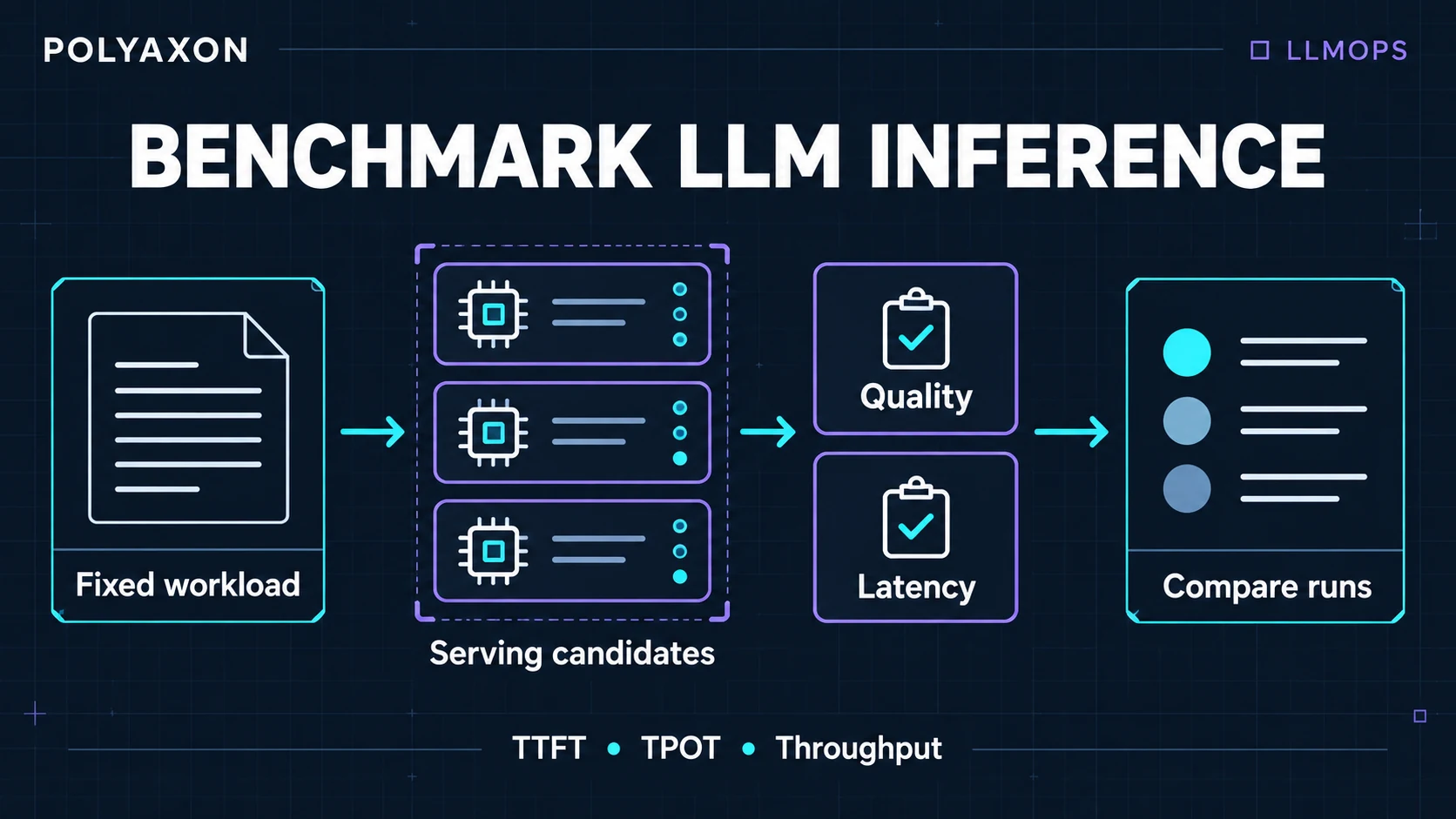
A support assistant sends the same long product manual with every question. The question changes, but the server repeatedly processes much of the same input. vLLM's automatic prefix caching can reuse that work when matching context is still available in its cache.
The practical question is how much reuse survives your prompt formatting, traffic mix, and serving topology. This guide follows one document-questioning workload from prompt layout to a controlled comparison, with Polyaxon retaining the experiment evidence.
Reuse input computation
Automatic prefix caching, or APC, retains reusable key-value attention state for matching input prefixes. A later request can skip part of the prompt-processing phase, called prefill. It still generates its answer; APC is not a stored-response lookup or semantic search for similar questions. Long shared context with short answers is a more promising candidate than unique prompts dominated by lengthy generation. vLLM APC overview.
Start with a text-only attention-based model supported by your pinned vLLM version. Hybrid models, multimodal inputs, and external cache connectors introduce additional rules beyond this example. Treat the upstream documentation reviewed on September 21, 2026 as guidance, and use the matching version's documentation for your deployed image.
Make the shared prefix visible
Suppose the application answers questions about a versioned equipment manual. These two schematic requests share a useful beginning:
Request A
[Stable instructions and answer format]
[The same complete manual, revision 17]
Question: How often should the filter be replaced?

Request B
[Stable instructions and answer format]
[The same complete manual, revision 17]
Question: Which warning applies before opening the housing?
The brackets describe the prompt structure; the actual requests must contain the document text. After applying the same chat template and tokenizer, their common opening can qualify for reuse. vLLM's documented cache design keys blocks using token identity, preceding context, and additional identifiers such as adapters or cache salts. Matching text later in an otherwise different prompt is not enough. Prefix-cache design.
This suggests a practical prompt review: keep genuinely stable context in a consistent position and format, and avoid inserting changing request IDs or timestamps before it when the model does not need them. Keep operational metadata outside the prompt when possible. Preserve instruction roles and evaluate answer quality after any layout change.
For RAG, retrieved documents can differ in content and order between questions. Reuse the shared system instructions where possible, but do not sort evidence or remove relevant context merely to increase the cache hit rate. The cache serves the application's task; the task should not be redesigned around a convenient benchmark.
Make the cache setting explicit
On a development host with compatible hardware, a pinned vLLM environment, and an approved local model snapshot, an illustrative server command is:
MODEL_PATH=/models/support-model-snapshot
vllm serve "$MODEL_PATH" \
  --host 127.0.0.1 \
  --port 8000 \
  --enable-prefix-caching \
  --prefix-caching-hash-algo sha256
Replace the path with your actual model and tokenizer snapshot; it is not a downloadable model name. The example binds locally for a benchmark client on the same host. A Polyaxon service needs its normal service networking, resource allocation, and access configuration.
For the disabled baseline, stop that server and launch the same configuration with --no-enable-prefix-caching instead. Keep the remaining arguments and environment unchanged. Explicit flags make the comparison independent of defaults. The vLLM serve reference documents these options. Stop the development server when finished to release its resources.
Measure cold, warm, and mixed traffic
Keep the same model snapshot, chat template, GPU allocation, output limits, request schedule, and evaluation cases. Then compare these scenarios:
| Scenario | Preparation | Question it answers |
|---|---|---|
| APC disabled | Replay the fixed workload without prefix reuse | What is the baseline under the same serving conditions? |
| APC enabled, cold prefixes | Start from a fresh local cache; use distinct document prefixes for the measured first requests | What happens before the relevant context has been cached? |
| APC enabled, warm prefixes | Prime the document prefixes, let those requests complete, then measure different questions sharing them | What can retained context save? |
| APC enabled, realistic mix | Replay the intended mix of repeated documents, new documents, and revisit intervals | How much of the warm-case benefit survives normal traffic? |
Use identical measured requests for the cold-versus-warm pair; only the preparatory priming traffic changes. Repeat each workload with APC disabled as its matched baseline. Treat the realistic mix as a separate workload, not as a directly comparable replacement for the repeated-document set.
“Cold” here describes prefix state, not necessarily model initialization. A fresh server also pays model-loading and compilation costs. Separate those costs from steady-state measurements, and use unrelated prompts for any engine warmup so it does not accidentally prime the measured documents.
Keep priming traffic outside the warm measurement window and record its cost separately. Retain request order and timestamps: repeating a document immediately and revisiting it after many unrelated requests are different workloads. Cached state can be evicted as capacity is reused; enabling APC does not promise indefinite retention. Cache eviction design.
Our repeatable inference benchmark guide provides the measurement contract and a Polyaxon recorder. Use its approach to preserve failures and quality outcomes alongside timing results.
Read cache metrics alongside user latency
vLLM exposes Prometheus metrics at /metrics, including prefix-cache hit/query counters and latency distributions. The cache counters count tokens, so their ratio is not the fraction of requests answered from cache. Use matched counter deltas over the measurement window, handle process resets, and inspect the metric names and labels exposed by your installed version. vLLM metrics documentation.
Record time to first token, end-to-end latency, output-token throughput, request failures, and task quality. Inspect queueing and cache use when they help explain a change. A better hit ratio can coexist with worse tail latency if the server is overloaded, and an unchanged decoding cost can dominate the total response time.
Make the acceptance rule concrete before comparing results: the candidate must improve the chosen user-facing metric while preserving the workload's quality and error requirements. Do not infer a percentage improvement from a cache ratio.
Account for replicas and reuse boundaries
An independent serving engine has its own KV cache. A request that warmed one replica does not automatically warm another. vLLM's data-parallel deployment documentation explicitly describes independent engine caches and the importance of load balancing.
That makes routing part of the experiment. Directing related requests to a warm engine may improve reuse, but concentrating them can increase its queue. Compare latency and load distribution across the real endpoint, including after scaling or replica restarts. APC alone does not create a distributed shared cache or configure a cache-aware gateway.
In a shared service, also define which requests are allowed to reuse context. vLLM documents cache_salt as a way to partition prefix reuse: matching salts can reuse matching cached state. The serving boundary should control that value for the intended tenant or trust domain. It is not an authorization mechanism. Cache isolation design.
Keep the comparison reproducible in Polyaxon
Use one benchmark run per cache scenario, load setting, and repetition. Retain an experiment manifest containing the vLLM version and image digest, model/tokenizer revisions, template revision, dataset identity, cache flag, routing policy, warmup procedure, and measured time window.
Polyaxon's tracking API can record those inputs, the measured metrics, and the request-level evidence produced by your benchmark. The engine performs prefix reuse; Polyaxon preserves the configuration and results for comparison. Keep document contents and sensitive request data out of artifacts unless they belong in the approved evidence store.
A grid search can enumerate benchmark scenarios. When they share one endpoint, serialize the benchmark operations and explicitly prepare each cache state. Matrix concurrency controls runs; the client controls request concurrency within each run. For on/off comparisons, include the server reconfiguration step—changing a run's input label alone does not change the endpoint.
Start with one repeated-document workload on one engine. Establish whether useful prefix reuse improves its measured behavior, then repeat the comparison through the production routing path. That gives the next prompt, model, or serving update a concrete baseline.