Reduce the cost of self-hosted ML workloads
Reduce self-hosted ML costs with outcome-based accounting, right-sized resources, elastic capacity, interruption-ready workloads, local data paths, and deliberate retention.
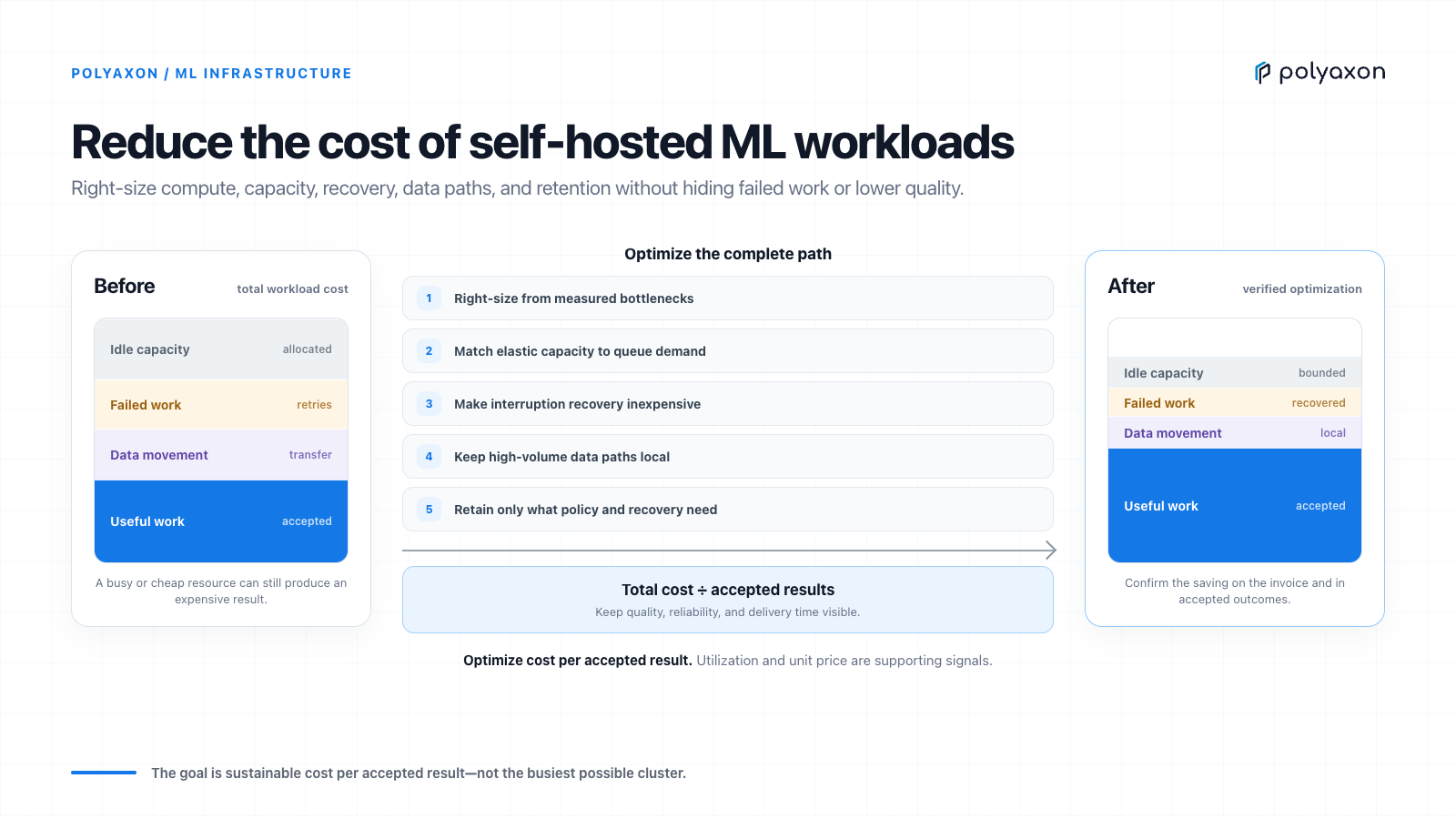
Self-hosting replaces a simple provider invoice with a larger system of costs: worker nodes, idle capacity, control-plane services, storage, network transfer, observability, backups, failed work, and the engineering time required to operate them.
That control can produce better economics, especially for steady or specialized workloads. It can also hide waste behind a cluster-wide utilization percentage. Optimize the complete cost of accepted work rather than one infrastructure line item.
Build an attributable cost model
Start with actual billing exports, infrastructure inventory, and workload records. Separate direct usage from shared and operational cost:
| Cost group | Examples | Useful allocation basis |
|---|---|---|
| Compute | CPU, memory, GPU, local disk, node licenses | Requested or occupied resource-hours by environment |
| Storage | Datasets, checkpoints, artifacts, logs, caches, backups | Stored byte-time, operations, retrieval, and retention class |
| Network | Cross-zone, cross-region, internet egress, NAT, gateways | Observed bytes on the billed path |
| Managed dependencies | Databases, queues, registries, model endpoints | Usage, provisioned capacity, or an explicit shared allocation |
| Reliability capacity | Warm pools, replicas, recovery environments | Service or tenant that requires the availability margin |
| Operations | Upgrades, incidents, security, capacity planning | Measured labor or an agreed allocation model |
| Failed work | Retries, canceled runs, unusable results | Original project, task class, and failure cause |
Document which values come from invoices, which are measurements, and which are estimates. A configured hourly rate is useful for comparison, but it does not automatically include discounts, storage, transfer, taxes, or shared services.
Allocate cost to project, user or team, workload class, queue, execution environment, resource type, and outcome. Keep the denominator meaningful: cost per accepted training result, evaluated candidate, processed item, or served request. Lower cost per run is not an improvement if more runs fail or the result no longer meets its quality target.
Establish a comparable baseline
Choose representative workloads and record immutable inputs: code, image, dataset, model, parameters, resource requests, node type, region, and execution policy. Measure queue delay, startup, active processing, waits, total duration, retries, and output acceptance.
Separate reserved from active resources. Kubernetes schedules from requests, while invoices usually follow provisioned infrastructure. A job can reserve four GPUs for two hours while keeping them active only part of that time; the cluster can also have no allocated GPUs while idle nodes continue billing.
Track at least:
- requested and occupied CPU-, memory-, and accelerator-hours;
- node uptime and billable infrastructure by pool;
- queue age and unschedulable time by resource shape;
- application throughput and accepted outcomes;
- failed, canceled, preempted, and retried attempts;
- image, data, checkpoint, and artifact transfer;
- cache hit and invalidation behavior; and
- storage volume, operations, retrieval, and retention.
The GPU utilization metrics guide explains why allocation, device activity, pressure, and useful throughput should remain separate.
Right-size from the application's bottleneck
Reduce oversized requests only after measuring the application. CPU, memory, GPU memory, disk throughput, and network can each be the limiting resource. A smaller instance that runs twice as long may consume more resource-hours and delay other work.
Run controlled comparisons around the knee of the performance-cost curve. Keep the output acceptance criterion fixed. For distributed training, compare time to result and total accelerator-hours; better wall-clock speed can require more aggregate capacity.
Requests influence scheduling and bin packing. An unnecessarily large request can leave fragments that no pending workload can use, while an unrealistically small request can cause contention or eviction. Use workload-specific presets instead of one generous default for every experiment.
Remove accelerators from stages that do not need them. Data validation, preprocessing, artifact transfer, evaluation aggregation, and report generation can often run separately from GPU training. Split stages only when releasing the scarce resource outweighs the additional startup and data-movement cost.
Match capacity to queue demand
For variable demand, node autoscaling can add nodes for unschedulable Pods and consolidate nodes that are no longer needed. The Kubernetes node-autoscaling documentation describes this interaction between workload requests and infrastructure capacity.
Scale-to-zero is useful for burst pools, but it introduces provisioning, image-pull, driver, and data-warmup latency. Define a start-time objective, then keep only the warm capacity needed to meet it. Separate steady baseline from burst capacity so long-term commitments or owned hardware serve predictable demand while elastic pools absorb peaks.
Prevent runaway scale-out. Bound workload fan-out, queue concurrency, per-project resources, and total environment cost. A large hyperparameter search or mapping operation should not turn an input mistake into an unrestricted infrastructure event.
Measure the cold path after an idle period. A controller that quickly creates nodes but needs many minutes to make GPUs usable has a different service profile from one with prewarmed drivers, images, and data.
Use interruptible capacity only for recoverable work
Spot or preemptible instances can reduce the unit price of compatible workloads. The saving is real only after accounting for interruptions, lost progress, restart delay, repeated transfer, and the on-demand capacity used when spot is unavailable.
Classify workloads by interruption tolerance. Short, restartable batch steps may need no checkpoint. Long training runs need durable, validated checkpoints at an interval justified by interruption risk and checkpoint overhead. Stateful services or fragile distributed jobs may be poor candidates unless their recovery path is proven.
Test termination with a real worker interruption. Confirm that the replacement can reach the checkpoint, restore all required application state, and avoid exposing partial outputs as complete. Record recomputation and failed-attempt cost with the final result.
Use node labels, selectors, taints, tolerations, and priority policy to keep interruption-tolerant work on the intended pools. Kubernetes PriorityClass can order pending work, but preemption does not create an application checkpoint or guarantee that eviction is economical.
Keep large data paths local
Compute savings can disappear when images, datasets, model weights, caches, checkpoints, or artifacts cross expensive boundaries. Measure actual traffic by source, destination, region, and service path. Include network-address-translation and gateway processing where they are billed separately.
Place high-volume stores and registries near the compute that repeatedly consumes them, subject to residency and recovery requirements. Use private provider paths when appropriate and verify their billing behavior in the deployed account. The region-aware workload guide covers eligibility, Kubernetes topology, replication, and failover in more detail.
Cache immutable content with keys that include every input affecting correctness. A fast cache with stale model weights or an incomplete dataset is not a cost optimization. Measure hit rate, saved transfer and startup time, storage cost, and invalidation effort together.
Treat storage and retention as active policies
Artifacts accumulate quietly: frequent checkpoints, model packages, evaluation reports, logs, traces, temporary shards, notebook files, and caches. Classify them by purpose and required lifetime.
Keep authoritative outputs, release evidence, and required audit records according to policy. Apply shorter retention to reproducible intermediate files and redundant diagnostics when the investigation window allows it. Delete failed multipart uploads, orphaned volumes, abandoned caches, and outputs from expired experiments through controlled lifecycle rules.
Compression and lower-cost storage tiers can help, but include retrieval latency and charges in the recovery design. A checkpoint that is cheap to retain but too slow or expensive to restore within the objective belongs to a different recovery class.
Do not use logs as long-term artifact storage. Retain structured metadata that identifies the run and its outputs, then store large files in the system designed for them.
Schedule for value, not maximum activity
Unlimited concurrency can reduce one queue's delay while forcing costly scale-out, saturating storage, or increasing provider failures. Set concurrency by workload class and the bottleneck the system can support.
Use priorities for explicit business or service needs. A production repair, deadline-bound evaluation, exploratory notebook, and overnight sweep may justify different queue behavior. Consider non-preempting priority when important work should start before lower-priority queued work without discarding an already-running job.
Cancel superseded work. When a new run replaces an older search or evaluation, stop dispatching its remaining children and account for actions already in flight. Timeouts should reflect the workload's expected progress, not merely stop every long task at a round number.
Review queue age alongside cost. A restrictive cap that lowers the bill but makes useful work miss its deadline is not a successful optimization.
Include reliability and engineering effort
Self-hosted economics depend on the operating model. Count the time and infrastructure required for cluster upgrades, driver compatibility, security patches, incident response, backup verification, capacity planning, observability, access management, and support.
Standardize workload definitions, environment presets, and machine classes to reduce repeated debugging. Prefer a small catalog of measured options over exposing every instance type and scheduler field to every user.
Capacity held for reliability should be attributed to the service that requires it rather than labeled as waste. The self-hosted reliability guide explains how failure domains, durable state, and eligible failover determine that margin.
Apply cost controls with Polyaxon
Polyaxon operations record the execution context needed to compare workload configurations. Use reusable components and environment presets to define a small catalog of CPU, memory, GPU, spot, region, and storage choices.
Polyaxon cost estimation can attach a rate to a component or environment preset and aggregate estimates by project, user, team, queue, or agent. Treat the configured rate as a documented model, then reconcile it with provider billing and shared-cost allocation.
Commercial queues can apply priority, concurrency, resource, and cost constraints while routing operations to namespaces or clusters. Use node scheduling to target compatible on-demand or interruptible pools. Preserve checkpoints and outputs through configured artifact connections.
Track the accepted outcome alongside duration, resources, estimated cost, failures, and artifacts. This keeps a cheaper environment from appearing better when it increases retries, transfer, or invalid results.
Prioritize changes by verified savings
Start with changes that have measurable scope and reversible rollout:
- Remove abandoned services, orphaned storage, and obviously oversized defaults.
- Attribute cost and outcomes to projects, queues, workload classes, and environments.
- Right-size a representative workload and validate its output.
- Bound concurrency and fan-out before enabling broader elasticity.
- Test interruption recovery, then route only compatible work to spot capacity.
- Co-locate one high-volume dependency and measure the complete transfer path.
- Apply retention policies with documented recovery and audit requirements.
- Reconcile estimated savings with the actual invoice and service objectives.
The best self-hosted cost optimization is not the lowest unit price or the busiest cluster. It is a verified reduction in total cost per accepted result while preserving delivery time, reliability, security, and reproducibility.