SLOs for AI applications and agents
Define service-level objectives for AI quality, task success, safety, latency, availability, and cost using measurable user-centered indicators.
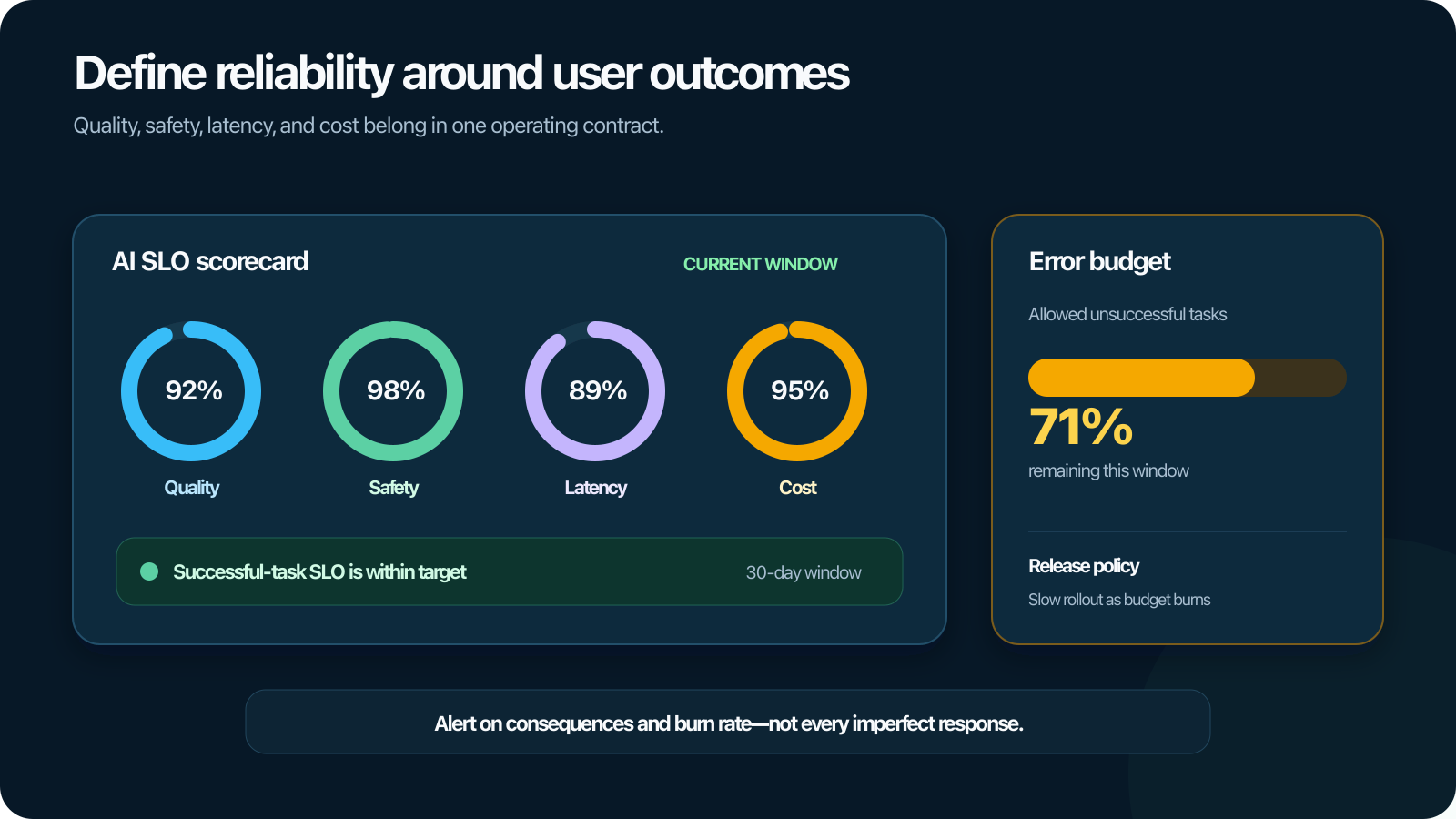
An AI application can be available and fast while returning an unsupported answer or taking the wrong action. Traditional reliability objectives remain necessary, but they do not describe whether the system behaves usefully and safely.
Service-level objectives for AI applications extend user-centered reliability to task success, semantic quality, safety, and operating cost. They convert those expectations into measurable targets and a policy for responding when the system misses them.
What is an AI SLO?
An AI service-level objective is a target for a measurable aspect of an AI application's behavior over a defined population and time window.
It follows the established SRE structure:
- A service-level indicator (SLI) measures behavior.
- A service-level objective (SLO) sets the target for that indicator.
- An error budget represents the acceptable amount of behavior outside the target.
Google's SRE guidance on SLOs emphasizes defining indicators from what users care about and using error budgets to guide decisions. For AI systems, “good service” may require several conditions beyond a successful response code.
An illustrative task-level indicator could be:
The proportion of eligible support tasks that complete successfully, pass policy checks, and respond within the latency threshold.
The exact definition must specify eligible tasks, success, evaluators, exclusions, threshold, measurement source, and time window.
Why infrastructure SLOs are not enough
AI systems have silent failures:
- A response is fluent but factually wrong.
- A RAG system uses an outdated source.
- An agent calls a valid tool with the wrong arguments.
- A fallback model changes policy behavior.
- A task completes after an expensive loop.
- The application refuses safe requests too often.
Availability, latency, and error rate do not capture these outcomes. At the same time, a semantic score without operational context can hide timeouts, unavailable tools, and unaffordable cost.
Use a small set of SLOs that together represent the user experience and the risks the team must manage.
Choose the right measurement boundary
Define what receives the service:
- One model operation.
- One response or conversation turn.
- One user task.
- One agent run or workflow.
- One business outcome.
For agents and multi-step applications, the task boundary is usually more meaningful than the model-call boundary. A successful model call can lead to a failed tool action or unresolved task.
Also define the population. Interactive questions, long-running research, and high-risk actions may need different indicators and targets. Do not average incompatible workloads into one objective.
AI SLO dimensions
Availability and completion
Measure whether eligible tasks receive a result or expected escalation. Include application, model-provider, retrieval, tool, and infrastructure failures.
Possible SLIs:
- Completed tasks divided by eligible tasks.
- Tasks without unhandled errors or timeouts.
- Tasks that reach a verified final state.
Latency
Measure from the user's perspective. Depending on the interface, use time to first useful output, total response time, or time to completed task.
Agents may need separate objectives for interactive steps and long-running execution. Include retries and tools in end-to-end latency.
Task success
Define the observable outcome for each task class. Use system state or deterministic verification when possible, then add calibrated semantic evaluation where the outcome is open-ended.
Examples include a correctly updated record, resolved support request, valid cited answer, accepted recommendation, or appropriate escalation.
Quality
Select a small number of dimensions tied to user value: correctness, groundedness, relevance, completeness, citation support, or tool correctness.
Document the evaluator and threshold. If a model-based judge supplies the SLI, version and calibrate it against human review.
Safety and policy
Critical safety or authorization behavior should often be a separate guardrail rather than averaged with general quality.
Examples include:
- Unauthorized actions.
- Exposure of protected information.
- Use of prohibited or unapproved sources.
- Failure to obtain required consent.
- Violation of a domain policy or action limit.
Some events may require immediate incident response regardless of the rolling percentage.
Cost and efficiency
Define a task-level cost or resource budget while preserving quality. Possible indicators include tasks below a cost threshold, calls or tokens per successful task, or the proportion of traces without unnecessary retries.
Cost objectives should not encourage the application to refuse difficult but valid work. Segment by task class.
Design an AI SLI
A robust SLI definition includes:
| Element | Question |
|---|---|
| Population | Which tasks, users, environments, and versions are eligible? |
| Good event | What exact conditions make one event successful? |
| Data source | Which traces, metrics, outcomes, or review records supply the measurement? |
| Evaluator | Which rule, model, rubric, or human process determines semantic quality? |
| Window | Over what rolling or calendar period is the ratio calculated? |
| Segments | Which task or risk classes must be reported separately? |
| Delay | When is the outcome final enough to count? |
| Exclusions | Which events are excluded, and how are exclusions audited? |
| Owner | Who investigates and who can change the definition? |
Express ratio indicators as good events divided by eligible events where possible. This supports intuitive targets and error budgets.
Use composite indicators carefully
A task may count as good only if it is successful, safe, grounded, and within latency. This composite reflects the complete user experience, but it can hide which condition is failing.
Maintain the component indicators and budgets separately. Use the composite for an overall view and the components for diagnosis and policy.
Never let high quality compensate mathematically for a critical policy violation. Safety requirements need explicit treatment.
Example SLOs for a support agent
The following targets are illustrative, not universal recommendations.
| Dimension | Example SLI | Example target |
|---|---|---|
| Completion | Eligible tasks reaching a verified answer, action, or correct escalation | 99% over 28 days |
| Interactive latency | Tasks with first useful response below the threshold | 95% below 2 seconds |
| Task success | Reviewed or deterministically verified tasks completed correctly | 97% over 28 days |
| Groundedness | Sampled factual answers passing a calibrated groundedness evaluator | 98% over 28 days |
| Authorization | Action tasks without an unauthorized tool operation | 100%, with every violation investigated |
| Cost | Ordinary successful tasks within the defined task-class budget | 95% over 28 days |
The team should choose targets from user needs, risk, measurement quality, and operating reality—not copy a generic percentage.
Create meaningful error budgets
For an SLO expressed as a success ratio, the error budget is the allowable share outside the target. A 99% task-completion SLO permits 1% incomplete eligible tasks during the window.
Define what happens as the budget burns:
- Increase trace sampling and human review.
- Pause a rollout or revert a prompt, model, tool, or routing policy.
- Route high-risk tasks to a safer fallback or human.
- Prioritize reliability and evaluation work over new features.
- Tighten provider, tool, or agent limits.
- Conduct an incident review for a critical failure.
An error budget without an agreed response policy is only a dashboard number.
Measure semantic SLIs responsibly
Calibrate automated evaluators
Compare model-based or heuristic evaluators with expert-labeled cases. Track false passes and false failures by task and segment.
Account for sampling
If only a sample receives semantic evaluation, record the sampling policy and confidence. Prioritize high-risk, new-release, uncertain, and unusual traces while retaining a representative random sample.
Handle delayed outcomes
Some tasks are only known to be successful after a user action, human review, or downstream state change. Keep provisional and finalized measurements separate.
Version the measurement system
An evaluator, rubric, sampling policy, or task taxonomy change can shift the SLI without a product change. Preserve version history and backfill only when methodologically valid.
Audit exclusions
Teams can improve an SLO artificially by excluding difficult events. Keep exclusions narrow, visible, and reviewed.
Segment before aggregating
Report SLOs by important dimensions:
- Task and risk class.
- Language or region.
- Model, prompt, retrieval, agent, tool, and release version.
- Provider and fallback path.
- Tenant or bounded user segment.
- Input or context size category.
A global SLO can pass while a critical low-volume group receives poor service. Define separate objectives where user expectations or consequences differ materially.
Connect SLOs with traces and evaluations
Metrics show budget consumption. Traces show which requests spent it. Evaluations explain whether semantic criteria passed. Outcomes confirm whether the user task succeeded.
For every SLO breach, the team should be able to move from:
- The affected SLI and time window.
- The release, segment, model, prompt, tool, or provider contributing to the change.
- Representative traces.
- The failing span, evaluator, or outcome.
- A reproducible regression case.
- A candidate fix and controlled release.
This turns the SLO into an operating mechanism rather than a reporting artifact.
Use SLOs in release policy
Before release, require the candidate to pass offline quality and safety gates. During rollout, compare leading indicators with the baseline and monitor error-budget burn.
Define actions for:
- A critical safety event.
- Fast burn over a short window.
- Slow burn that threatens the period budget.
- A regression isolated to one segment.
- An evaluator or measurement-system failure.
- Provider degradation that triggers fallback.
The policy can distinguish rollback, traffic reduction, human escalation, feature pause, and investigation.
Common AI SLO mistakes
Choosing what is easy to measure
Start from what users need, then design the indicator. Model latency is easier to measure than task success but may not represent the service.
Defining one universal quality score
Different tasks require different criteria. Preserve quality dimensions and critical guardrails.
Setting every target to 100%
Perfect targets can make error budgets unusable and slow improvement. Reserve zero-tolerance handling for genuinely critical events and define explicit incident policy.
Trusting an uncalibrated evaluator
The SLO is only as reliable as its measurement. Version, calibrate, sample, and review semantic evaluators.
Ignoring measurement delay
Do not count a task as successful before the final outcome is observable. Label provisional data clearly.
Reporting averages without segments
Track important task and risk classes separately so low-volume harm is visible.
Creating SLOs without consequences
Agree on owners, alerts, error-budget actions, and release policy before treating the objective as operational.
Polyaxon and the AI reliability roadmap
Polyaxon's tracking, orchestration, and platform observability capabilities provide a foundation for versioned metrics, automated workflows, infrastructure reliability, and reproducible evaluation inputs.
Full LLM and agent observability and evaluations are active areas on the Polyaxon roadmap, together with an AI gateway, prompt management, and agent sandboxing.
The direction is to measure user-centered AI SLIs from traces, evaluations, cost, and task outcomes, then connect budget consumption with the exact application version and a reproducible improvement workflow.
Define reliability from the user's task
AI reliability is more than uptime. It includes whether the system completed the task, used appropriate evidence and tools, respected policy, responded in time, and operated within a sustainable budget.
Choose a small set of measurable objectives around those needs. Keep the definitions and evaluator versions explicit, segment the results, and attach an error-budget policy. AI observability supplies the evidence, while offline and online evaluation keeps those objectives connected to releases and real behavior. That gives teams a shared way to balance release velocity with the behavior users depend on.