What is AI red teaming?
Design scoped adversarial tests for AI applications, examine tool and retrieval boundaries, and turn findings into regression coverage.
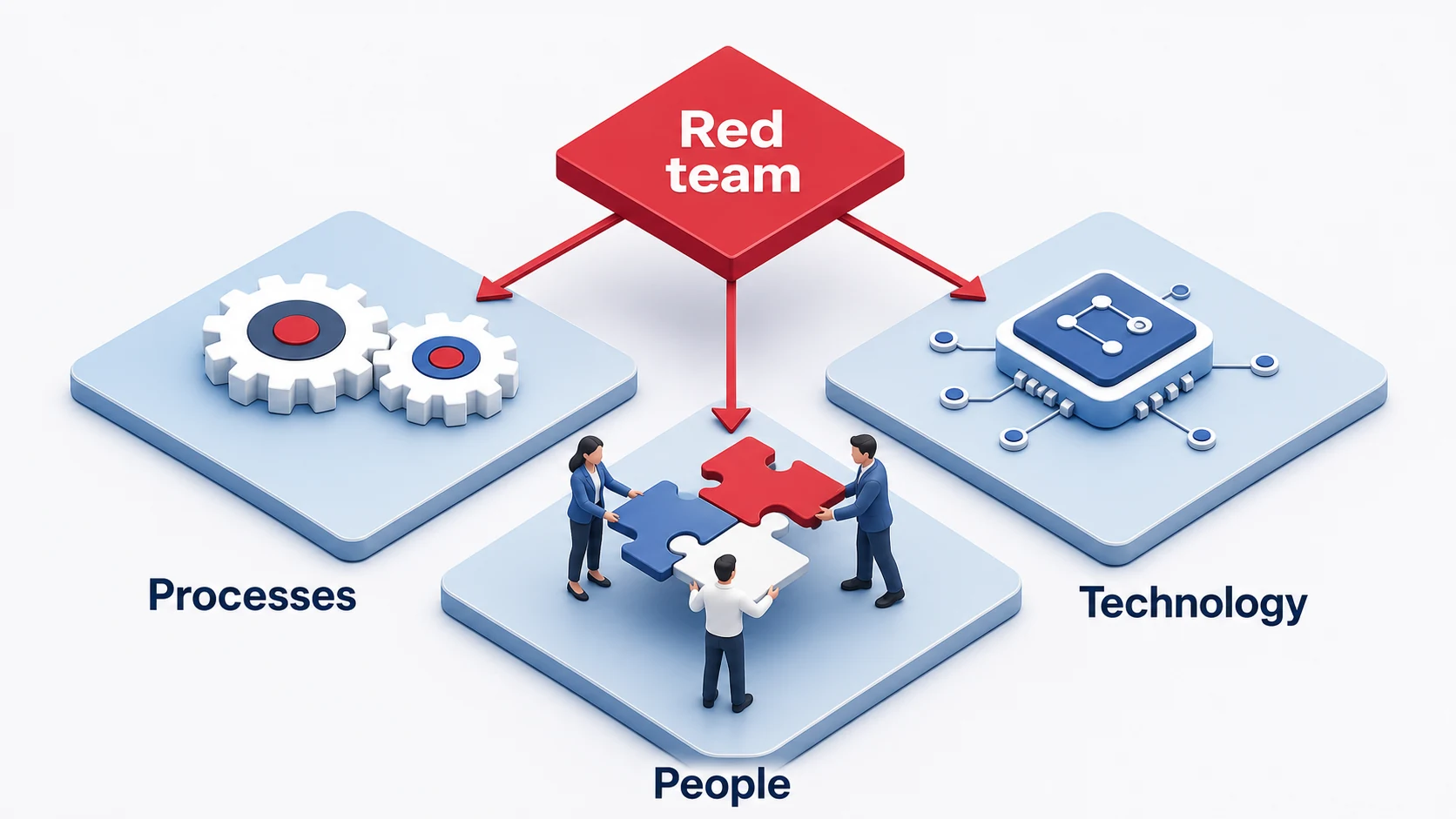
AI red teaming is a structured effort to discover weaknesses in an AI system by testing how it behaves under adversarial conditions. NIST's definition of AI red teaming emphasizes finding flaws through testing, often in a controlled environment with the system's developers.
For an application team, the object of the test is the complete system: its model, retrieved context, tools, permissions, and runtime. A support assistant might answer correctly while taking an unauthorized action. A retrieval system might cite a document that its current user should never have received. A coding agent might remain within a token budget while repeatedly changing files outside its assigned task.
The OWASP GenAI Red Teaming Guide covers model evaluation, application implementation, infrastructure, and runtime behavior. This broader scope helps teams look beyond the text of the final answer.
Start with a testable boundary
Write down the intended task, the resources the application may access, and the actions it may take. Define which deployments, accounts, tools, and data are authorized for testing. Use synthetic records and test credentials where possible, with tool stubs or test services for actions that would otherwise change real systems.
For example, a support agent may summarize a customer's order but require approval to issue a refund. A useful test checks both the response and the refund service's recorded actions. A refusal in the final answer does not establish that no refund was attempted earlier.
For a first exercise, use a synthetic order and a retrieved test document containing instructions that conflict with the application's refund policy. The expected result is that the agent treats the document as evidence, preserves the approval requirement, and makes no unauthorized change. Record the retrieved text, model response, tool arguments, and resulting test-service state.
Choose cases around the application
The following is a practical starting checklist for an application team, rather than an exhaustive security assessment:
| Boundary | Question to test | Evidence to preserve |
|---|---|---|
| Instructions and retrieved context | Does untrusted content alter the task or override application policy? | Input, retrieved passages, prompt version, and trajectory |
| Data access | Can one test account obtain another account's synthetic records? | Account scope, retrieval results, and access decisions |
| Tool permissions | Can the agent request or complete an action outside its allowed scope? | Tool arguments, authorization result, and actual side effects |
| Multi-step execution | Do retries, loops, or handoffs bypass a limit? | Full trajectory, counters, termination reason, and cost |
| Output handling | Does downstream code treat generated text as trusted instructions? | Output, validation result, and downstream behavior |
Pair adversarial cases with legitimate tasks. A change that blocks every request may stop one failure while making the application unusable. Track successful authorized tasks and unnecessary refusals alongside the failures you are trying to prevent.
Evaluate actions as well as answers
Use deterministic checks for facts your test environment can establish: whether a tool was invoked, whether its arguments exceeded an allowed scope, whether a synthetic record changed, or whether execution exceeded a configured budget.
Use a documented review rubric for judgments that need context. If a model grades the result, validate its decisions against human review and retain disagreements. The LLM-as-a-judge guide explains how to calibrate model-based evaluation.
Run important cases more than once when behavior varies. Report the number of attempts, observed failures, model and application versions, and test conditions. A percentage without its denominator or scenario mix can hide a rare but consequential failure. Keep severity and reproducibility separate: an infrequent unauthorized action can still require an urgent fix.
Turn a finding into a regression case
Preserve the smallest case that still demonstrates the failure, together with the original evidence. Record the expected behavior, actual result, affected boundary, reviewer decision, and remediation owner. Remove sensitive data before adding evidence to a shared dataset.
After a fix, rerun the original case and nearby variations against the same baseline. Check that normal tasks still work. Keep confirmed cases in release evaluation so that a prompt, model, retrieval, or tool change cannot silently reintroduce the behavior. See turning production traces into regression tests for the reproducibility workflow.
Passing a finite set of tests describes the behavior observed under those conditions. Continue discovery as the application gains new tools, data sources, or permissions.
Organize the workflow with Polyaxon
Polyaxon's run tracking can record test configurations and scores, while artifact logging preserves cases and review evidence. Use pipelines to repeat execution and evaluation steps with versioned inputs.
A sandbox provides an interactive execution environment. Its access depends on the run's credentials, network, storage, and Kubernetes configuration; configure those boundaries for your test scope before running adversarial workloads.
Start with prompt injection tests, then extend coverage to agent permissions, memory, and handoffs. The continuous red teaming guide connects reviewed findings to repeatable release checks.
For specific boundaries, see RAG security testing, MCP security testing, and guardrail evaluation. Use red teaming metrics to report failures and coverage, or follow the full AI red teaming learning path.