What is an AI gateway?
An AI gateway centralizes model access, routing, resilience, policy, cost controls, and telemetry across production LLM applications and agents.
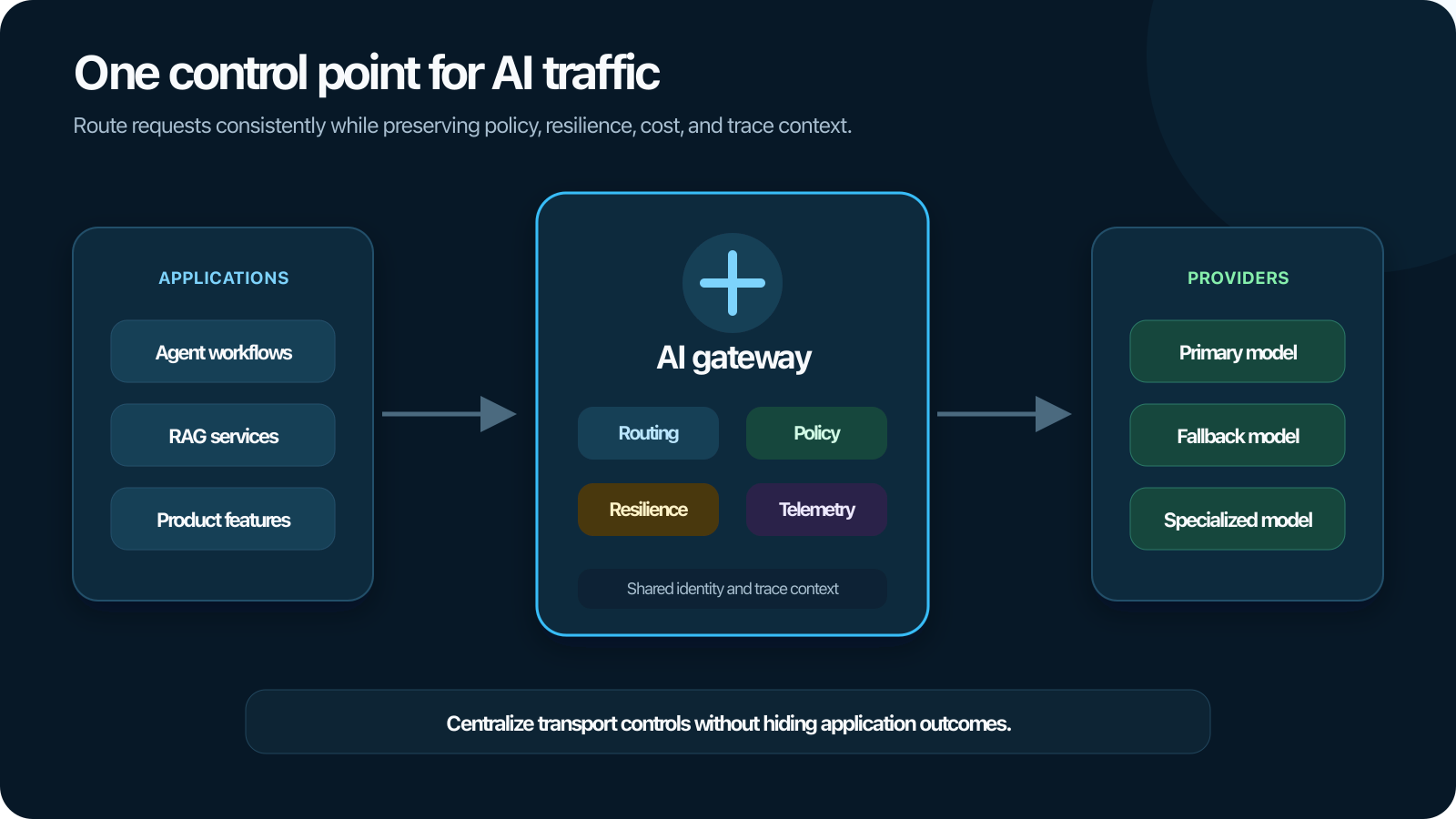
An application that starts with one model API can quickly depend on several providers, embedding services, rerankers, guardrails, regional endpoints, and self-hosted models. Each integration brings its own authentication, request format, quotas, errors, pricing, and telemetry.
An AI gateway provides a controlled entry point to those model services. It separates application logic from provider-specific operations and gives platform teams one place to apply routing, resilience, governance, cost controls, and observability.
What is an AI gateway?
An AI gateway is an infrastructure layer that manages and governs traffic between AI applications or agents and model providers or inference endpoints.
It can provide:
- Centralized credentials and access control.
- A consistent request interface across providers.
- Model aliases and version-aware routing.
- Load balancing, retries, timeouts, and fallbacks.
- Rate, token, concurrency, and budget limits.
- Request and response validation.
- Safety, privacy, and policy enforcement.
- Caching where semantics allow.
- Usage, latency, error, token, and cost telemetry.
- Trace context propagation across the model call.
The gateway does not replace application evaluation or end-to-end observability. It controls and observes the boundary around model access; application traces connect that boundary with retrieval, tools, business logic, and the user outcome.
AI gateway vs. API gateway
An AI gateway builds on familiar API-gateway concerns but adds model-specific behavior.
| API gateway | AI gateway |
|---|---|
| Routes HTTP, RPC, or service traffic | Routes generation, embedding, reranking, image, audio, and other model operations |
| Applies authentication and request limits | Adds provider credentials, model aliases, token limits, and usage budgets |
| Retries known service errors | Uses model-aware retry and fallback policies |
| Tracks status, latency, and throughput | Adds model, token, cache, finish reason, estimated cost, and evaluation context |
| Validates request schemas | Can validate messages, tool schemas, output formats, and content policy |
| Balances equivalent backends | May route by capability, quality, cost, region, capacity, or task |
Some platforms extend an existing API gateway; others provide a specialized proxy or SDK. The important distinction is the operating contract, not the product category.
Where the gateway fits
A typical request path is:
- The application selects a logical model or capability.
- It sends the request with trace, tenant, task, and policy context.
- The gateway authenticates the application and resolves the model alias.
- It applies budgets, rate limits, validation, and guardrails.
- A routing policy selects the provider and endpoint.
- The gateway translates the request if needed and forwards it.
- It handles retry, timeout, or fallback according to policy.
- It records usage, cost, latency, errors, and routing decisions.
- The response returns with the resolved model and trace context.
Keep task-specific prompting and orchestration in the application. A gateway can decorate or validate requests, but hiding complex product behavior in infrastructure policy makes evaluation and ownership difficult.
Core AI gateway capabilities
Credential management
Applications authenticate to the gateway rather than storing provider keys independently. The gateway selects controlled credentials by environment, tenant, provider, region, or workload.
Rotate keys, restrict scopes, prevent credentials from appearing in logs, and audit which application accessed which provider. Use secret stores and short-lived credentials where available.
Provider abstraction
A normalized interface reduces provider-specific code and supports portability. Preserve access to provider-specific features explicitly; the lowest common denominator can hide important capabilities or semantics.
Record both the logical model alias and the resolved provider, model, endpoint, and version in the trace.
Model routing
Routing policies can consider:
- Task or requested capability.
- Quality and safety requirements.
- Region and data-residency policy.
- Provider health, capacity, and quota.
- Latency and cost budget.
- Tenant or plan.
- Model or prompt compatibility.
- Experiment, canary, or release allocation.
Routing is a production decision system. Version the policy, preserve the reason, and evaluate it by task outcome rather than only endpoint latency.
Resilience and fallback
Use timeouts, retries, circuit breakers, and provider fallbacks to handle transient failure. Make policies operation-aware.
Generation requests may be expensive or non-idempotent from the user's perspective. A retry can produce a different answer, duplicate streamed output, or cause repeated downstream work if the application does not coordinate it.
Define:
- Which errors are retryable.
- Maximum attempts and total deadline.
- Whether to retry the same endpoint or switch provider.
- Whether model quality or behavior can change on fallback.
- How the application is told that a fallback occurred.
- How duplicate output and billing are handled.
Rate and budget controls
Limit requests, tokens, concurrency, or estimated spend by application, tenant, model, environment, or user tier. Token-aware controls are more useful than request counts when payload sizes vary widely.
Apply maximum context, output, and agent-task budgets where appropriate. The application should still enforce end-to-end task limits across several gateway calls.
Validation and policy
Validate request size, message structure, tool definitions, output schemas, and supported model parameters. Apply redaction, content policy, or provider restrictions based on the use case.
Keep high-impact authorization in the application or tool layer as well. A model-access gateway cannot determine whether a user is allowed to refund an order unless it receives and verifies the necessary business context.
Caching
Semantic or exact caching can reduce latency and cost for stable requests. Cache keys must include every input that changes the acceptable response: prompt, model behavior, tenant, permissions, source versions, tools, policies, and freshness.
Do not share cached content across security boundaries. Avoid caching requests whose results must be current, personalized, or non-repeatable.
Observability
Record:
- Logical alias and resolved model endpoint.
- Application, tenant, release, task, and trace identifiers.
- Routing policy and decision reason.
- Request type, input and output units, cache status, and finish reason.
- Attempts, fallback chain, error category, and status.
- Queue, provider, and end-to-end gateway latency.
- Estimated cost and pricing-table version.
- Policy, validation, and redaction actions.
Propagate trace context so the model span remains part of the complete application or agent trace.
Design routing policies with evaluation evidence
A routing policy should optimize a defined outcome, not simply choose the cheapest available model.
Start by segmenting tasks. Evaluate candidate models on representative cases for quality, safety, latency, and cost. Define which models are eligible for each task and when escalation is justified.
For example:
- A small model handles language detection and bounded classification.
- A medium model answers ordinary grounded questions.
- A stronger model receives complex multi-document requests.
- A restricted regional endpoint handles sensitive workloads.
- A fallback activates only after a retryable provider failure.
Measure cost per successful task and fallback quality. A cheaper primary model may increase total cost if it causes more retries, tool loops, or human escalation.
Make failover visible
Fallback is a behavior change. The application and observability system should know:
- The requested logical model.
- The original resolved target.
- Each failed attempt and reason.
- The final provider and model.
- Whether the prompt or parameters were translated.
- The added latency and cost.
- The effect on quality and output compatibility.
Alert on fallback rate and correlate it with task success. A gateway that returns successful HTTP responses while silently degrading quality is not healthy.
Example: a multi-provider support assistant
A support assistant uses one logical alias, support-generation, across development and production.
The gateway policy:
- Allows only approved applications and tenants.
- Enforces regional endpoints for regulated data.
- Limits context and output tokens.
- Routes ordinary questions to the default model.
- Routes policy-sensitive tasks to a validated stronger model.
- Retries one transient provider error within the task deadline.
- Uses an approved fallback only when its evaluation profile meets the task requirements.
- Records the routing decision, resolved model, tokens, cost, and trace context.
If spend increases, the team can distinguish traffic growth from longer prompts or more fallbacks. If quality declines, application traces reveal whether the affected tasks were routed differently.
Build or adopt an AI gateway?
Building a thin proxy can centralize keys and basic telemetry quickly. Production requirements expand as teams add providers, streaming, tool calls, quotas, regional policies, schema differences, and high availability.
Evaluate options using:
- Supported providers and operations.
- Fidelity of request and response translation.
- Streaming and tool-call behavior.
- Routing, retries, fallbacks, and circuit breaking.
- Credential, tenant, and policy isolation.
- Trace and metric standards.
- Data retention and content-capture controls.
- Deployment, scaling, and failure architecture.
- Configuration versioning and audit history.
- Performance overhead and cost.
Keep the application capable of identifying the resolved target and handling gateway failure. Centralization should reduce duplicated complexity without becoming an opaque single point of failure.
Common AI gateway mistakes
Treating providers as interchangeable
Models and APIs differ in behavior, schemas, limits, and safety. Evaluate every target and fallback for the actual task.
Retrying without an end-to-end deadline
Gateway retries can consume the application's entire latency and cost budget. Propagate deadlines and attempt counts.
Hiding routing decisions
Record the logical alias, resolved target, policy version, and reason. Otherwise, production behavior cannot be reproduced.
Applying generic caching across tenants
Include permissions, data versions, and user context in cache policy. Prefer no cache when correctness or isolation is uncertain.
Monitoring the gateway but not the outcome
Gateway latency and errors do not show whether the user task succeeded. Connect model telemetry with application traces and evaluations.
Putting all prompt and product logic in the gateway
Keep ownership clear. Infrastructure policy should not become an unversioned application runtime.
Polyaxon and the AI-gateway roadmap
Polyaxon's orchestration, tracking, and platform-observability capabilities provide a foundation for reliable AI workflows, application lineage, and infrastructure operations.
An AI gateway is an active area on the Polyaxon roadmap, alongside full LLM and agent observability, evaluations, prompt management and optimization, and agent sandboxing.
The direction is to connect gateway policy and provider telemetry with application versions, traces, evaluation results, cost, and task outcomes.
Centralize control without losing context
An AI gateway can simplify provider access and make routing, resilience, policy, and cost controls consistent across applications. Its value depends on preserving the identity and behavior of the resolved model operation.
Keep routing decisions versioned, fallbacks visible, trace context intact, and quality connected to the user outcome. Combine cost monitoring with AI agent tracing to understand the complete effect of each routing decision. That creates a controlled model-access layer without turning it into a black box.