What is LLMOps? From prototype to production
LLMOps applies repeatable development, evaluation, deployment, and observability practices to production LLM applications and AI agents.
An LLM prototype can look impressive after a few prompts and still be far from production-ready. Real users phrase requests differently, retrieved context changes, model providers update their systems, tools fail, and small prompt edits can alter quality, latency, or cost in unexpected ways.
LLMOps is the discipline for managing that complexity. It brings repeatable engineering practices to the full lifecycle of applications built with large language models, including assistants, retrieval-augmented generation (RAG) systems, copilots, and AI agents.
What is LLMOps?
LLMOps, short for large language model operations, is the set of practices, processes, and tools used to develop, evaluate, deploy, observe, and improve LLM applications in production.
The model is only one part of the system. A production application may also include prompt templates, retrieval pipelines, vector databases, tools, memory, guardrails, routing logic, provider APIs, and business rules. LLMOps treats these components as a connected, versioned system rather than a collection of isolated experiments.
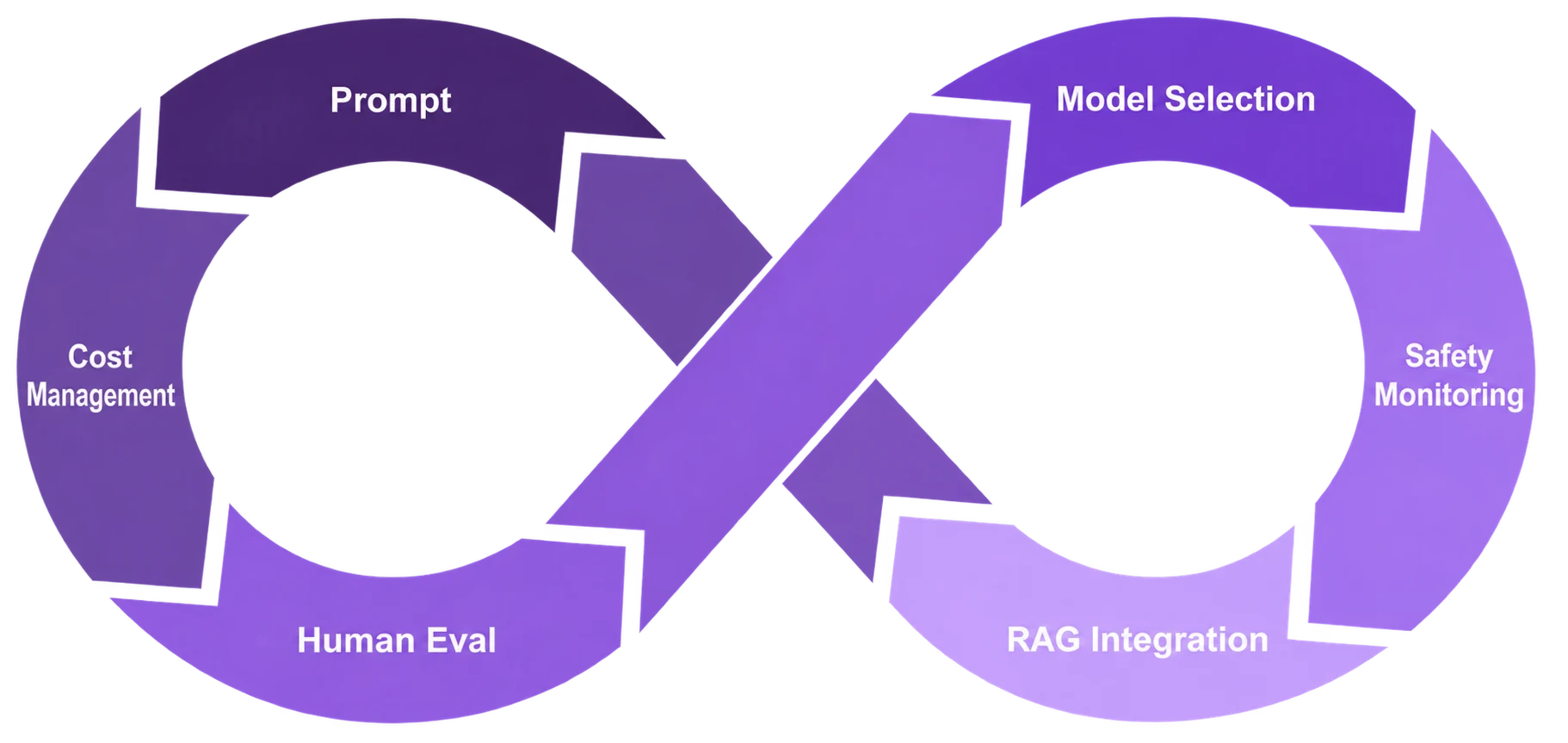
LLMOps extends the continuous development, deployment, monitoring, and improvement loop with prompts, retrieval, tools, evaluations, and application traces.
A mature LLMOps practice should help a team answer five questions:
- What exactly changed between two versions of the application?
- Did the change improve quality on representative tasks?
- Can the team release it safely and roll it back quickly?
- How does the application behave with real users and production data?
- Which production evidence should become the next evaluation or experiment?
This makes LLMOps both a delivery practice and a learning loop. The objective is not merely to put an LLM behind an API. It is to make the complete application measurable, reproducible, and improvable.
Why LLM applications need an operations discipline
LLM applications inherit familiar software risks and introduce new forms of uncertainty.
Outputs are variable
Traditional software is often evaluated against an exact expected result. LLM outputs can be useful in several forms, and the same input can produce different answers. Quality may depend on correctness, relevance, completeness, tone, safety, or whether a task was completed—not on a single exact string.
Behavior depends on more than code
A release can change because of a prompt, model, inference parameter, retrieval index, tool definition, guardrail, or context-window strategy. Some dependencies are controlled by the team; others are managed by external providers. Without versioning and lineage, it becomes difficult to explain why behavior changed.
Successful requests can still be failures
An HTTP 200 response says little about whether the answer was accurate or the agent took the correct action. Conventional availability and latency monitoring remain essential, but they cannot measure semantic quality or task success on their own.
Each request can be a workflow
An agent may plan, retrieve context, call several tools, retry a failed step, hand work to another agent, and produce a final response. The quality, cost, and latency of the result depend on the full path, not only the final model call.
Cost is usage-dependent
Spend varies with input size, output length, model choice, retrieval volume, tool use, and retries. A cheaper model call does not necessarily produce a cheaper completed task if it causes more loops or human corrections.
LLMOps provides the controls and evidence needed to manage these properties as the application moves from a notebook or prompt playground into a production service.
The LLMOps lifecycle
LLMOps is best understood as a continuous lifecycle rather than a one-time deployment process.
1. Define the task and success criteria
Start with the outcome the application must produce. A support assistant might need to answer policy questions accurately, cite approved documents, and escalate account-specific cases. An agent might need to resolve a ticket without taking an unauthorized action.
Translate that outcome into measurable dimensions such as task success, factual accuracy, groundedness, tool correctness, policy compliance, latency, and cost. These definitions become the basis for datasets, evaluation rubrics, release criteria, and production monitoring.
2. Develop and experiment
Teams compare models, prompts, retrieval strategies, tool definitions, and orchestration logic. Every meaningful run should record the configuration and artifacts needed to understand and reproduce the result.
Useful lineage includes:
- Application and code version.
- Model provider, model name, and inference parameters.
- Prompt template and prompt version.
- Dataset, document index, and retrieval configuration.
- Tool schemas, agent instructions, and routing logic.
- Evaluation results, latency, token use, and cost.
This is where the practices of experiment tracking and reproducibility remain central, even when the application uses a hosted model instead of training one.
3. Evaluate the complete application
Evaluation should happen before release and cover the system rather than only the model. A RAG application needs separate signals for retrieval relevance and answer quality. An agent needs checks for the final outcome and for the trajectory of tool calls and decisions that produced it.
No single evaluator is sufficient for every property. Strong evaluation suites combine deterministic tests, reference-based metrics, model-based scoring, human review, and task-specific simulations. The mix depends on the risk and ambiguity of the use case.
4. Release with control
Version the deployable application as a complete unit. Use evaluation thresholds as release gates, and compare important changes through shadow traffic, canary releases, or controlled experiments where appropriate.
A release record should connect the production version to its prompt, model, retrieval, tool, code, and evaluation evidence. That connection makes rollbacks and incident investigation much faster.
5. Observe production behavior
Production observability connects operational signals—errors, throughput, latency, and resource usage—with AI-specific context such as prompts, retrieved documents, tool calls, token use, evaluations, and user feedback.
This is the difference between knowing that a metric changed and being able to investigate why. AI observability should make it possible to follow a request across the complete application and compare behavior by version, model, user segment, tool, or failure type.
6. Feed production evidence back into development
Production is the best source of realistic edge cases. Low-rated conversations, failed tool calls, policy violations, expensive traces, and unusual user requests should be reviewed, labeled, and promoted into regression datasets.
This closes the LLMOps loop: production evidence improves evaluation, evaluation supports safer releases, and releases generate new evidence.
Core LLMOps capabilities
Different platforms group the capabilities differently, but a production LLMOps system generally needs the following building blocks.
| Capability | What it controls or explains |
|---|---|
| Experiment tracking | Comparisons across models, prompts, parameters, datasets, retrieval strategies, and tools |
| Prompt management | Prompt ownership, versions, variables, environments, and release history |
| Evaluation | Quality, groundedness, task success, safety, tool behavior, and regressions |
| Tracing and observability | The sequence, inputs, outputs, latency, cost, and errors of application steps |
| AI gateway | Provider access, routing, fallbacks, limits, policy enforcement, and consistent telemetry |
| Orchestration | Repeatable evaluation, indexing, deployment, and improvement workflows |
| Feedback management | User feedback, human review, annotations, and failure categorization |
| Governance | Access controls, audit history, redaction, retention, and approval processes |
The value comes from connecting these capabilities. A trace is more useful when it identifies the prompt and model version. An evaluation result is more useful when it is attached to the exact application configuration. A cost dashboard is more useful when spend can be compared with task success.
LLMOps, MLOps, and DevOps
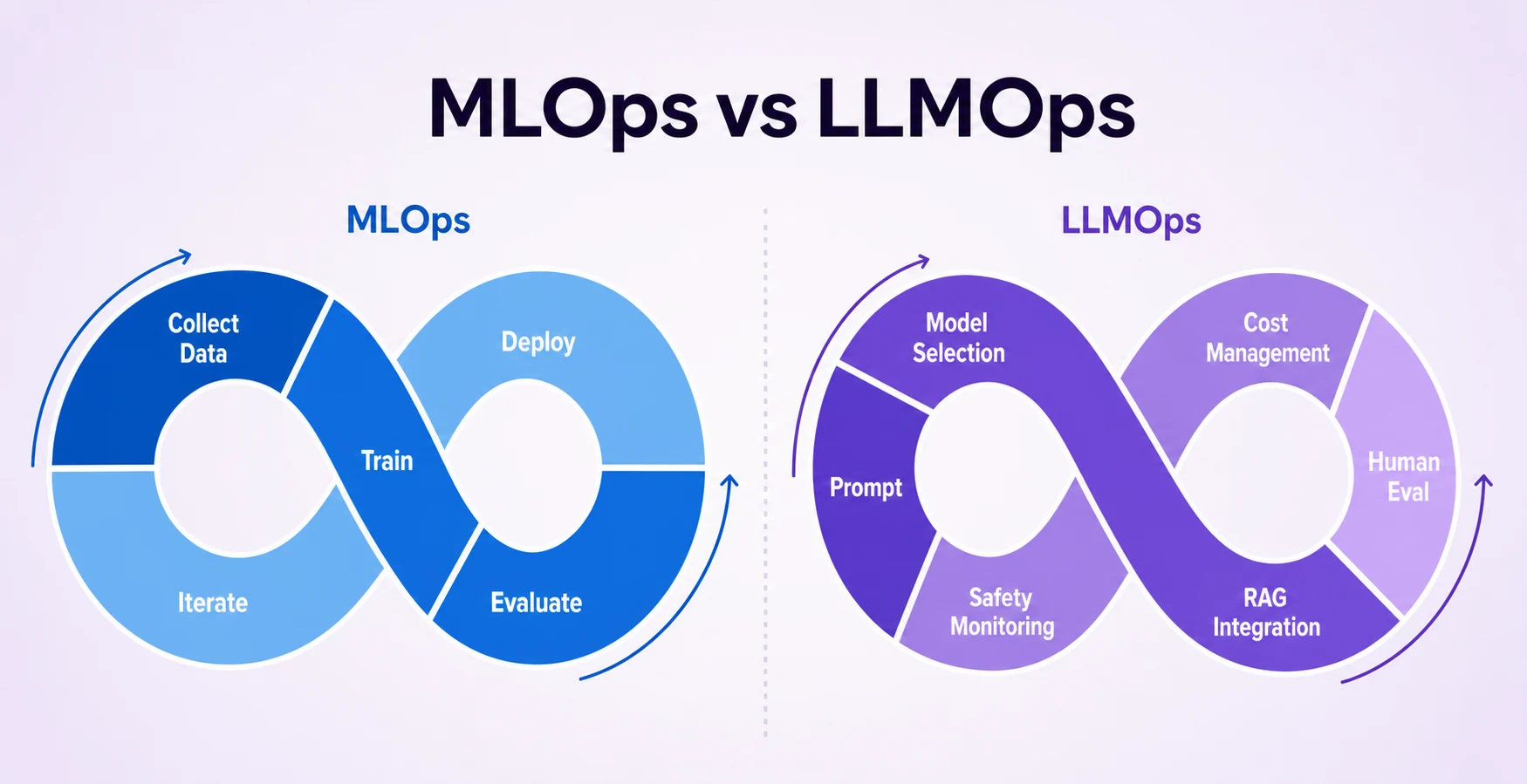
LLMOps extends rather than replaces established operational disciplines.
| Discipline | Primary system | Typical concerns |
|---|---|---|
| DevOps | Software services | Builds, deployments, availability, errors, latency, and infrastructure |
| MLOps | Predictive ML systems | Data and model lineage, training, validation, deployment, drift, and retraining |
| LLMOps | Generative AI applications and agents | Prompts, retrieval, tools, semantic evaluation, traces, feedback, tokens, and provider behavior |
The boundaries overlap. An LLM application still needs reliable software delivery and infrastructure. A team that fine-tunes or trains models still needs MLOps practices for data, training, and model governance. LLMOps adds the application-level context required to operate generative systems whose quality depends on prompts, context, tools, and multi-step behavior.
The most effective operating model connects all three instead of creating a separate process for every new AI component.
Example: an LLMOps workflow for a support agent
Consider an agent that answers product questions and can create, update, or escalate support tickets.
During development, the team records each candidate model, prompt, retrieval configuration, and tool schema. It runs a versioned evaluation dataset containing ordinary requests, ambiguous questions, outdated documentation, permission-sensitive actions, and adversarial instructions.
The release gate checks several dimensions:
- The answer is grounded in approved documentation.
- Citations point to relevant sources.
- The agent selects the correct tool when an action is required.
- Tool arguments contain the correct customer and ticket information.
- Restricted actions are refused or escalated.
- Task-level latency and cost stay within their budgets.
After release, traces connect each conversation to its model, prompt, retrieval results, tool calls, evaluation signals, and user feedback. If ticket-update failures increase, the team can determine whether the cause is a tool-schema change, an agent-planning problem, missing context, or a provider regression.
Representative failures are added to the evaluation dataset. A proposed fix must pass those cases before another controlled release. The workflow converts an isolated incident into durable protection against recurrence.
How to introduce LLMOps incrementally
Teams do not need to build the complete operating model at once. A practical sequence is:
- Choose one valuable workflow. Define the user, the task, and the consequence of failure.
- Version the important context. Record prompts, models, datasets, retrieval settings, tools, and code together.
- Build a representative evaluation set. Include common cases, edge cases, and examples of unacceptable behavior.
- Instrument the end-to-end path. Preserve request, retrieval, model, tool, and outcome context with appropriate redaction.
- Create release criteria. Combine quality and safety checks with latency and cost budgets.
- Review production failures systematically. Segment them by version and failure type instead of reading samples at random.
- Turn failures into regression cases. Maintain a living dataset that evolves with users and the application.
Start with the evidence needed for a real decision. Collecting every prompt and metric without a clear debugging, evaluation, or governance use case can create cost and privacy risk without improving the application.
Common LLMOps mistakes
Managing only prompts
Prompt versioning is important, but behavior can also change because of the model, retrieval layer, tool contract, inference parameters, or surrounding code. Version and evaluate the application configuration as a whole.
Monitoring only infrastructure
Availability, latency, and error rates cannot show whether an answer was grounded or an action was appropriate. Add semantic quality, task outcome, and user feedback signals.
Evaluating only before launch
Static test sets miss changing user behavior and production edge cases. Use production evidence to keep evaluation datasets current.
Optimizing token price instead of completed-task cost
A low-cost call can cause additional retries, tool calls, or human work. Compare cost with task success and quality at the trace or session level.
Using one score for every decision
An average quality score can hide failures in a critical segment. Keep safety and policy checks as explicit guardrails, and inspect performance by task, user cohort, language, tool, and version.
Ignoring sensitive data
Prompts, retrieved context, tool arguments, and outputs can contain personal or confidential information. Decide what to redact, hash, sample, retain, and restrict before collecting production traces at scale.
Polyaxon and the LLMOps roadmap
Polyaxon's current experiment-tracking, orchestration, and platform-observability capabilities provide a foundation for reproducible AI development and reliable production workflows. Teams can organize experiments, capture lineage and metadata, automate operations, and monitor the infrastructure that runs their workloads.
The Polyaxon roadmap extends that foundation toward the complete generative AI application lifecycle. Active areas include full OpenTelemetry-compatible LLM and agent observability, evaluations, an AI gateway, prompt management and optimization, and an agent sandbox for inspecting execution and state.
The goal is a connected loop from development and evaluation to production evidence and improvement, without separating model experiments, application behavior, and infrastructure operations into disconnected systems.
LLMOps is a continuous learning system
The hardest part of a production LLM application is not making the first model call. It is creating a reliable process for understanding changes, measuring behavior, releasing safely, and learning from real use.
LLMOps provides that process. When versions, evaluations, traces, feedback, cost, and operational context are connected, teams can move beyond impressive demos and improve generative AI systems with evidence.