What is sovereign AI? Control across the AI lifecycle
Define sovereign AI as control over data, models, compute, operations, providers, and evidence, then implement it with Kubernetes.
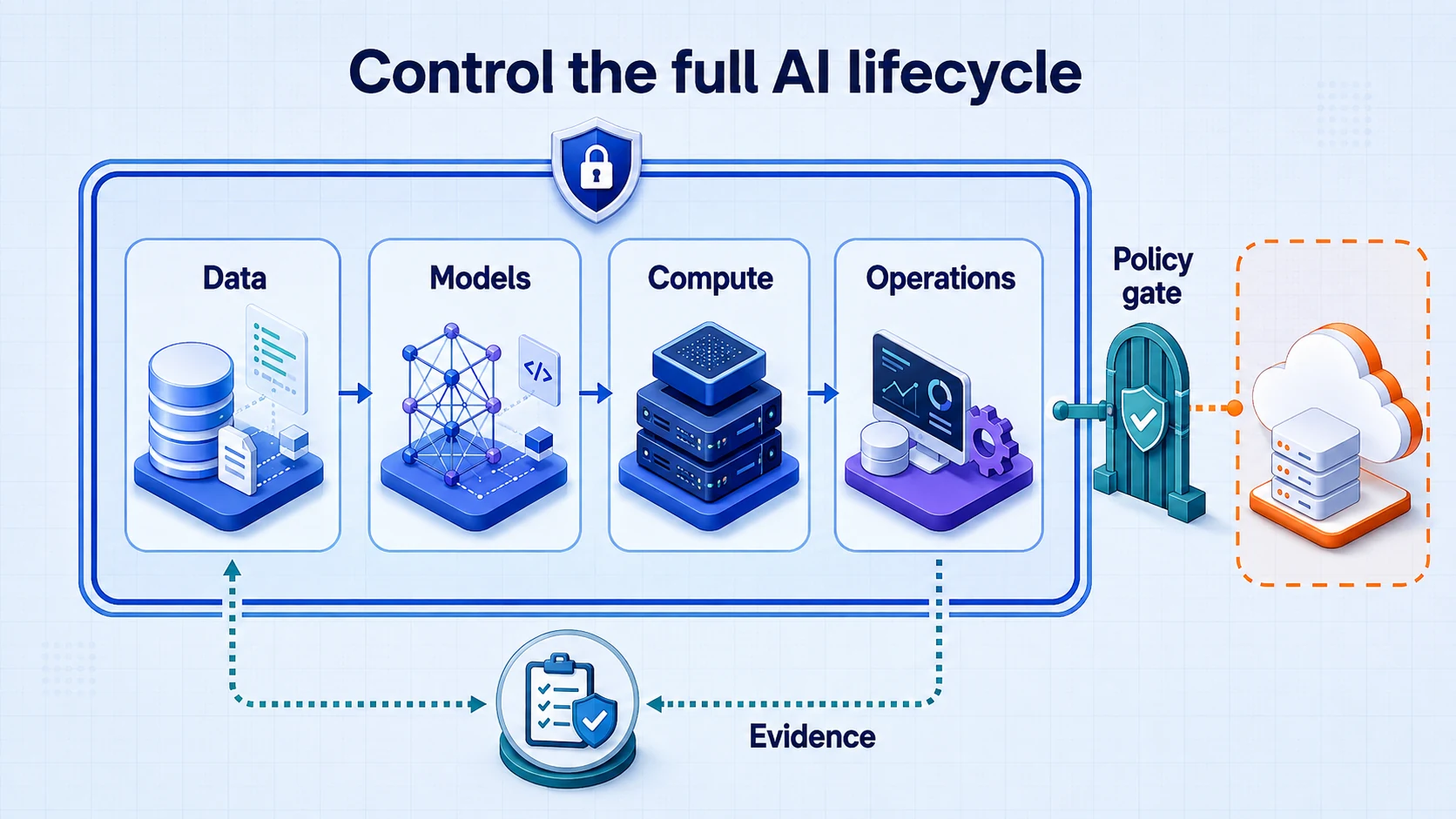
Sovereign AI is the ability to build, run, and govern an AI system within boundaries an organization or jurisdiction defines and can enforce. Those boundaries can cover where data and compute reside, which laws and contracts apply, who operates the system, which models and providers it may use, and whether the organization can inspect, change, recover, or replace its critical components.
This makes sovereign AI broader than data residency. A workload can keep its database in an approved region while sending prompts to an external model, fetching code from a public repository, exporting traces to another jurisdiction, or relying on administrators outside the operating boundary. It can also run entirely on premises and still lack reliable access controls, provenance, evaluation, or recovery.
Sovereignty is therefore an operating property of a complete AI system. It is not established by one product label, cluster location, or self-hosting decision.
Define sovereignty as verifiable control
There is no single official architecture for sovereign AI. The useful starting point is a set of control dimensions that can be tested for a particular workload.
| Dimension | Question the architecture must answer |
|---|---|
| Territorial | Where do compute, storage, backups, logs, and support operations occur? |
| Legal | Which jurisdictions, contracts, and disclosure obligations apply to every operator and provider? |
| Data | Who can read, transform, retain, export, and delete each class of data? |
| Technical | Can the organization inspect, configure, patch, and replace critical software and models? |
| Operational | Who can deploy, pause, recover, audit, and decommission the system? |
| Supply chain | Where do images, packages, models, datasets, and updates originate, and how are they verified? |
| Continuity | Can the workload continue or recover if an external service, license, region, or supplier becomes unavailable? |
These dimensions form a spectrum. A public FAQ assistant and a model trained on protected health records do not need identical controls. The McKinsey sovereign AI explainer similarly describes sovereignty as contextual rather than binary and recommends starting with workloads that need a higher level of control.
Avoid turning every preference into an absolute requirement. Full localization can increase cost, operating effort, energy use, and time to adopt new models. The goal is to retain the control needed for the task and its consequences, then document which dependencies remain external.
Start with a workload sovereignty contract
Write requirements before selecting a cloud, model server, or platform. A compact machine-readable contract makes architectural discussions concrete:
workload: claims-document-assistant
dataClasses:
  - internal
  - regulated-personal-data
allowedRegions:
  - eu-central
modelPolicy:
  allowedEndpoints:
    - in-cluster-vllm
  retainPrompts: false
execution:
  eligibleClusters:
    - eu-restricted-gpu
  internetEgress: deny
operators:
  requiredOrganization: example-eu-entity
artifacts:
  store: eu-model-artifacts
  requireDigest: true
evidence:
  retainDays: 365
  required:
    - dataset-version
    - image-digest
    - model-digest
    - evaluation-report
    - deployment-approval
recovery:
  externalProviderUnavailable: use-approved-local-model
The values are illustrative. The actual contract should come from the system owner, security and platform teams, data governance, procurement, and the people responsible for applicable legal obligations. Attach an owner and review date to every rule. “EU only” is incomplete until it identifies the services, data categories, operators, and evidence covered by that phrase.
Treat the contract as a release input. A new telemetry destination, base image, model endpoint, support arrangement, or backup region can change sovereignty even when application code stays the same.
Map every data path, including the quiet ones
Draw the path for training, batch evaluation, online inference, retrieval, tools, and observability. Include user inputs, labels, datasets, embeddings, checkpoints, caches, temporary volumes, prompts, responses, tool arguments, logs, metrics, traces, backups, and support exports.
For each movement, record:
- The sending process and receiving service.
- The data class and minimum fields required.
- Region and jurisdiction at rest, in transit, and during processing.
- Workload and human identities that can access it.
- Encryption and key ownership.
- Retention, backup, deletion, and incident-response behavior.
- The evidence that proves the route and policy were applied.
Inspect startup and failure paths as carefully as the main process. An initializer may download a model before training begins. An SDK may send usage telemetry by default. A failed job may upload logs containing prompts. A notebook may install a package from a public registry. The guide to network dependencies of ML jobs shows how to assign each connection to the component that actually makes it.
Use default-deny egress where the contract requires it, then allow named destinations through controlled DNS, network policy, proxies, or gateways. Test the enforcement from the workload itself. A diagram that says “private network” is not evidence that a container cannot reach an unapproved endpoint.
Keep compute placement and storage explicit
Kubernetes provides portable scheduling primitives, but a cluster does not become sovereign merely because it is self-managed. Record cluster ownership, physical or cloud region, node and accelerator supply, administrator access, control-plane location, storage classes, backup targets, and managed-service dependencies.
Label eligible nodes and clusters with attributes derived from verified infrastructure inventory. Admission or scheduling policy can reject a workload whose data class, model, or operator requirements do not match that environment. Separate regulated projects with namespaces, service accounts, RBAC, network policy, storage permissions, and, where needed, separate clusters or accounts. A namespace alone is not a complete security boundary; the guide to running ML workloads on existing Kubernetes covers the controls that must work together.
Pin every output to an approved store. Datasets, checkpoints, model packages, evaluation reports, logs, and generated artifacts should not fall back to an operator laptop or a default bucket outside the boundary. Include replicas and disaster-recovery copies in the inventory. Recovery that depends on an unapproved region contradicts the contract precisely when the primary environment fails.
Make the model and software supply chain replaceable
Sovereign operation does not require that every component was invented locally. It requires visibility into critical dependencies and enough practical authority to manage their risk. Maintain an inventory of:
- Base images, operating-system packages, Python packages, and build tools.
- Model weights, tokenizer, configuration, adapters, custom code, and licenses.
- Training and evaluation datasets with provenance and permitted uses.
- Registries, mirrors, update channels, signing keys, and scanners.
- Model servers, routers, retrieval libraries, agent frameworks, and tool schemas.
Mirror required artifacts into approved registries when disconnected or controlled operation requires it. Pin immutable versions and digests, verify signatures and checksums, generate software bills of materials where appropriate, and retain the result with the release. Scan model packages before loading them; model artifact scanning explains why static inspection and behavioral evaluation answer different questions.
Test substitution rather than assuming portability. Can the application move from one approved model to another while preserving output contracts, evaluation thresholds, latency, and resource limits? Can it rebuild without an unavailable public registry? Open formats and APIs help, but only an exercised migration path demonstrates operational independence.
Keep identity and operations inside the boundary
Sovereignty includes the people and services that operate the system. Integrate the platform with the approved identity provider, map groups to least-privilege roles, use workload identities or scoped service accounts, and separate development, approval, deployment, and audit responsibilities where the risk requires it.
Inventory indirect access. Cloud support, managed databases, certificate authorities, remote monitoring, software update services, and incident-response vendors may have technical or contractual paths into the environment. Record which parties can access plaintext data, keys, control planes, backups, or logs and under what process.
Administrative evidence should answer who changed a connection, approved a model, launched a workload, inspected an artifact, altered retention, or exported a report. The system also needs break-glass access, credential rotation, joiner and leaver procedures, and a tested way to revoke access during an incident.
Treat external services as explicit policy decisions
Hybrid sovereignty can be appropriate when a workload separates sensitive and general tasks. A router might send public summarization to an external model while keeping regulated documents on a local endpoint. That design is sovereign only to the extent that the classification and routing controls are reliable, observable, and owned by the organization.
Place an explicit gate before each external provider. Check data class, user or workload identity, destination, model version, retention terms, allowed fields, and failure behavior. Redact only when the remaining data is demonstrably suitable for external processing. Record the intended destination and the service that actually handled the request, including fallbacks.
Define what happens when a provider is unavailable or changes its model, API, policy, or region. A silent fallback can cross a boundary even while improving availability. Fail closed, queue work, request approval, or use an approved local alternative according to the task contract.
Produce evidence continuously
Location and configuration are starting conditions. Preserve evidence that the deployed system continues to match them:
| Evidence | What it should establish |
|---|---|
| Release manifest | Exact code, image, model, dataset, prompt, and policy versions |
| Placement record | Cluster, namespace, nodes, region, and relevant scheduling decision |
| Connection inventory | Stores, registries, repositories, endpoints, scopes, and owners |
| Evaluation report | Task quality, prohibited behavior, security, latency, and resource results |
| Network observations | Actual destinations, denied connections, and unexpected data movement |
| Audit history | Identity, approval, configuration change, export, and administrative action |
| Recovery exercise | Restore point, dependencies, achieved recovery time, and unresolved gaps |
The NIST AI Risk Management Framework organizes ongoing work around govern, map, measure, and manage. The EU AI Act is a separate risk-based legal framework; the European Commission overview highlights controls such as risk management, data quality, logging, documentation, human oversight, robustness, and cybersecurity for covered high-risk systems. A “sovereign” deployment label does not replace those lifecycle practices.
Monitor drift in every dimension: an image rebuilt from a new base, a model alias changed by a provider, data replicated to a new region, an expired network exception, a missing audit stream, or an operator added outside the approved organization. Connect alerts to the version and owner that can resolve them.
Use Polyaxon to operationalize the contract
Polyaxon is open source and can be self-hosted on Kubernetes locally, on cloud infrastructure, or on premises. It can run without internet access, with public images mirrored into a private registry. Agents deployed in Kubernetes clusters poll the control plane and manage workloads locally, supporting separate execution environments and multi-cluster placement.
Use queues, presets, and cluster eligibility to route jobs and services to approved compute. Use managed connections to attach permitted artifact stores, registries, Git repositories, databases, and secrets without repeating credentials in workload definitions. Track immutable inputs, parameters, metrics, logs, artifacts, lineage, and evaluation results; register approved model and component versions in the registry. Apply RBAC to projects and resources, and use audit logs where the deployment edition provides them.
Polyaxon supplies orchestration, versioning, access, and evidence within the AI engineering lifecycle. The surrounding environment still owns Kubernetes hardening, network enforcement, storage and key configuration, identity infrastructure, model-serving controls, provider contracts, and the legal interpretation of the workload requirements.
Test exit, recovery, and decommissioning
A sovereign architecture should keep working when assumptions fail. Practice restoring the control plane and artifacts from approved backups, rebuilding images and environments from mirrored dependencies, replacing a model endpoint, rotating keys, moving an eligible workload to another controlled cluster, and producing the evidence needed for an investigation.
Test decommissioning too. Revoke workload identities, remove provider keys, delete or archive data according to policy, preserve required records, unregister endpoints, and prove that forgotten caches and backups follow the same decision. Confirm which licensed components stop working and which exports are required before a contract ends.
The strongest sovereignty claim is operationally modest and technically specific: this workload uses these data classes, versions, identities, clusters, stores, models, providers, and operators; these controls keep them within the approved boundary; this evidence shows the controls worked; and these tested paths let the organization recover or replace dependencies when they do not.