ML infrastructure explained for business teams
Understand what ML infrastructure pays for, how it affects delivery and reliability, and how to evaluate an investment using measurable workflow outcomes.
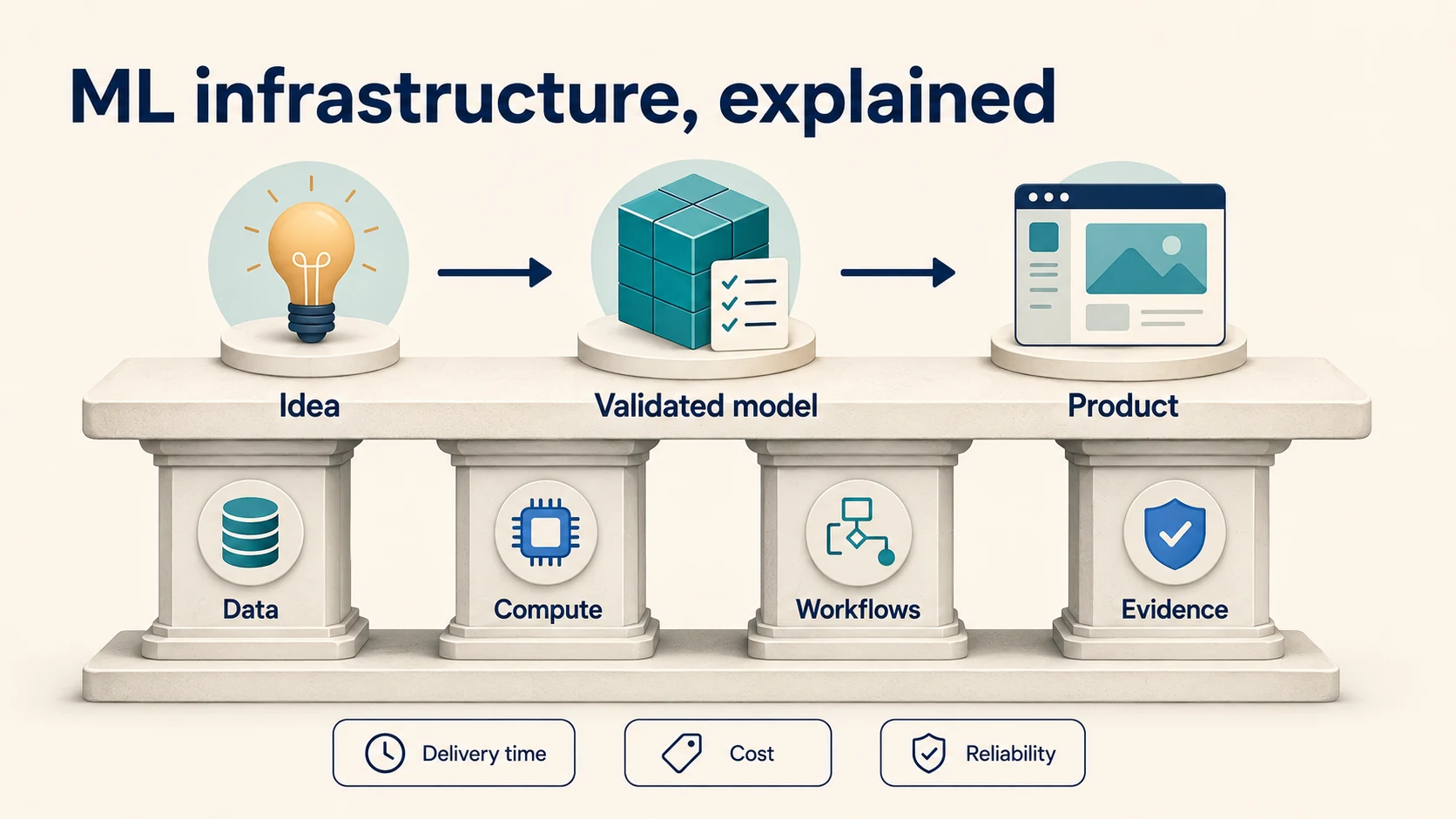
ML infrastructure is the set of systems that lets a team develop, evaluate, deliver, and operate machine learning reliably. It includes the compute used to train models, but also data access, experiment records, workflow automation, artifact storage, and the controls around changes.
For a business team, the useful question is what these systems make possible. Can an engineer repeat a promising experiment? Can a reviewer establish which model was approved? Can a failed training run recover without starting from scratch? Can the product team estimate when a model update will be ready?
Those questions turn a discussion about tools into a discussion about delivery, operating cost, and accountability.
Follow one model change through the organization
Consider a team updating a demand forecast after a change in customer behavior. It needs a reliable data snapshot, time on suitable compute, a comparison with the existing forecast, and a controlled release. The team must also explain an unfavorable result and restore the previous version if necessary.
Each part depends on infrastructure:
| Capability | What it enables | Business question |
|---|---|---|
| Data access and versioning | Training and evaluation use identifiable inputs | Can we explain which information informed the model? |
| Compute and scheduling | Jobs get appropriate resources under shared policies | What determines the wait before work begins? |
| Experiment tracking | Parameters, outputs, and comparisons remain available | Can another person verify the result? |
| Workflow automation | Repeatable steps execute with clear failure handling | How much manual coordination does an update require? |
| Artifact and model management | Reviewed packages have identifiable versions | Can we retrieve the approved version and its evidence? |
| Monitoring and recovery | Problems are detected and investigated | Who responds, and what can they restore? |
Buying faster compute addresses only some of these needs. If the team spends most of its time locating data or reconstructing previous work, more GPUs may leave the main delay unchanged.
Separate three kinds of value
Infrastructure investment can create capacity, improve predictability, or reduce operating effort. Measure those outcomes separately because they do not all become cash savings.
Capacity means more useful work can be completed with the available people and resources. Faster iteration may let a team evaluate more hypotheses, but it does not guarantee that one produces a better model.
Predictability means delivery and recovery become easier to plan. Consistent execution environments and complete records can reduce uncertainty even when the average training time remains unchanged.
Operating effort includes maintenance, incident response, manual handoffs, and repeated setup. Time freed from these activities has value, but it is not automatically a reduction in payroll or cloud bills.
Agree which outcome the investment is intended to improve. Otherwise, one stakeholder may expect lower spending while another is deliberately using the new capacity to run more experiments.
Use a complete cost boundary
Compare alternatives over the same period and workload volume. Include compute, storage, networking, software, support, and the engineering effort required to operate the system. For owned hardware, include the agreed allocation of purchase, power, facilities, and maintenance costs.
A useful operational measure is:
Cost per completed evaluation =
  Costs attributed to the evaluation workflow during the period
  / Evaluations that finished with complete, usable results
Keep the numerator and denominator consistent. Include failed attempts and retries in the workflow cost, and define what makes a result usable. If the denominator changes from individual test cases to full model comparisons, the number no longer means the same thing.
Also report total spend and workload volume. A lower unit cost can coexist with a larger bill if demand increases. Distinguish allocated capacity from actual usage when interpreting GPU utilization; a reserved GPU is not necessarily doing useful training work throughout its reservation.
Build a baseline before estimating savings
Record one representative workflow over a normal operating period. Measure the time from a ready input to a reviewable result, including queue wait, setup, computation, evaluation, and manual handoffs. Track failures and the effort required to recover them.
For a simple illustrative capacity calculation, suppose a team completes 30 model comparisons a month and saves 20 minutes of manual setup per comparison. That frees 600 minutes, or 10 hours, each month. It is a time estimate, not a customer result or a guaranteed financial return.
The estimate becomes useful when the team verifies the underlying assumptions: the comparisons really occur at that frequency, the saved work is not replaced by another maintenance task, and the new process still meets the same quality requirements. Report adoption and exceptions rather than extrapolating a best-case demonstration to every project.
Compare operating models as well as features
A team can assemble infrastructure from individual tools, adopt a broader platform, or combine the two. Compare the work that remains in each case: integration, upgrades, access management, backups, support, and migration.
For a self-managed deployment, identify the people who will own that work and the time they can allocate. For a managed service, examine its integration boundaries, support model, data location, and export capabilities. A smaller list of tools is not enough evidence of a lower total operating burden.
Polyaxon connects workload execution, experiment tracking, and versioned assets. Its deployment options support different operational arrangements. Evaluate the relevant edition and configuration against your actual workflow, including the responsibilities that remain with your team.
Run a pilot with a decision attached
Choose a workflow with a known pain point and a named owner. Define the evidence that would justify expansion before beginning the pilot.
Useful pilot questions include whether another engineer can reproduce a run, whether a failed job can recover, whether approved artifacts can be retrieved, and whether the time to a reviewable result improves. Include a realistic failure case as well as a successful demonstration.
At the end, compare the baseline and pilot using the same workload and quality requirements. Record the costs, new responsibilities, unresolved constraints, and reasons to expand or stop. The MLOps learning path and ML knowledge repository guide show how execution records can supply evidence for that decision.